Transcription, speech recognition, and voice AI are approached differently by each of the platforms listed below.
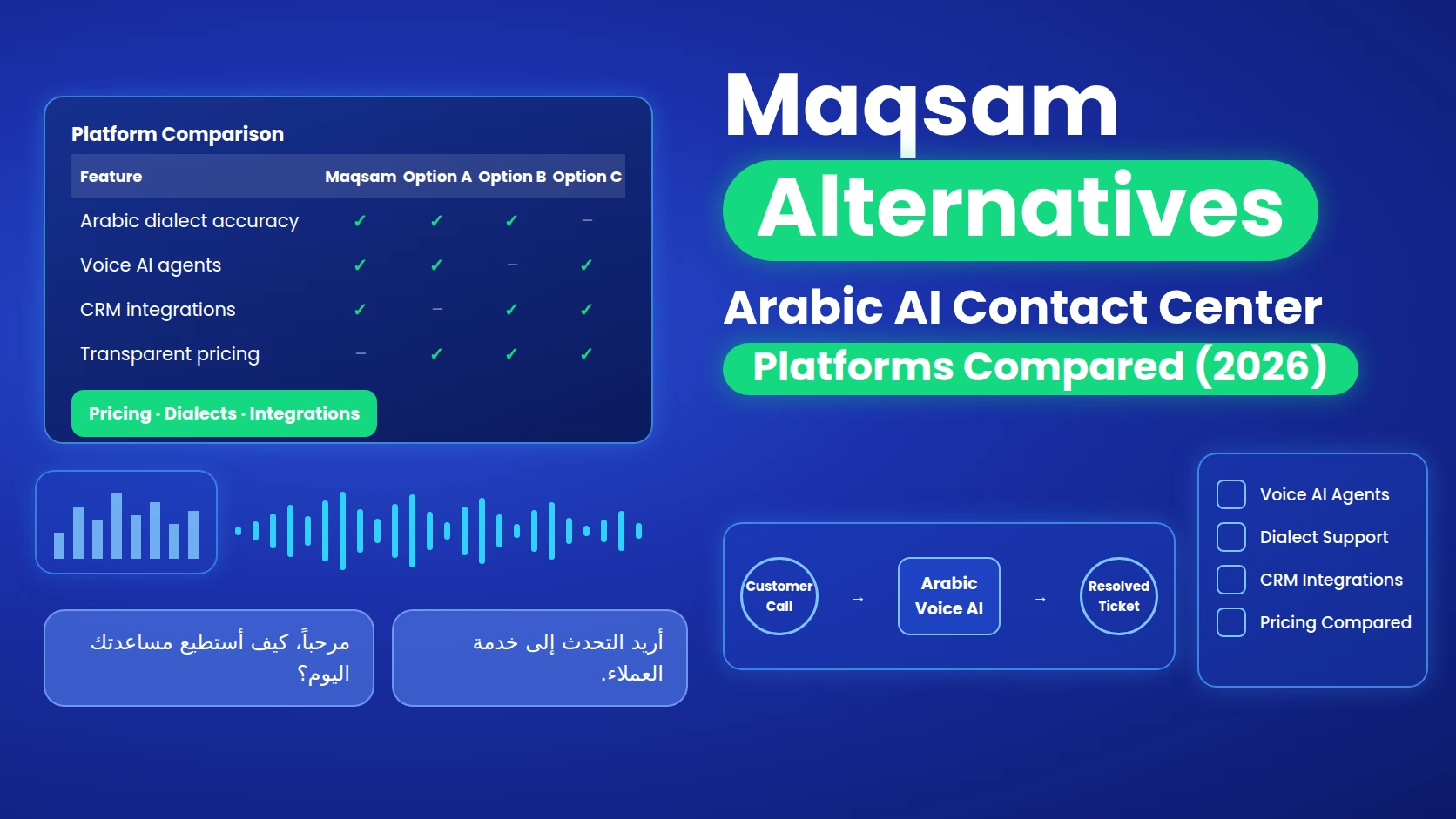
1. Munsit: Best for Arabic Voice AI Across the UAE and MENA
What it is: Munsit is an Arabic-first Speech-to-Text model built from scratch by CNTXT AI, a UAE-based company. It is not a multilingual model with Arabic added as an afterthought. Every architectural decision, training dataset, and evaluation benchmark was designed around Arabic speech from the beginning.
The core distinction: Every other provider on this list treats Arabic as one of many supported languages. Munsit was built specifically because general-purpose STT models trained on English-first datasets consistently underperform on real-world Arabic audio, particularly dialectal Arabic, which is what 400 million Arabic speakers actually produce every day.
- Arabic dialect coverage: Understands 25+ Arabic dialects in real time, Gulf (Khaleeji), Levantine, Egyptian, Moroccan (Darija), and Modern Standard Arabic, without requiring dialect pre-selection.
- Complete Arabic Voice AI stack: Together, Munsit (STT), Faseeh (TTS), Munsit Web, and Munsit App make a single Arabic Voice Artificial Intelligence platform. Developers get one API for the whole pipeline; companies get a browser-based workspace; people get a mobile app for everyday Arabic voice recording.
- Dealing with PDPL and NCA data residency needs for UAE and Saudi regulated entities, deployment alternatives comprise cloud, sovereign cloud, and on-premise.
- Deployment options: Cloud, sovereign cloud, and on-premise, deployment options designed to support organisations with PDPL and NCA data residency requirements for UAE and Saudi regulated entities.
- Proven enterprise adoption: Trusted by 150,000+ users and 250+ companies and government agencies across MENA (per Munsit) as of February 2026.
Why it beats Speechmatics for Arabic: Speechmatics supports Arabic, but its models were built around English-first architecture with Arabic added later. Munsit's structural advantage on Arabic audio is architectural; it cannot be replicated through fine-tuning on top of an English-first model.
Best for: Enterprises, government agencies, media companies, contact centres, and developers building Arabic-language voice applications across the UAE and wider MENA.
2. AssemblyAI: Best for Western English Production Voice Applications
What it is: AssemblyAI's current flagship is Universal-3 Pro for async transcription and Universal-3 Pro Streaming for real-time use. It leads English non-open-source accuracy benchmarks and offers the most complete English voice agent pipeline available from a single API.
- Natural-language prompting: Unlike Speechmatics' keyword-only approach, AssemblyAI supports full LLM-style instructions that steer the model dynamically, a meaningful capability upgrade for voice agent workflows.
- Streaming diarization: Real-time speaker identification at sub-300ms latency. Approximately 70% of AssemblyAI customers use diarization; most competitors only offer it in async mode.
- Voice Agent API: Priced at $4.50/hr for the complete pipeline, one WebSocket replaces several STT, LLM, and TTS companies. This directly answers Speechmatics' Flow architecture's multi-hop latency issue that remains unaddressed.
- Medical Mode: At $0.15 per hour, much less expensive than competitors asking many dollars per hour for healthcare-specific transcription.
Important limitation: AssemblyAI's real-time streaming supports six languages as of mid-2026. For Arabic or other MENA languages in live voice agents, AssemblyAI is not built for that use case.
Best for: English-language production voice applications, call centre analytics, and teams that need a unified voice agent pipeline without the multi-vendor integration complexity.
3. ElevenLabs: TTS-Focused with Multilingual Voice Options
What it is: ElevenLabs is the global leader in neural TTS and voice agents, with over 1 million creators and enterprise deployments across 32 languages. Its Eleven v3 model sets the benchmark for natural-sounding synthetic voice; its Conversational AI Platform offers a complete agent builder with HubSpot, Salesforce, Zendesk, and ServiceNow integrations.
- Scribe STT: ElevenLabs' Scribe v2 Realtime delivers live transcription in under 150ms, competitive with the fastest providers on this list for English and other well-resourced languages.
- Full agent platform: Agent testing, coaching, version control, SSO, HIPAA, and SOC 2 compliance. EU data residency available. For English enterprise deployments, this is the most production-ready agent stack available.
- Enterprise integrations: Microsoft Azure, HubSpot, Salesforce, ServiceNow, Zendesk, reducing buying friction for enterprise sales cycles.
Important caveat for MENA teams: ElevenLabs has a dedicated Arabic TTS landing page but Arabic support is an add-on to a globally trained model, not an architecture designed for Arabic. It does not natively handle 25+ Arabic dialects, dialect code-switching, or GCC data sovereignty requirements. ElevenLabs offers EU data residency; GCC sovereign deployment requires a different provider.
Best for: Global enterprises needing premium English TTS, full voice agent pipelines, and broad ecosystem integrations. Not the primary choice for Arabic-first deployments.
4. Deepgram: Real-Time ASR with Arabic Dialect Recognition
What it is: Deepgram is a US-based speech AI platform founded in 2015, offering Speech-to-Text, Text-to-Speech, and a Voice Agent API under a single developer-focused infrastructure. Its Nova-3 model is its flagship ASR engine, covering 45+ languages in batch and streaming modes.
- Nova-3 Arabic dialect coverage: Supports ar-AE, ar-SA, ar-QA, ar-KW, ar-EG, ar-LB, ar-SY, ar-MA, ar-DZ, ar-TN, ar-IQ, ar-JO and more through the same API endpoint. Benchmarks show up to 40% lower WER on conversational Arabic compared to competing STT systems.
- Flux, voice agent model: Deepgram’s Flux model is purpose-built for real-time voice agent pipelines, with model-integrated end-of-turn detection, natural interruption handling, and sub-300ms latency. Flux Multilingual (launched May 2026) extends streaming support across 10 languages.
- Pricing and free tier: Deepgram starts with $200 in free credits (no credit card required). Pay-As-You-Go rates: Nova-3 pre-recorded at $0.0043/min; streaming at $0.0077/min.
Important limitation: Nova-3 Arabic is cloud-only in standard tiers; on-premise deployment requires an enterprise contract. Deepgram does not offer a no-code agent builder, it is a developer API platform and requires engineering resources to integrate.
Best for: Developer teams and enterprises building real-time voice applications, contact centre analytics, and multilingual voice agents where Arabic dialect accuracy at scale is required alongside strong English performance.
5. Intella: Arabic-First Transcription and Call Intelligence
What it is: Intella is an Arabic speech intelligence company founded in Egypt in 2021 by CEO Nour Taher and CTO Omar Mansour, headquartered in Riyadh with operations across Egypt, Saudi Arabia, and the broader MENA region.
Key capabilities (sourced from intella.me and menabytes.com):
- intellaVX; speech-to-text engine: Proprietary Arabic STT engine supporting 25+ dialects with 95.73% transcription accuracy, outperforming Google Cloud (62.5%), Microsoft Azure (66.2%), and IBM Watson (59.1%) on Arabic benchmarks. Features noise filtering and speaker diarization for up to 8 speakers.
- intellaCX; call centre analytics: Full-featured analytics platform that transforms 100% of call centre interactions into actionable insights. Provides transcriptions, KPI management, agent performance scoring, sentiment analysis, and churn risk detection across Arabic dialects.
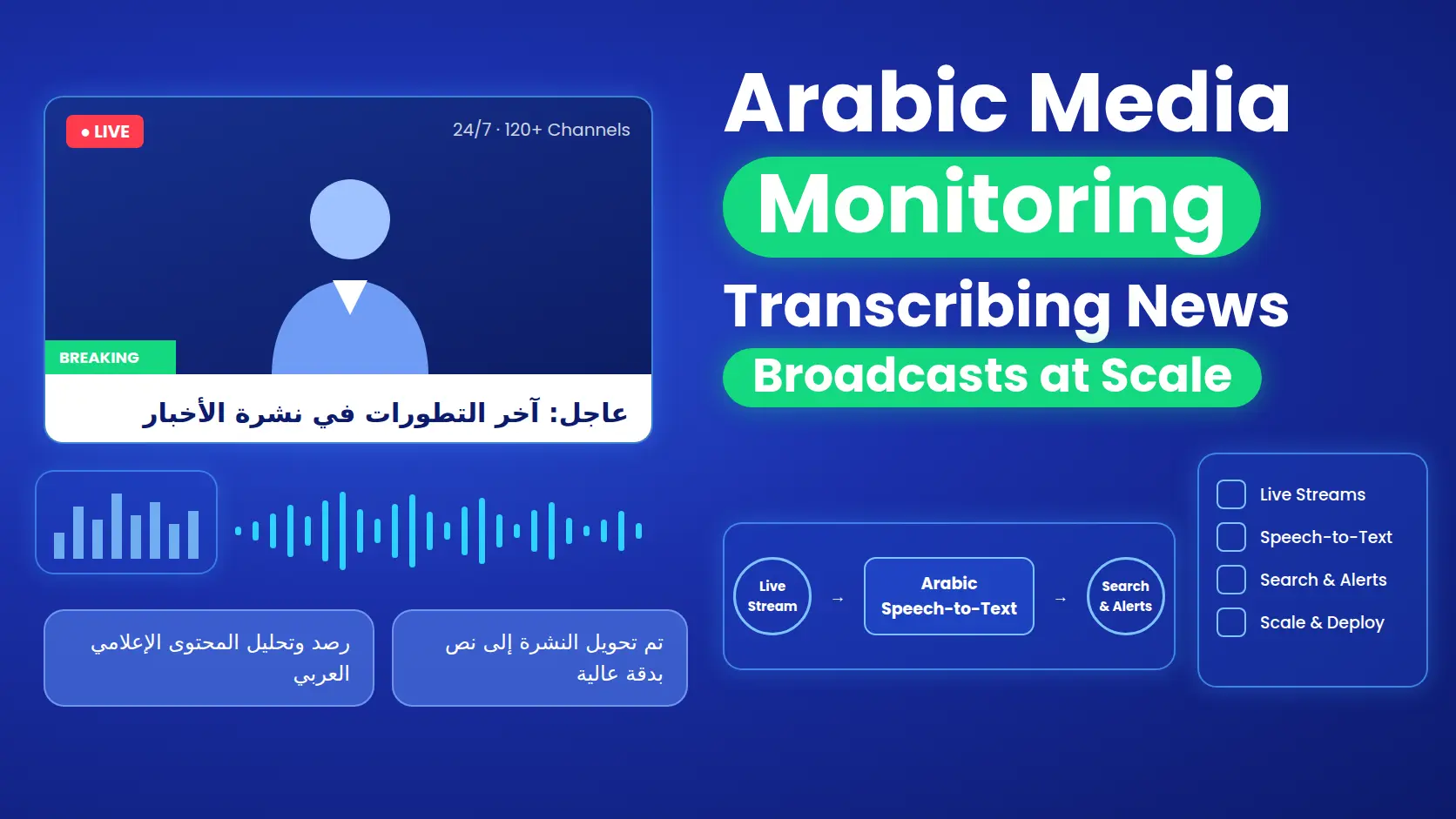
- intellaMX; media transcription: AI transcription service for media content with API access, media subtitling with timestamps, SRT extraction, and English translation. Designed for broadcasters, media companies, and content teams across MENA.
Key limitation: Intella is primarily focused on transcription, analytics, and call intelligence rather than offering a full TTS + voice agent pipeline in the way Munsit does. On-premise and sovereign cloud deployment options are not publicly confirmed as of June 2026, Intella is cloud-based.
Best for: Arabic-first enterprises across MENA, particularly in finance, telecom, media, and government, needing high-accuracy Arabic transcription, call centre analytics, and AI-powered customer engagement tools across 25+ dialects.
Two More Providers Worth Knowing
These providers did not make the primary list but are worth evaluating for specific use cases:
6. Nabrah: Arabic Voice Agents for the Saudi Market
What it is: Nabrah is a Saudi-based Arabic voice AI platform founded in 2024 and headquartered in Riyadh. It provides STT, TTS, voice cloning, and AI voice agents specifically built for the Saudi and Gulf Arabic market.
Key capabilities (sourced from nabrah.ai):
- Voice agent use cases: Sales calls, customer support, appointment reminders, voice surveys, and interviews. Automates both outbound and inbound calls with personalized Arabic conversations.
- Arabic dialect focus: Primary focus on Saudi Arabic dialects; broader Arabic coverage available.
- TTS + STT + voice cloning: Ultra-realistic Arabic TTS, STT transcription, and voice cloning for branded voice experiences.
- Infrastructure: Cloud-based. No publicly confirmed on-premise or sovereign cloud option as of June 2026.
7. Fenek AI: Media-Focused Transcription and Subtitling for MENA
Supported by Microsoft and Nvidia, Fenek AI (from Kanari AI) was the first MENA-focused automatic transcription and subtitling solution covering 19 Arabic dialects spread over 20 countries. Perfect for media and broadcast applications needing dialect-accurate transcription for Arabic material.
Limitation: Mostly a tool for transcribing and subtitling; does not provide the complete STT → TTS → agents → meetings environment that Munsit do.
Best for: MENA media organizations, broadcasters, and content teams needing accurate Arabic transcription and subtitling across all dialects. Not a primary choice for enterprise voice AI or agent deployments.
However, evaluating speech recognition platforms for Arabic requires a different set of criteria than evaluating them for English or other widely supported languages.







.webp)
.webp)
.webp)





%20for%20Arabic%20Conversational%20AI%20%20%20.png)









.svg)
.svg)