l 5min

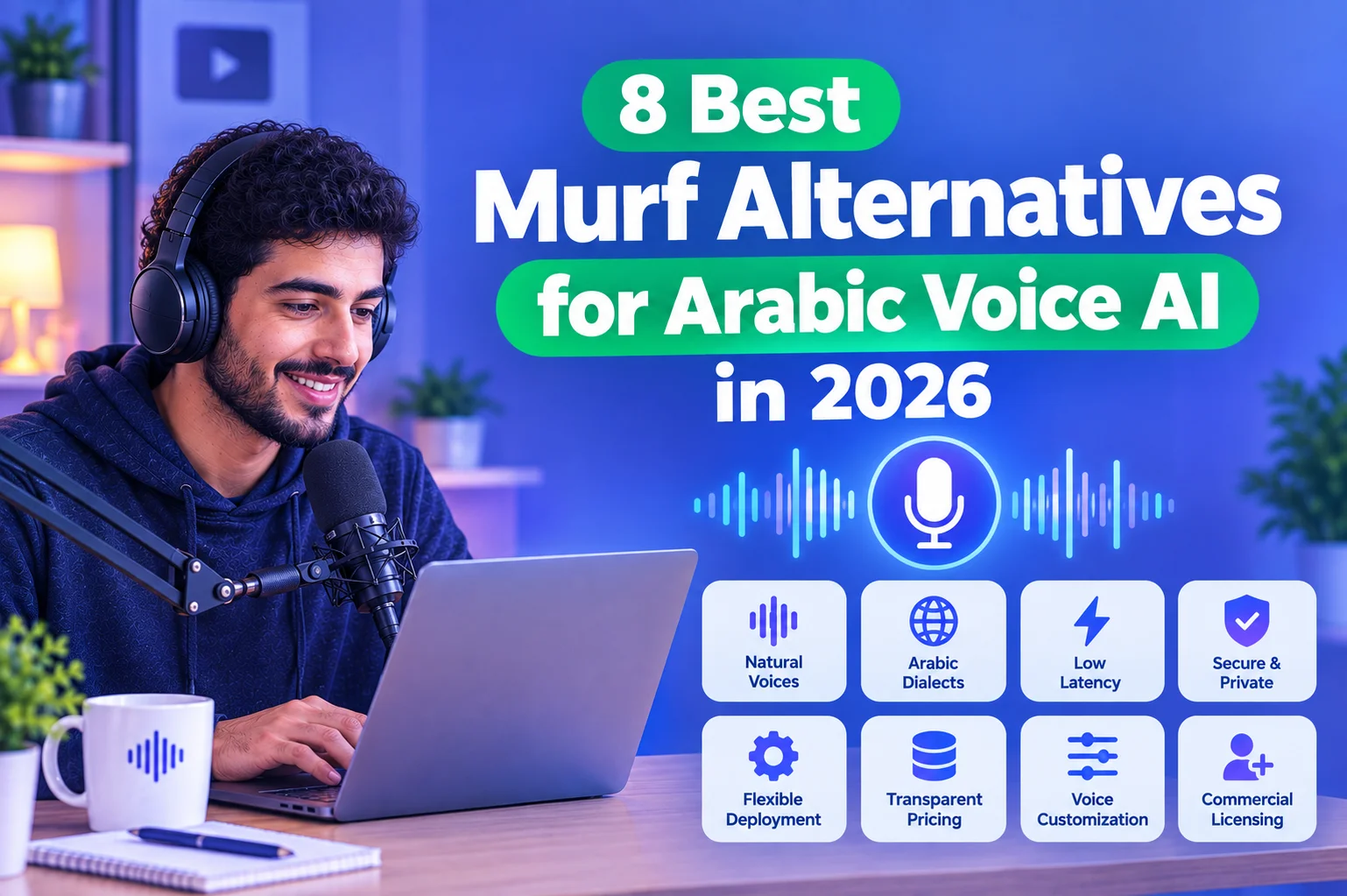
8 Best Murf Alternatives for Arabic Voice AI in 2026

Author

Key Takeaways

1

Arabic support needs deeper evaluation: Check dialect coverage, API availability, voice quality, and deployment options rather than relying on a simple “Arabic supported” label.

2

Deployment matters for GCC enterprises: UAE and Saudi organizations may need sovereign cloud, on-premises, or other deployment options for regulated voice data

3

The alternatives serve different use cases: The list covers Arabic-first platforms, multilingual voice tools, real-time transcription platforms, and GCC-focused contact-center solutions.

4

Test dialect depth, not just language count: Teams should test their own Arabic scripts and confirm that Arabic support exists in the specific product or API they plan to use.

This guide compares 8 Murf alternatives for Arabic Voice AI in 2026, covering dialect support, voice generation, cloning, deployment, accuracy benchmarks, pricing, and GCC compliance considerations to help teams evaluate platforms for their specific use cases.

8 Best Murf Alternatives for Arabic Voice AI in 2026

Murf AI, founded in October 2020, is known primarily as an English-first voiceover and AI voice agent platform for enterprise content production  text-to-speech for e-learning modules, marketing videos, YouTube narration, and product demos, plus AI voice agents for receptionist automation, sales outreach, and customer service, and video dubbing for localization. 
‍

It markets itself around ethically sourced voices (voice actors who consent and are compensated) and lists Forbes 2000 companies such as Pfizer, Cisco, and Honeywell among its customers, a self-reported figure worth treating as a marketing claim rather than an independently verified one. If you’re based in the UAE or wider GCC and searching for Murf alternatives, voice quality alone won’t tell you what you need to know. 
‍

People look elsewhere mainly because Murf’s Arabic support doesn’t hold up to the same scrutiny as its English product: it markets Arabic text-to-speech as part of its language offering and lists Arabic among the 20 languages documented in Murf Studio, but doesn’t itemize which Gulf, Egyptian, or Levantine dialects it actually covers, doesn’t list Arabic at all in its own API language reference, and offers no sovereign or on-premises deployment option for regulated UAE and Saudi industries. This guide compares eight Murf AI alternatives relevant to a UAE audience, from Arabic-first specialists to enterprise platforms with GCC deployment options.
‍

Disclaimer: Company background, customer names, and scale figures for Murf are based on Murf’s own published “About” page at the time of writing and are self-reported rather than independently audited to verify current claims directly with Murf before relying on them.

This is some text inside of a div block.

Quick Comparison: Murf Alternatives at a Glance

Tool Best For Arabic Focus Deployment
Munsit Sovereign deployment, verified accuracy Arabic-first Cloud, VPC, on-prem, on-device
Lahajati Maximum claimed dialect variety Arabic-first Cloud only
Nabarati All-in-one Arabic content suite Arabic-first Cloud only
ElevenLabs Multilingual voice cloning Generic support Cloud only
Speechmatics Code-switching, on-prem STT/TTS Gulf, Egyptian, Levantine Cloud, on-premises
Deepgram (Nova-3 Arabic) Real-time voice agent transcription 17 dialect variants Cloud, on-prem (Enterprise)
Intella GCC contact center analytics 25+ Arabic dialects Cloud, on-premises
WellSaid Labs Enterprise training narration No Arabic support Cloud only


Note: The competitor information in this article is based on publicly available sources at the time of writing. This article is intended to help UAE and GCC readers make informed decisions and is not a criticism of any platform mentioned. Every tool has strengths depending on use case. Always verify current features, pricing, and claims directly with each vendor before making a purchasing decision

This is some text inside of a div block.

Heading

Lorem ipsum dolor sit amet, consectetur adipiscing elit. Suspendisse varius enim in eros elementum tristique. Duis cursus, mi quis viverra ornare, eros dolor interdum nulla, ut commodo diam libero vitae erat. Aenean faucibus nibh et justo cursus id rutrum lorem imperdiet. Nunc ut sem vitae risus tristique posuere.

Lorem ipsum dolor sit amet, consectetur adipiscing elit. Suspendisse varius enim in eros elementum tristique. Duis cursus, mi quis viverra ornare, eros dolor interdum nulla, ut commodo diam libero vitae erat. Aenean faucibus nibh et justo cursus id rutrum lorem imperdiet. Nunc ut sem vitae risus tristique posuere.

Lorem ipsum dolor sit amet, consectetur adipiscing elit. Suspendisse varius enim in eros elementum tristique. Duis cursus, mi quis viverra ornare, eros dolor interdum nulla, ut commodo diam libero vitae erat. Aenean faucibus nibh et justo cursus id rutrum lorem imperdiet. Nunc ut sem vitae risus tristique posuere.

Lorem ipsum dolor sit amet, consectetur adipiscing elit. Suspendisse varius enim in eros elementum tristique. Duis cursus, mi quis viverra ornare, eros dolor interdum nulla, ut commodo diam libero vitae erat. Aenean faucibus nibh et justo cursus id rutrum lorem imperdiet. Nunc ut sem vitae risus tristique posuere.

Why UAE Teams Search for Murf Alternatives

Murf covers scripted, English-language voiceover well. UAE and GCC teams typically look elsewhere for three reasons.
‍

Arabic Dialect Depth Is Unverified  and Murf’s Own Documentation Disagrees With Itself

Murf’s consumer Arabic TTS page references training on “native-speaker recordings across Middle East and North Africa regional dialects” without naming which ones, and lists Arabic among 20 languages in Murf Studio’s documentation. But Murf’s own API language reference  which lists 40+ languages across its Falcon and Gen2 voice models  does not include Arabic in either model’s documented language set. In other words, Arabic appears to be available through Murf’s Studio web app but not confirmed in the API most developers would actually integrate against. For teams evaluating Murf specifically for programmatic use rather than the web editor, that gap is worth confirming directly with Murf’s sales team before assuming API-level Arabic support exists.
‍

No Sovereign or On-Premises Deployment

Murf is cloud-only. Regulated UAE and Saudi industries  banking, government, healthcare  often require audio processing to stay on infrastructure they control, which a cloud-only SaaS tool can’t satisfy.
‍

UAE Data Residency Requirements

Under the UAE PDPL (Federal Decree-Law No. 45 of 2021), voice is treated as biometric-adjacent identifying data. Teams handling Arabic voice content increasingly need a vendor that can document where audio is processed, not just where a marketing page says it’s hosted.

‍

The 8 Best Murf Alternatives in 2026

1. Munsit  Best for Sovereign Deployment and Verified Dialect Accuracy

Munsit, built in the UAE by CNTXT AI, takes an Arabic-first approach across TTS and speech recognition. On the independent Open Universal Arabic ASR Leaderboard  which benchmarks Arabic ASR across Modern Standard Arabic, Egyptian, Gulf, Levantine, and Maghrebi test sets  its Munsit-1 model posts a 26.68% word error rate against 36.86% for OpenAI Whisper on the same test sets: independently checkable, not a vendor claim. It covers 25-plus dialects with automatic detection and is the only platform here offering cloud, sovereign VPC, on-premises, and on-device deployment.
‍

Pricing: free credits on signup; paid from $8/month. (Verify current rates at munsit.com/pricing.)

Best for: UAE and Saudi enterprises needing verified accuracy and deployment beyond the cloud.
‍

2. Lahajati  Best for Maximum Claimed Dialect Variety

Lahajati is an Arabic TTS specialist claiming 192+ dialects and 600+ professional voices, positioned toward creators and voiceover production. Those figures are self-reported by Lahajati rather than independently itemized or benchmarked, so test your target dialect before committing.
‍

Deployment: cloud only.

Pricing: free tier; paid from roughly $5/month. (Verify current rates directly with Lahajati.)

Best for: UAE creators sampling a wide range of dialect voices without enterprise infrastructure.
‍

3. Nabarati  Best for All-in-One Arabic Content Creation

Nabarati bundles TTS, voice cloning, AI dubbing, podcast creation, speech-to-text, and music generation into one Arabic-first dashboard, claiming coverage across Gulf (Saudi, Emirati, Kuwaiti), Egyptian, Levantine (Syrian, Lebanese, Palestinian, Jordanian), Maghrebi (Moroccan, Algerian, Tunisian, Libyan), Iraqi, Yemeni, and Sudanese dialects, with “1000+ dialect tones” and over 700,000 users.

These figures are self-reported rather than independently benchmarked. It’s cloud-only, with no published independent benchmark or documented enterprise SLA.
‍

Best for: small teams wanting one Arabic voice tool instead of several.
‍

4. ElevenLabs  Best for Multilingual Content Beyond Arabic

ElevenLabs is widely cited for realistic voice cloning and dubbing across 70+ languages, with Arabic supported generically inside its multilingual models rather than as a dedicated locale  dialect-specific voice selection (Gulf vs. Egyptian vs. Levantine) is not a documented feature.
‍

Deployment: cloud only.

Pricing: free tier; paid from roughly $5/month. (Verify current rates at their pricing page)

Best for: projects where UAE Arabic content is part of a broader language mix.
‍

5. Speechmatics  Best for Code-Switching and On-Premises Deployment

Speechmatics, a UK-based speech technology company founded in 2006, trains on Gulf, Egyptian, Levantine, and Maghrebi Arabic rather than MSA alone, with a documented strength in Arabic-English code-switching common in GCC business content  see their own write-up on real-world Arabic transcription. It offers both a cloud API and on-premises deployment, and a genuine text-to-speech product alongside its speech recognition.
‍

Pricing: custom enterprise. (Verify current rates at speechmatics.com/pricing.)

Best for: UAE enterprises needing on-premises deployment and code-switching handling.
‍

6. Deepgram (Nova-3 Arabic)  Best for Real-Time Voice Agent Transcription

Deepgram’s Nova-3 Arabic model, launched January 2026, documents 17 regional dialect variants across Gulf, MSA, Egyptian, Levantine, and North African groups. Its speech-to-text only  Deepgram’s Aura text-to-speech product does not support Arabic as of this writing  so it’s only a Murf alternative for teams that also need Arabic transcription, not voice generation.
‍

Pricing: pay-as-you-go from roughly $0.0048/minute. (Verify current rates at their pricing page)

Best for: developers building real-time Arabic voice agents that also need transcription.
‍

7. Intella  Best for GCC Contact Center Analytics

Intella is a Riyadh-headquartered Arabic speech intelligence platform, originally founded in Egypt in 2021, focused on contact-center and customer-experience use cases  combining transcription with sentiment analysis and call quality scoring. The company raised a $12.5M Series A led by Prosus and states support for more than 25 Arabic dialects with a self-reported 95.73% transcription accuracy figure (vendor-reported, not independently benchmarked).
‍

Deployment: cloud and on-premises.

Pricing: custom enterprise.

Best for: GCC contact centers needing speech analytics rather than voice generation.
‍

8. WellSaid Labs  Best for Enterprise Training Narration

WellSaid integrates directly with Articulate Rise and Storyline, tools that dominate corporate L&D stacks, built for narrator consistency across long training modules. According to WellSaid’s own language documentation, its voice library is currently English-only, with a small number of additional languages in beta and Arabic not among the languages listed. It has no sovereign deployment option, so it fits best as a supplementary English-language tool alongside an Arabic-first platform rather than an Arabic voice solution at all.
‍

Best for: multinational UAE teams managing English-language training content.

See how Munsit performs on real Arabic speech

Evaluate dialect coverage, noise handling, and in-region deployment on data that reflects your customers.
Explore

Feature and Deployment Comparison

Tool Independent Benchmark On-Premises Option Primary Use Case
Munsit Yes; public ASR leaderboard Yes TTS + STT, full voice stack
Lahajati No No TTS, dialect voiceover
Nabarati No No TTS, cloning, dubbing, STT
ElevenLabs No No TTS, voice cloning, dubbing
Speechmatics No Yes STT + TTS, code-switching
Deepgram No Yes (Enterprise) STT only
Intella No Yes Contact center analytics
WellSaid Labs No No English-only narration

‍

FAQ

Is Murf AI good for Arabic voiceovers in the UAE?
What is the best Murf alternative for enterprise use in the UAE?
Does any Murf alternative offer on-premises deployment?

Powering the Future with AI

Join our newsletter for insights on cutting-edge technology built in the UAE
Thank you! Your submission has been received!
Oops! Something went wrong while submitting the form.
Last update :
September 25, 2026

8 Best Murf Alternatives for Arabic Voice AI in 2026

Author
Sarra Turki
5min read

Bring Arabic Voice AI to production

Native‑level Arabic STT & TTS
Built for GCC gov & enterprises
Sovereign and on‑prem deployment
Contact Sales
Thank you! Your submission has been received!
Oops! Something went wrong while submitting the form.

Key Takeaways

Arabic support needs deeper evaluation: Check dialect coverage, API availability, voice quality, and deployment options rather than relying on a simple “Arabic supported” label.

Deployment matters for GCC enterprises: UAE and Saudi organizations may need sovereign cloud, on-premises, or other deployment options for regulated voice data

The alternatives serve different use cases: The list covers Arabic-first platforms, multilingual voice tools, real-time transcription platforms, and GCC-focused contact-center solutions.

Test dialect depth, not just language count: Teams should test their own Arabic scripts and confirm that Arabic support exists in the specific product or API they plan to use.

Verify accuracy claims independently: Vendor-reported accuracy figures should be treated as a starting point; public benchmarks can provide a more consistent basis for evaluation.

Compliance and voice consent are important: Arabic voice generation and cloning can involve personal-data requirements, while voice cloning should use documented consent from the voice owner.

This guide compares 8 Murf alternatives for Arabic Voice AI in 2026, covering dialect support, voice generation, cloning, deployment, accuracy benchmarks, pricing, and GCC compliance considerations to help teams evaluate platforms for their specific use cases.

8 Best Murf Alternatives for Arabic Voice AI in 2026

Murf AI, founded in October 2020, is known primarily as an English-first voiceover and AI voice agent platform for enterprise content production  text-to-speech for e-learning modules, marketing videos, YouTube narration, and product demos, plus AI voice agents for receptionist automation, sales outreach, and customer service, and video dubbing for localization. 
‍

It markets itself around ethically sourced voices (voice actors who consent and are compensated) and lists Forbes 2000 companies such as Pfizer, Cisco, and Honeywell among its customers, a self-reported figure worth treating as a marketing claim rather than an independently verified one. If you’re based in the UAE or wider GCC and searching for Murf alternatives, voice quality alone won’t tell you what you need to know. 
‍

People look elsewhere mainly because Murf’s Arabic support doesn’t hold up to the same scrutiny as its English product: it markets Arabic text-to-speech as part of its language offering and lists Arabic among the 20 languages documented in Murf Studio, but doesn’t itemize which Gulf, Egyptian, or Levantine dialects it actually covers, doesn’t list Arabic at all in its own API language reference, and offers no sovereign or on-premises deployment option for regulated UAE and Saudi industries. This guide compares eight Murf AI alternatives relevant to a UAE audience, from Arabic-first specialists to enterprise platforms with GCC deployment options.
‍

Disclaimer: Company background, customer names, and scale figures for Murf are based on Murf’s own published “About” page at the time of writing and are self-reported rather than independently audited to verify current claims directly with Murf before relying on them.

Lorem ipsum dolor
Lorem ipsum dolor
Lorem ipsum dolor
Lorem ipsum dolor
Lorem ipsum dolor
Lorem ipsum dolor
Lorem ipsum dolor
Lorem ipsum dolor
Lorem ipsum dolor
Lorem ipsum dolor
Lorem ipsum dolor
Lorem ipsum dolor
Lorem ipsum dolor
Lorem ipsum dolor
Lorem ipsum dolor
Lorem ipsum dolor
Lorem ipsum dolor
Lorem ipsum dolor
Lorem ipsum dolor
Lorem ipsum dolor
Lorem ipsum dolor
Lorem ipsum dolor
Lorem ipsum dolor
Lorem ipsum dolor
Lorem ipsum dolor
Lorem ipsum dolor
Lorem ipsum dolor
Lorem ipsum dolor
Lorem ipsum dolor
Lorem ipsum dolor
Lorem ipsum dolor
Lorem ipsum dolor

Quick Comparison: Murf Alternatives at a Glance

Understanding the origins of AI hallucinations is the first step toward mitigating them. The phenomenon is not a single problem but rather a complex issue with multiple contributing factors.

1

Training Data Deficiencies

Tool Best For Arabic Focus Deployment
Munsit Sovereign deployment, verified accuracy Arabic-first Cloud, VPC, on-prem, on-device
Lahajati Maximum claimed dialect variety Arabic-first Cloud only
Nabarati All-in-one Arabic content suite Arabic-first Cloud only
ElevenLabs Multilingual voice cloning Generic support Cloud only
Speechmatics Code-switching, on-prem STT/TTS Gulf, Egyptian, Levantine Cloud, on-premises
Deepgram (Nova-3 Arabic) Real-time voice agent transcription 17 dialect variants Cloud, on-prem (Enterprise)
Intella GCC contact center analytics 25+ Arabic dialects Cloud, on-premises
WellSaid Labs Enterprise training narration No Arabic support Cloud only


Note: The competitor information in this article is based on publicly available sources at the time of writing. This article is intended to help UAE and GCC readers make informed decisions and is not a criticism of any platform mentioned. Every tool has strengths depending on use case. Always verify current features, pricing, and claims directly with each vendor before making a purchasing decision

2

Training Data Deficiencies

The most significant contributor to AI hallucinations is the data on which the models are trained. LLMs learn from vast datasets scraped from the internet, which contain a mixture of factual information, opinions, misinformation, and biases. Several specific data-related issues can lead to hallucinations:

Enterprise Use Cases for Arabic Voice AI in 2025

The move to dialect-aware Arabic ASR is unlocking a new wave of enterprise applications across the GCC and MENA regions. Organizations are moving beyond basic transcription to sophisticated Arabic speech analytics.

Arabic speech technology is rapidly advancing in 2025, driven by massive multilingual models and new Arabic-centric foundation models.

Arabic speech technology is rapidly advancing in 2025, driven by massive multilingual models and new Arabic-centric foundation models.

Arabic speech technology is rapidly advancing in 2025, driven by massive multilingual models and new Arabic-centric foundation models.

Arabic speech technology is rapidly advancing in 2025, driven by massive multilingual models and new Arabic-centric foundation models.

Why UAE Teams Search for Murf Alternatives

Understanding the origins of AI hallucinations is the first step toward mitigating them. The phenomenon is not a single problem but rather a complex issue with multiple contributing factors.

1

Training Data Deficiencies

Murf covers scripted, English-language voiceover well. UAE and GCC teams typically look elsewhere for three reasons.
‍

Arabic Dialect Depth Is Unverified  and Murf’s Own Documentation Disagrees With Itself

Murf’s consumer Arabic TTS page references training on “native-speaker recordings across Middle East and North Africa regional dialects” without naming which ones, and lists Arabic among 20 languages in Murf Studio’s documentation. But Murf’s own API language reference  which lists 40+ languages across its Falcon and Gen2 voice models  does not include Arabic in either model’s documented language set. In other words, Arabic appears to be available through Murf’s Studio web app but not confirmed in the API most developers would actually integrate against. For teams evaluating Murf specifically for programmatic use rather than the web editor, that gap is worth confirming directly with Murf’s sales team before assuming API-level Arabic support exists.
‍

No Sovereign or On-Premises Deployment

Murf is cloud-only. Regulated UAE and Saudi industries  banking, government, healthcare  often require audio processing to stay on infrastructure they control, which a cloud-only SaaS tool can’t satisfy.
‍

UAE Data Residency Requirements

Under the UAE PDPL (Federal Decree-Law No. 45 of 2021), voice is treated as biometric-adjacent identifying data. Teams handling Arabic voice content increasingly need a vendor that can document where audio is processed, not just where a marketing page says it’s hosted.

‍

2

Training Data Deficiencies

The most significant contributor to AI hallucinations is the data on which the models are trained. LLMs learn from vast datasets scraped from the internet, which contain a mixture of factual information, opinions, misinformation, and biases. Several specific data-related issues can lead to hallucinations:

Enterprise Use Cases for Arabic Voice AI in 2025

The move to dialect-aware Arabic ASR is unlocking a new wave of enterprise applications across the GCC and MENA regions. Organizations are moving beyond basic transcription to sophisticated Arabic speech analytics.

Arabic speech technology is rapidly advancing in 2025, driven by massive multilingual models and new Arabic-centric foundation models.

Arabic speech technology is rapidly advancing in 2025, driven by massive multilingual models and new Arabic-centric foundation models.

Arabic speech technology is rapidly advancing in 2025, driven by massive multilingual models and new Arabic-centric foundation models.

Arabic speech technology is rapidly advancing in 2025, driven by massive multilingual models and new Arabic-centric foundation models.

Building better AI systems takes the right approach

We help with custom solutions, data pipelines, and Arabic intelligence.

The 8 Best Murf Alternatives in 2026

Understanding the origins of AI hallucinations is the first step toward mitigating them. The phenomenon is not a single problem but rather a complex issue with multiple contributing factors.

1

Training Data Deficiencies

1. Munsit  Best for Sovereign Deployment and Verified Dialect Accuracy

Munsit, built in the UAE by CNTXT AI, takes an Arabic-first approach across TTS and speech recognition. On the independent Open Universal Arabic ASR Leaderboard  which benchmarks Arabic ASR across Modern Standard Arabic, Egyptian, Gulf, Levantine, and Maghrebi test sets  its Munsit-1 model posts a 26.68% word error rate against 36.86% for OpenAI Whisper on the same test sets: independently checkable, not a vendor claim. It covers 25-plus dialects with automatic detection and is the only platform here offering cloud, sovereign VPC, on-premises, and on-device deployment.
‍

Pricing: free credits on signup; paid from $8/month. (Verify current rates at munsit.com/pricing.)

Best for: UAE and Saudi enterprises needing verified accuracy and deployment beyond the cloud.
‍

2. Lahajati  Best for Maximum Claimed Dialect Variety

Lahajati is an Arabic TTS specialist claiming 192+ dialects and 600+ professional voices, positioned toward creators and voiceover production. Those figures are self-reported by Lahajati rather than independently itemized or benchmarked, so test your target dialect before committing.
‍

Deployment: cloud only.

Pricing: free tier; paid from roughly $5/month. (Verify current rates directly with Lahajati.)

Best for: UAE creators sampling a wide range of dialect voices without enterprise infrastructure.
‍

3. Nabarati  Best for All-in-One Arabic Content Creation

Nabarati bundles TTS, voice cloning, AI dubbing, podcast creation, speech-to-text, and music generation into one Arabic-first dashboard, claiming coverage across Gulf (Saudi, Emirati, Kuwaiti), Egyptian, Levantine (Syrian, Lebanese, Palestinian, Jordanian), Maghrebi (Moroccan, Algerian, Tunisian, Libyan), Iraqi, Yemeni, and Sudanese dialects, with “1000+ dialect tones” and over 700,000 users.

These figures are self-reported rather than independently benchmarked. It’s cloud-only, with no published independent benchmark or documented enterprise SLA.
‍

Best for: small teams wanting one Arabic voice tool instead of several.
‍

4. ElevenLabs  Best for Multilingual Content Beyond Arabic

ElevenLabs is widely cited for realistic voice cloning and dubbing across 70+ languages, with Arabic supported generically inside its multilingual models rather than as a dedicated locale  dialect-specific voice selection (Gulf vs. Egyptian vs. Levantine) is not a documented feature.
‍

Deployment: cloud only.

Pricing: free tier; paid from roughly $5/month. (Verify current rates at their pricing page)

Best for: projects where UAE Arabic content is part of a broader language mix.
‍

5. Speechmatics  Best for Code-Switching and On-Premises Deployment

Speechmatics, a UK-based speech technology company founded in 2006, trains on Gulf, Egyptian, Levantine, and Maghrebi Arabic rather than MSA alone, with a documented strength in Arabic-English code-switching common in GCC business content  see their own write-up on real-world Arabic transcription. It offers both a cloud API and on-premises deployment, and a genuine text-to-speech product alongside its speech recognition.
‍

Pricing: custom enterprise. (Verify current rates at speechmatics.com/pricing.)

Best for: UAE enterprises needing on-premises deployment and code-switching handling.
‍

6. Deepgram (Nova-3 Arabic)  Best for Real-Time Voice Agent Transcription

Deepgram’s Nova-3 Arabic model, launched January 2026, documents 17 regional dialect variants across Gulf, MSA, Egyptian, Levantine, and North African groups. Its speech-to-text only  Deepgram’s Aura text-to-speech product does not support Arabic as of this writing  so it’s only a Murf alternative for teams that also need Arabic transcription, not voice generation.
‍

Pricing: pay-as-you-go from roughly $0.0048/minute. (Verify current rates at their pricing page)

Best for: developers building real-time Arabic voice agents that also need transcription.
‍

7. Intella  Best for GCC Contact Center Analytics

Intella is a Riyadh-headquartered Arabic speech intelligence platform, originally founded in Egypt in 2021, focused on contact-center and customer-experience use cases  combining transcription with sentiment analysis and call quality scoring. The company raised a $12.5M Series A led by Prosus and states support for more than 25 Arabic dialects with a self-reported 95.73% transcription accuracy figure (vendor-reported, not independently benchmarked).
‍

Deployment: cloud and on-premises.

Pricing: custom enterprise.

Best for: GCC contact centers needing speech analytics rather than voice generation.
‍

8. WellSaid Labs  Best for Enterprise Training Narration

WellSaid integrates directly with Articulate Rise and Storyline, tools that dominate corporate L&D stacks, built for narrator consistency across long training modules. According to WellSaid’s own language documentation, its voice library is currently English-only, with a small number of additional languages in beta and Arabic not among the languages listed. It has no sovereign deployment option, so it fits best as a supplementary English-language tool alongside an Arabic-first platform rather than an Arabic voice solution at all.
‍

Best for: multinational UAE teams managing English-language training content.

2

Training Data Deficiencies

The most significant contributor to AI hallucinations is the data on which the models are trained. LLMs learn from vast datasets scraped from the internet, which contain a mixture of factual information, opinions, misinformation, and biases. Several specific data-related issues can lead to hallucinations:

Enterprise Use Cases for Arabic Voice AI in 2025

The move to dialect-aware Arabic ASR is unlocking a new wave of enterprise applications across the GCC and MENA regions. Organizations are moving beyond basic transcription to sophisticated Arabic speech analytics.

Arabic speech technology is rapidly advancing in 2025, driven by massive multilingual models and new Arabic-centric foundation models.

Arabic speech technology is rapidly advancing in 2025, driven by massive multilingual models and new Arabic-centric foundation models.

Arabic speech technology is rapidly advancing in 2025, driven by massive multilingual models and new Arabic-centric foundation models.

Arabic speech technology is rapidly advancing in 2025, driven by massive multilingual models and new Arabic-centric foundation models.

Feature and Deployment Comparison

Understanding the origins of AI hallucinations is the first step toward mitigating them. The phenomenon is not a single problem but rather a complex issue with multiple contributing factors.

1

Training Data Deficiencies

Tool Independent Benchmark On-Premises Option Primary Use Case
Munsit Yes; public ASR leaderboard Yes TTS + STT, full voice stack
Lahajati No No TTS, dialect voiceover
Nabarati No No TTS, cloning, dubbing, STT
ElevenLabs No No TTS, voice cloning, dubbing
Speechmatics No Yes STT + TTS, code-switching
Deepgram No Yes (Enterprise) STT only
Intella No Yes Contact center analytics
WellSaid Labs No No English-only narration

‍

2

Training Data Deficiencies

The most significant contributor to AI hallucinations is the data on which the models are trained. LLMs learn from vast datasets scraped from the internet, which contain a mixture of factual information, opinions, misinformation, and biases. Several specific data-related issues can lead to hallucinations:

Enterprise Use Cases for Arabic Voice AI in 2025

The move to dialect-aware Arabic ASR is unlocking a new wave of enterprise applications across the GCC and MENA regions. Organizations are moving beyond basic transcription to sophisticated Arabic speech analytics.

Arabic speech technology is rapidly advancing in 2025, driven by massive multilingual models and new Arabic-centric foundation models.

Arabic speech technology is rapidly advancing in 2025, driven by massive multilingual models and new Arabic-centric foundation models.

Arabic speech technology is rapidly advancing in 2025, driven by massive multilingual models and new Arabic-centric foundation models.

Arabic speech technology is rapidly advancing in 2025, driven by massive multilingual models and new Arabic-centric foundation models.

UAE and Saudi Compliance for Arabic Voice AI

Understanding the origins of AI hallucinations is the first step toward mitigating them. The phenomenon is not a single problem but rather a complex issue with multiple contributing factors.

1

Training Data Deficiencies

Whichever Murf alternative you shortlist, voice generation and cloning carry the same regulatory considerations across the UAE and Saudi Arabia. Voice counts as personal data under both the UAE PDPL (Federal Decree-Law No. 45/2021) and the Saudi PDPL (enforced since September 2024), so cloning someone else’s voice for commercial use requires documented, explicit consent from the voice’s owner. The UAE’s Federal Decree-Law No. 34/2021 (Cybercrimes Law) separately covers unauthorized use of another person’s likeness or voice.
‍

Cloud-only platforms, most of the tools above except Munsit, Speechmatics, and Intella  process audio outside customer-controlled infrastructure, often the deciding factor for government and banking buyers before voice quality is evaluated.
‍

This is general information, not legal advice; consult qualified UAE or Saudi counsel for your organization.

2

Training Data Deficiencies

The most significant contributor to AI hallucinations is the data on which the models are trained. LLMs learn from vast datasets scraped from the internet, which contain a mixture of factual information, opinions, misinformation, and biases. Several specific data-related issues can lead to hallucinations:

Enterprise Use Cases for Arabic Voice AI in 2025

The move to dialect-aware Arabic ASR is unlocking a new wave of enterprise applications across the GCC and MENA regions. Organizations are moving beyond basic transcription to sophisticated Arabic speech analytics.

Arabic speech technology is rapidly advancing in 2025, driven by massive multilingual models and new Arabic-centric foundation models.

Arabic speech technology is rapidly advancing in 2025, driven by massive multilingual models and new Arabic-centric foundation models.

Arabic speech technology is rapidly advancing in 2025, driven by massive multilingual models and new Arabic-centric foundation models.

Arabic speech technology is rapidly advancing in 2025, driven by massive multilingual models and new Arabic-centric foundation models.

How to Choose the Right Murf Alternative

Understanding the origins of AI hallucinations is the first step toward mitigating them. The phenomenon is not a single problem but rather a complex issue with multiple contributing factors.

1

Training Data Deficiencies

Match the Tool to Your Deployment Requirement

Before comparing voice samples, decide whether your content or customer data can stay cloud-only or needs sovereign or on-premises handling. That single requirement eliminates several tools on this list immediately for regulated UAE industries.
‍

Test Dialect Depth, Not Just Language Count

A platform listing “Arabic” as supported says nothing about whether it handles Gulf, Egyptian, or Levantine speech naturally. Run your own script through each shortlisted Murf alternative before committing  and, as the Murf Studio-vs-API discrepancy above shows, confirm that Arabic support exists in the specific product tier (web editor vs. API) you actually plan to use, not just somewhere on the vendor’s marketing site.
‍

Ask for an Independent Benchmark, Not a Sales Claim

Vendor-reported accuracy numbers are a starting point, not proof. Where a public benchmark like the Open Universal Arabic ASR Leaderboard exists, check a platform’s placement on it before trusting a marketing page.

2

Training Data Deficiencies

The most significant contributor to AI hallucinations is the data on which the models are trained. LLMs learn from vast datasets scraped from the internet, which contain a mixture of factual information, opinions, misinformation, and biases. Several specific data-related issues can lead to hallucinations:

Enterprise Use Cases for Arabic Voice AI in 2025

The move to dialect-aware Arabic ASR is unlocking a new wave of enterprise applications across the GCC and MENA regions. Organizations are moving beyond basic transcription to sophisticated Arabic speech analytics.

Arabic speech technology is rapidly advancing in 2025, driven by massive multilingual models and new Arabic-centric foundation models.

Arabic speech technology is rapidly advancing in 2025, driven by massive multilingual models and new Arabic-centric foundation models.

Arabic speech technology is rapidly advancing in 2025, driven by massive multilingual models and new Arabic-centric foundation models.

Arabic speech technology is rapidly advancing in 2025, driven by massive multilingual models and new Arabic-centric foundation models.

Conclusion

Understanding the origins of AI hallucinations is the first step toward mitigating them. The phenomenon is not a single problem but rather a complex issue with multiple contributing factors.

1

Training Data Deficiencies

Murf AI remains a reasonable pick for English-language marketing voiceovers, but it’s rarely the right tool for UAE and GCC teams producing Arabic content or operating under regulated data-residency requirements and its own documentation leaves genuine ambiguity about whether Arabic is available outside the Studio web app. Of the eight Murf alternatives covered here, the right pick depends on your use case: Lahajati or Nabarati for broad Arabic creator work, Speechmatics or Intella for on-premises GCC deployment, and Munsit if independently verified Arabic accuracy and sovereign infrastructure are non-negotiable. Test each shortlisted platform against your own Arabic script before signing a contract.

2

Training Data Deficiencies

The most significant contributor to AI hallucinations is the data on which the models are trained. LLMs learn from vast datasets scraped from the internet, which contain a mixture of factual information, opinions, misinformation, and biases. Several specific data-related issues can lead to hallucinations:

Enterprise Use Cases for Arabic Voice AI in 2025

The move to dialect-aware Arabic ASR is unlocking a new wave of enterprise applications across the GCC and MENA regions. Organizations are moving beyond basic transcription to sophisticated Arabic speech analytics.

Arabic speech technology is rapidly advancing in 2025, driven by massive multilingual models and new Arabic-centric foundation models.

Arabic speech technology is rapidly advancing in 2025, driven by massive multilingual models and new Arabic-centric foundation models.

Arabic speech technology is rapidly advancing in 2025, driven by massive multilingual models and new Arabic-centric foundation models.

Arabic speech technology is rapidly advancing in 2025, driven by massive multilingual models and new Arabic-centric foundation models.

Understanding the origins of AI hallucinations is the first step toward mitigating them. The phenomenon is not a single problem but rather a complex issue with multiple contributing factors.

1

Training Data Deficiencies

2

Training Data Deficiencies

The most significant contributor to AI hallucinations is the data on which the models are trained. LLMs learn from vast datasets scraped from the internet, which contain a mixture of factual information, opinions, misinformation, and biases. Several specific data-related issues can lead to hallucinations:

Enterprise Use Cases for Arabic Voice AI in 2025

The move to dialect-aware Arabic ASR is unlocking a new wave of enterprise applications across the GCC and MENA regions. Organizations are moving beyond basic transcription to sophisticated Arabic speech analytics.

Arabic speech technology is rapidly advancing in 2025, driven by massive multilingual models and new Arabic-centric foundation models.

Arabic speech technology is rapidly advancing in 2025, driven by massive multilingual models and new Arabic-centric foundation models.

Arabic speech technology is rapidly advancing in 2025, driven by massive multilingual models and new Arabic-centric foundation models.

Arabic speech technology is rapidly advancing in 2025, driven by massive multilingual models and new Arabic-centric foundation models.

Understanding the origins of AI hallucinations is the first step toward mitigating them. The phenomenon is not a single problem but rather a complex issue with multiple contributing factors.

1

Training Data Deficiencies

2

Training Data Deficiencies

The most significant contributor to AI hallucinations is the data on which the models are trained. LLMs learn from vast datasets scraped from the internet, which contain a mixture of factual information, opinions, misinformation, and biases. Several specific data-related issues can lead to hallucinations:

Enterprise Use Cases for Arabic Voice AI in 2025

The move to dialect-aware Arabic ASR is unlocking a new wave of enterprise applications across the GCC and MENA regions. Organizations are moving beyond basic transcription to sophisticated Arabic speech analytics.

Arabic speech technology is rapidly advancing in 2025, driven by massive multilingual models and new Arabic-centric foundation models.

Arabic speech technology is rapidly advancing in 2025, driven by massive multilingual models and new Arabic-centric foundation models.

Arabic speech technology is rapidly advancing in 2025, driven by massive multilingual models and new Arabic-centric foundation models.

Arabic speech technology is rapidly advancing in 2025, driven by massive multilingual models and new Arabic-centric foundation models.

FAQ
Is Murf AI good for Arabic voiceovers in the UAE?
What is the best Murf alternative for enterprise use in the UAE?
Does any Murf alternative offer on-premises deployment?
Is there a free alternative to Murf for Arabic content?
Do Murf alternatives support Arabic-English code-switching?

Bring Arabic Voice AI to production

Native‑level Arabic STT & TTS
Built for GCC gov & enterprises
Sovereign and on‑prem deployment
Contact Sales
Thank you! Your submission has been received!
Oops! Something went wrong while submitting the form.

Start free.  
Pay when you are ready.

10,000 credits. Test Munsit with your own audio, in your own dialect, and see the accuracy for yourself.