Product
l 5min

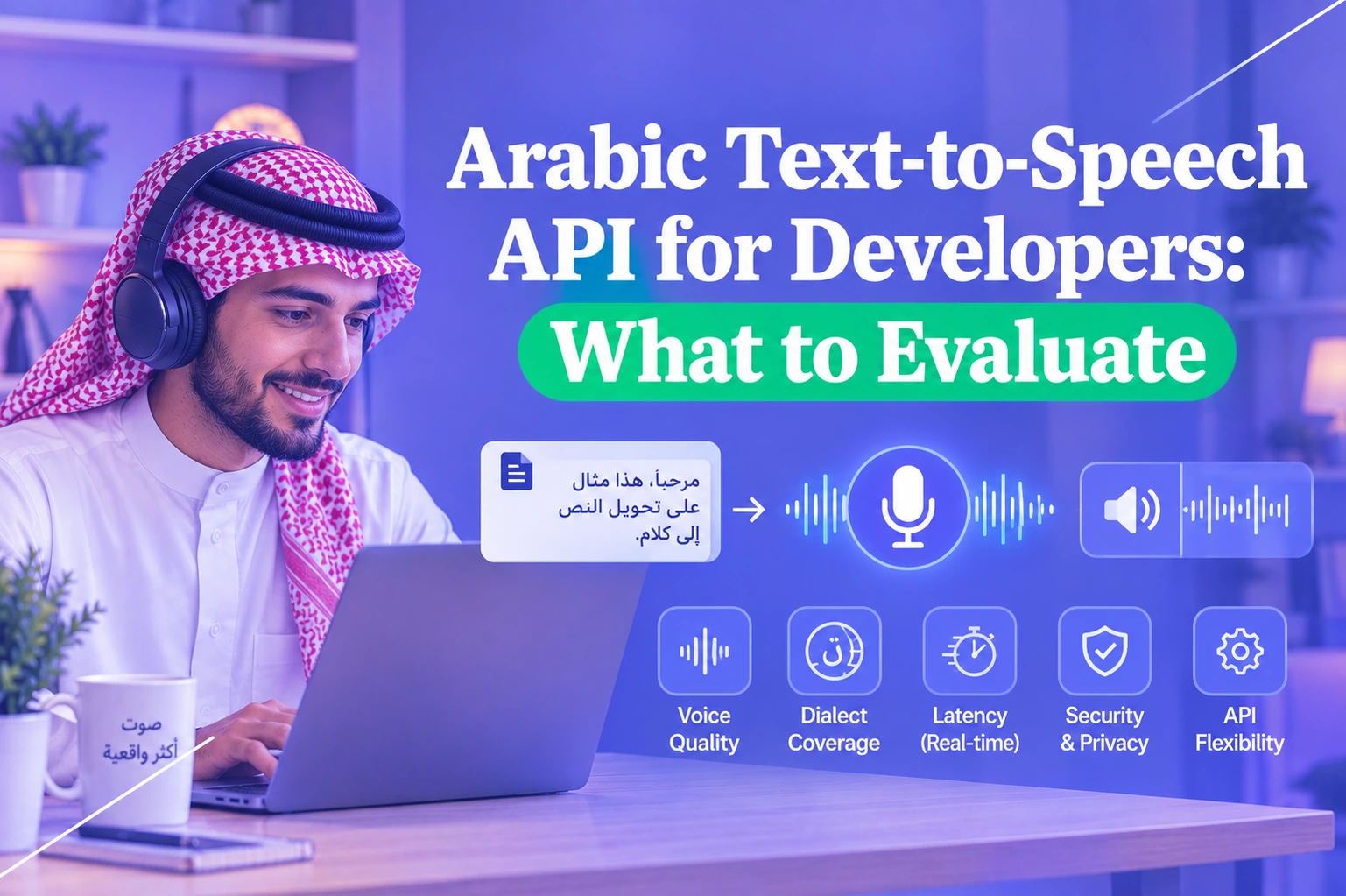
Arabic Text-to-Speech API for Developers: What to Evaluate

Arabic Voice AI
Author
Rym Bachouche

Key Takeaways

1

Evaluate more than Arabic support: Check streaming, latency, dialect coverage, voice selection, cloning, and API capabilities before choosing an Arabic TTS provider.

2

Streaming matters for voice agents: Real-time applications need audio streamed as it is generated, while TTFB is a more useful latency measure than total synthesis time.

3

Dialect coverage is essential: Developers should verify whether an API supports regional Arabic varieties such as Gulf, Egyptian, and Levantine rather than offering only a generic MSA voice.

4

API-level voice cloning improves automation: A callable cloning endpoint allows developers to create and manage custom voices programmatically instead of relying on a dashboard or manual setup

This guide explains what developers should evaluate when choosing an Arabic text-to-speech API, including real-time streaming, TTFB, dialect coverage, voice cloning, diacritization, API documentation, and deployment options. It also covers how Munsit’s Faseeh API addresses these requirements for Arabic voice applications.

Arabic Text-to-Speech API for Developers

Picking an Arabic text-to-speech API is not the same evaluation as picking an Arabic speech-to-text API, even though the two get bundled into the same vendor shortlist more often than they should. A provider with excellent Arabic transcription can have no Arabic text-to-speech product at all. Deepgram is the clearest example of this, and it trips up more integration plans than it should.

For developers actually shipping a voice agent, an IVR flow, or a narrated-content pipeline, the questions that matter are narrower and more technical than a general feature list: Does the API stream, or only return a finished file? What’s the time-to-first-byte on a short utterance? Can you clone a voice through the API itself, or only through a dashboard? Is there a published spec you can generate a client from, or hand-rolled docs you’ll be translating into types yourself?

This article walks through what actually matters when evaluating an Arabic TTS API as a developer, then covers how Munsit’s Faseeh API addresses each of those points  including an independent blind-test benchmark of its output against professional human recordings.

This is some text inside of a div block.

What Developers Actually Need to Evaluate

REST vs. streaming output. A REST endpoint that returns a complete audio file is fine for pre-generated content  e-learning modules, IVR prompts recorded once and cached, narration rendered ahead of time. A conversational voice agent needs audio streamed back as it’s generated, typically over WebSocket, so playback can start before synthesis finishes. Building a voice agent against a REST-only TTS API means bolting on your own chunking and buffering logic, or living with a noticeable pause before the agent speaks.
‍

Time-to-first-byte (TTFB), not just “fast.” Vendors advertise “low latency” without a shared definition. What matters for a voice agent is TTFB  the delay between sending text and receiving the first audio chunk, not total synthesis time for a long passage. Ask for TTFB benchmarks on short utterances, the kind a voice agent actually sends turn by turn, not marketing demos built around long paragraphs.
‍

Dialect and voice selection. Does the API expose Gulf, Egyptian, or Levantine voices as distinct options, or is “Arabic” a single Modern Standard Arabic (MSA) voice with no regional variants? For a UAE or Saudi consumer product, an MSA-only voice reads as formal and slightly foreign  the equivalent of a customer service line that only speaks textbook, broadcast-register English. This is one of the more overlooked evaluation criteria because most vendor docs list “Arabic” as a single checkbox rather than breaking out which variety is actually being synthesized.
‍

Voice cloning through the API, not just a dashboard. Some vendors treat cloning as a dashboard feature gated behind an enterprise sales conversation or an approval process; others expose it as a documented endpoint you can call programmatically. If a product needs custom or branded voices at scale, not just a handful set up manually by a vendor’s team API-level cloning is the difference between an automatable pipeline and a manual bottleneck every time a new voice is needed.
‍

Diacritization as a controllable step, specific to Arabic. Arabic script is normally written without short-vowel diacritics (tashkīl), which means the same written word can be pronounced multiple ways depending on context, a structural ambiguity with no real equivalent in English TTS.
‍

A synthesis engine has to resolve that ambiguity somehow, and for names, technical terms, or domain vocabulary, an automatic guess can land wrong. Whether a vendor exposes diacritization as its own inspectable or correctable step, rather than only handling it invisibly inside synthesis, matters more for Arabic than it would for almost any other language.
‍

Output format and audio controls. Check supported formats (WAV, MP3, PCM, Opus), sample rate options, and whether SSML or an equivalent markup is supported for pronunciation control, pauses, and emphasis.
‍

Authentication, SDKs, and spec publication. A single API key vs. OAuth flows, official SDKs vs. community wrappers, and  for teams generating their own clients  whether the vendor publishes an OpenAPI or AsyncAPI spec you can point a codegen tool at instead of hand-writing request and response types.
‍

Rate limits and concurrency. Documented rate limits (requests per minute, concurrent streams) that you can plan capacity around, rather than limits you only discover in production.
‍

Deployment model. Cloud-only is fine for most consumer apps. Government, banking, and healthcare integrations in the UAE and Saudi Arabia frequently require sovereign cloud (VPC), on-premises, or on-device deployment  worth confirming before an architecture decision locks a product into a cloud-only vendor.

This is some text inside of a div block.

Heading

Lorem ipsum dolor sit amet, consectetur adipiscing elit. Suspendisse varius enim in eros elementum tristique. Duis cursus, mi quis viverra ornare, eros dolor interdum nulla, ut commodo diam libero vitae erat. Aenean faucibus nibh et justo cursus id rutrum lorem imperdiet. Nunc ut sem vitae risus tristique posuere.

Lorem ipsum dolor sit amet, consectetur adipiscing elit. Suspendisse varius enim in eros elementum tristique. Duis cursus, mi quis viverra ornare, eros dolor interdum nulla, ut commodo diam libero vitae erat. Aenean faucibus nibh et justo cursus id rutrum lorem imperdiet. Nunc ut sem vitae risus tristique posuere.

Lorem ipsum dolor sit amet, consectetur adipiscing elit. Suspendisse varius enim in eros elementum tristique. Duis cursus, mi quis viverra ornare, eros dolor interdum nulla, ut commodo diam libero vitae erat. Aenean faucibus nibh et justo cursus id rutrum lorem imperdiet. Nunc ut sem vitae risus tristique posuere.

Lorem ipsum dolor sit amet, consectetur adipiscing elit. Suspendisse varius enim in eros elementum tristique. Duis cursus, mi quis viverra ornare, eros dolor interdum nulla, ut commodo diam libero vitae erat. Aenean faucibus nibh et justo cursus id rutrum lorem imperdiet. Nunc ut sem vitae risus tristique posuere.

The Trap: Arabic STT Support Doesn’t Mean Arabic TTS Support

This catches teams who shortlist a vendor based on its speech-to-text reputation and assume the same company’s text-to-speech product covers the same languages. It often doesn’t, and the gap tends to surface mid-integration rather than during evaluation.
‍

Deepgram is the clearest case. Its Nova-3 Arabic model is a genuinely strong, well-documented Arabic STT product covering 17 regional variants. But Deepgram’s Aura TTS line supports English, Spanish, German, French, Dutch, Italian, and Japanese  no Arabic. This isn’t a documentation gap; a Deepgram engineer confirmed directly, in a public GitHub discussion, that Arabic TTS is not currently on the roadmap (GitHub Discussion #982). A team that picks a vendor for a bidirectional Arabic voice agent  speech in, speech out  based on transcription quality alone can build most of an integration before discovering the output side isn’t covered.
‍

The practical rule: never assume a vendor’s speech-to-text and text-to-speech language coverage match, even within the same company. Check both API references independently, for the specific languages and dialects a product needs, before an architecture decision locks in one vendor for both directions of a voice pipeline.

‍

How Munsit’s Faseeh API Addresses This

Munsit is an Arabic Voice AI platform built in the UAE, offering both Arabic speech-to-text and text-to-speech, branded Faseeh, behind a single API key, documented with both an OpenAPI specification and an AsyncAPI specification for the WebSocket protocol.
‍

API surface:
‍

  • Synthesize: POST /text-to-speech/{model} — send text, receive audio. → Arabic TTS benchmark
  • Stream audio out: WebSocket at /websocket/text-to-speech — synthesize as text arrives, for low-latency conversational use.
  • List and preview voices: GET /voices, POST /voices/preview
  • Clone a voice: POST /voices/clone — submit a sample file and a name; returns a voice_id once processing completes.
  • Diacritize text first: POST /tashkil/diacritize — a standalone, inspectable step ahead of synthesis.
    ‍

Voice cloning is a callable endpoint, not a dashboard-only feature. POST /voices/clone takes an audio sample and a name and returns a voice_id you can pass straight to the synthesize endpoint once cloning completes — a pipeline a product can automate rather than a step that requires a vendor’s team to set up manually each time.
‍

Streaming is a dedicated endpoint, separate from the speech-to-text streaming endpoint: /websocket/text-to-speech synthesizes audio as text streams in, so playback can start on the first chunk instead of waiting for a complete response — the architecture a real-time voice agent needs.
‍

Tashkīl (diacritization) is exposed as its own endpoint (/tashkil/diacritize) rather than only resolved invisibly during synthesis, so developers can inspect or correct diacritized text before it’s spoken — useful for names, technical terms, or domain vocabulary where an automatic guess might land wrong.
‍

Voice agent framework integrations: drop-in plugins for LiveKit (listed separately for TTS and STT), Pipecat, VAPI, and Ultravox, so teams building on those frameworks don’t need to write custom WebSocket handling to wire Faseeh in.
‍

Deployment options: cloud API, sovereign cloud (VPC), on-premises for air-gapped government and banking environments, and on-device processing.
‍

Authentication: a single API key (x-api-key header) covers both TTS and STT endpoints with no separate signup or key for each product line.
‍

Pricing: free credits on signup, no card required. Paid plans from $8/month (billed annually) with 200,000 credits/month; enterprise pricing for sovereign deployment and high volume. (Verify current rates and the credits-to-audio-duration conversion directly at munsit.com/pricing, since usage-based pricing details change.)

See how Munsit performs on real Arabic speech

Evaluate dialect coverage, noise handling, and in-region deployment on data that reflects your customers.
Explore

UAE and Saudi Compliance Considerations for Arabic TTS

Text-to-speech integrations that process customer-facing scripts, cloned voices, or personal identifiers carry specific compliance obligations in the UAE and Saudi Arabia:
‍

Data protection. The UAE’s Federal Decree-Law No. 45/2021 (PDPL) and Saudi Arabia’s PDPL (enforced since September 2024) govern processing of personal data, which can include voice samples used for cloning. If a TTS vendor processes audio outside the UAE or Saudi Arabia, confirm the legal basis for that transfer and whether the vendor offers in-region or sovereign deployment as an alternative.
‍

Voice cloning consent. Cloning a real person’s voice  for a branded assistant, an IVR system using an executive’s voice, or any product feature  should be built on documented, explicit consent from the voice’s owner, captured and retained before the sample is submitted to any cloning endpoint.
‍

Cybercrime law. The UAE’s Federal Decree-Law No. 34/2021 covers unauthorized use of another person’s likeness or voice, which is directly relevant to any product feature that clones or synthesizes a real person’s voice without their authorization.
‍

Sovereign deployment for regulated sectors. Government, banking, and healthcare integrations frequently require audio processing to stay within a defined jurisdiction or air-gapped environment  worth checking whether a shortlisted vendor supports VPC, on-premises, or on-device deployment before an architecture assumes cloud-only.
‍

This section provides general information, not legal advice. Consult qualified legal counsel for compliance decisions specific to your product and jurisdiction.

FAQ

Does Deepgram support Arabic text-to-speech?
Can I clone an Arabic voice through Munsit’s API instead of a dashboard?
Is Munsit’s blind-test benchmark independently verified?

Powering the Future with AI

Join our newsletter for insights on cutting-edge technology built in the UAE
Thank you! Your submission has been received!
Oops! Something went wrong while submitting the form.
Last update :
September 25, 2026

Arabic Text-to-Speech API for Developers: What to Evaluate

Product
Arabic Voice AI
Author
Sarra Turki
Rym Bachouche
5min read

Bring Arabic Voice AI to production

Native‑level Arabic STT & TTS
Built for GCC gov & enterprises
Sovereign and on‑prem deployment
Contact Sales
Thank you! Your submission has been received!
Oops! Something went wrong while submitting the form.

Key Takeaways

Evaluate more than Arabic support: Check streaming, latency, dialect coverage, voice selection, cloning, and API capabilities before choosing an Arabic TTS provider.

Streaming matters for voice agents: Real-time applications need audio streamed as it is generated, while TTFB is a more useful latency measure than total synthesis time.

Dialect coverage is essential: Developers should verify whether an API supports regional Arabic varieties such as Gulf, Egyptian, and Levantine rather than offering only a generic MSA voice.

API-level voice cloning improves automation: A callable cloning endpoint allows developers to create and manage custom voices programmatically instead of relying on a dashboard or manual setup

Arabic needs controllable diacritization: Tashkīl can help resolve pronunciation ambiguity in names, technical terms, and domain-specific vocabulary before synthesis.

Check deployment and compliance requirements: Cloud, sovereign cloud, on-premises, and on-device options can matter for government, banking, and healthcare applications in the UAE and Saudi Arabia.

This guide explains what developers should evaluate when choosing an Arabic text-to-speech API, including real-time streaming, TTFB, dialect coverage, voice cloning, diacritization, API documentation, and deployment options. It also covers how Munsit’s Faseeh API addresses these requirements for Arabic voice applications.

Arabic Text-to-Speech API for Developers

Picking an Arabic text-to-speech API is not the same evaluation as picking an Arabic speech-to-text API, even though the two get bundled into the same vendor shortlist more often than they should. A provider with excellent Arabic transcription can have no Arabic text-to-speech product at all. Deepgram is the clearest example of this, and it trips up more integration plans than it should.

For developers actually shipping a voice agent, an IVR flow, or a narrated-content pipeline, the questions that matter are narrower and more technical than a general feature list: Does the API stream, or only return a finished file? What’s the time-to-first-byte on a short utterance? Can you clone a voice through the API itself, or only through a dashboard? Is there a published spec you can generate a client from, or hand-rolled docs you’ll be translating into types yourself?

This article walks through what actually matters when evaluating an Arabic TTS API as a developer, then covers how Munsit’s Faseeh API addresses each of those points  including an independent blind-test benchmark of its output against professional human recordings.

Lorem ipsum dolor
Lorem ipsum dolor
Lorem ipsum dolor
Lorem ipsum dolor
Lorem ipsum dolor
Lorem ipsum dolor
Lorem ipsum dolor
Lorem ipsum dolor
Lorem ipsum dolor
Lorem ipsum dolor
Lorem ipsum dolor
Lorem ipsum dolor
Lorem ipsum dolor
Lorem ipsum dolor
Lorem ipsum dolor
Lorem ipsum dolor
Lorem ipsum dolor
Lorem ipsum dolor
Lorem ipsum dolor
Lorem ipsum dolor
Lorem ipsum dolor
Lorem ipsum dolor
Lorem ipsum dolor
Lorem ipsum dolor
Lorem ipsum dolor
Lorem ipsum dolor
Lorem ipsum dolor
Lorem ipsum dolor
Lorem ipsum dolor
Lorem ipsum dolor
Lorem ipsum dolor
Lorem ipsum dolor

What Developers Actually Need to Evaluate

Understanding the origins of AI hallucinations is the first step toward mitigating them. The phenomenon is not a single problem but rather a complex issue with multiple contributing factors.

1

Training Data Deficiencies

REST vs. streaming output. A REST endpoint that returns a complete audio file is fine for pre-generated content  e-learning modules, IVR prompts recorded once and cached, narration rendered ahead of time. A conversational voice agent needs audio streamed back as it’s generated, typically over WebSocket, so playback can start before synthesis finishes. Building a voice agent against a REST-only TTS API means bolting on your own chunking and buffering logic, or living with a noticeable pause before the agent speaks.
‍

Time-to-first-byte (TTFB), not just “fast.” Vendors advertise “low latency” without a shared definition. What matters for a voice agent is TTFB  the delay between sending text and receiving the first audio chunk, not total synthesis time for a long passage. Ask for TTFB benchmarks on short utterances, the kind a voice agent actually sends turn by turn, not marketing demos built around long paragraphs.
‍

Dialect and voice selection. Does the API expose Gulf, Egyptian, or Levantine voices as distinct options, or is “Arabic” a single Modern Standard Arabic (MSA) voice with no regional variants? For a UAE or Saudi consumer product, an MSA-only voice reads as formal and slightly foreign  the equivalent of a customer service line that only speaks textbook, broadcast-register English. This is one of the more overlooked evaluation criteria because most vendor docs list “Arabic” as a single checkbox rather than breaking out which variety is actually being synthesized.
‍

Voice cloning through the API, not just a dashboard. Some vendors treat cloning as a dashboard feature gated behind an enterprise sales conversation or an approval process; others expose it as a documented endpoint you can call programmatically. If a product needs custom or branded voices at scale, not just a handful set up manually by a vendor’s team API-level cloning is the difference between an automatable pipeline and a manual bottleneck every time a new voice is needed.
‍

Diacritization as a controllable step, specific to Arabic. Arabic script is normally written without short-vowel diacritics (tashkīl), which means the same written word can be pronounced multiple ways depending on context, a structural ambiguity with no real equivalent in English TTS.
‍

A synthesis engine has to resolve that ambiguity somehow, and for names, technical terms, or domain vocabulary, an automatic guess can land wrong. Whether a vendor exposes diacritization as its own inspectable or correctable step, rather than only handling it invisibly inside synthesis, matters more for Arabic than it would for almost any other language.
‍

Output format and audio controls. Check supported formats (WAV, MP3, PCM, Opus), sample rate options, and whether SSML or an equivalent markup is supported for pronunciation control, pauses, and emphasis.
‍

Authentication, SDKs, and spec publication. A single API key vs. OAuth flows, official SDKs vs. community wrappers, and  for teams generating their own clients  whether the vendor publishes an OpenAPI or AsyncAPI spec you can point a codegen tool at instead of hand-writing request and response types.
‍

Rate limits and concurrency. Documented rate limits (requests per minute, concurrent streams) that you can plan capacity around, rather than limits you only discover in production.
‍

Deployment model. Cloud-only is fine for most consumer apps. Government, banking, and healthcare integrations in the UAE and Saudi Arabia frequently require sovereign cloud (VPC), on-premises, or on-device deployment  worth confirming before an architecture decision locks a product into a cloud-only vendor.

2

Training Data Deficiencies

The most significant contributor to AI hallucinations is the data on which the models are trained. LLMs learn from vast datasets scraped from the internet, which contain a mixture of factual information, opinions, misinformation, and biases. Several specific data-related issues can lead to hallucinations:

Enterprise Use Cases for Arabic Voice AI in 2025

The move to dialect-aware Arabic ASR is unlocking a new wave of enterprise applications across the GCC and MENA regions. Organizations are moving beyond basic transcription to sophisticated Arabic speech analytics.

Arabic speech technology is rapidly advancing in 2025, driven by massive multilingual models and new Arabic-centric foundation models.

Arabic speech technology is rapidly advancing in 2025, driven by massive multilingual models and new Arabic-centric foundation models.

Arabic speech technology is rapidly advancing in 2025, driven by massive multilingual models and new Arabic-centric foundation models.

Arabic speech technology is rapidly advancing in 2025, driven by massive multilingual models and new Arabic-centric foundation models.

The Trap: Arabic STT Support Doesn’t Mean Arabic TTS Support

Understanding the origins of AI hallucinations is the first step toward mitigating them. The phenomenon is not a single problem but rather a complex issue with multiple contributing factors.

1

Training Data Deficiencies

This catches teams who shortlist a vendor based on its speech-to-text reputation and assume the same company’s text-to-speech product covers the same languages. It often doesn’t, and the gap tends to surface mid-integration rather than during evaluation.
‍

Deepgram is the clearest case. Its Nova-3 Arabic model is a genuinely strong, well-documented Arabic STT product covering 17 regional variants. But Deepgram’s Aura TTS line supports English, Spanish, German, French, Dutch, Italian, and Japanese  no Arabic. This isn’t a documentation gap; a Deepgram engineer confirmed directly, in a public GitHub discussion, that Arabic TTS is not currently on the roadmap (GitHub Discussion #982). A team that picks a vendor for a bidirectional Arabic voice agent  speech in, speech out  based on transcription quality alone can build most of an integration before discovering the output side isn’t covered.
‍

The practical rule: never assume a vendor’s speech-to-text and text-to-speech language coverage match, even within the same company. Check both API references independently, for the specific languages and dialects a product needs, before an architecture decision locks in one vendor for both directions of a voice pipeline.

‍

2

Training Data Deficiencies

The most significant contributor to AI hallucinations is the data on which the models are trained. LLMs learn from vast datasets scraped from the internet, which contain a mixture of factual information, opinions, misinformation, and biases. Several specific data-related issues can lead to hallucinations:

Enterprise Use Cases for Arabic Voice AI in 2025

The move to dialect-aware Arabic ASR is unlocking a new wave of enterprise applications across the GCC and MENA regions. Organizations are moving beyond basic transcription to sophisticated Arabic speech analytics.

Arabic speech technology is rapidly advancing in 2025, driven by massive multilingual models and new Arabic-centric foundation models.

Arabic speech technology is rapidly advancing in 2025, driven by massive multilingual models and new Arabic-centric foundation models.

Arabic speech technology is rapidly advancing in 2025, driven by massive multilingual models and new Arabic-centric foundation models.

Arabic speech technology is rapidly advancing in 2025, driven by massive multilingual models and new Arabic-centric foundation models.

Building better AI systems takes the right approach

We help with custom solutions, data pipelines, and Arabic intelligence.

How Munsit’s Faseeh API Addresses This

Understanding the origins of AI hallucinations is the first step toward mitigating them. The phenomenon is not a single problem but rather a complex issue with multiple contributing factors.

1

Training Data Deficiencies

Munsit is an Arabic Voice AI platform built in the UAE, offering both Arabic speech-to-text and text-to-speech, branded Faseeh, behind a single API key, documented with both an OpenAPI specification and an AsyncAPI specification for the WebSocket protocol.
‍

API surface:
‍

  • Synthesize: POST /text-to-speech/{model} — send text, receive audio. → Arabic TTS benchmark
  • Stream audio out: WebSocket at /websocket/text-to-speech — synthesize as text arrives, for low-latency conversational use.
  • List and preview voices: GET /voices, POST /voices/preview
  • Clone a voice: POST /voices/clone — submit a sample file and a name; returns a voice_id once processing completes.
  • Diacritize text first: POST /tashkil/diacritize — a standalone, inspectable step ahead of synthesis.
    ‍

Voice cloning is a callable endpoint, not a dashboard-only feature. POST /voices/clone takes an audio sample and a name and returns a voice_id you can pass straight to the synthesize endpoint once cloning completes — a pipeline a product can automate rather than a step that requires a vendor’s team to set up manually each time.
‍

Streaming is a dedicated endpoint, separate from the speech-to-text streaming endpoint: /websocket/text-to-speech synthesizes audio as text streams in, so playback can start on the first chunk instead of waiting for a complete response — the architecture a real-time voice agent needs.
‍

Tashkīl (diacritization) is exposed as its own endpoint (/tashkil/diacritize) rather than only resolved invisibly during synthesis, so developers can inspect or correct diacritized text before it’s spoken — useful for names, technical terms, or domain vocabulary where an automatic guess might land wrong.
‍

Voice agent framework integrations: drop-in plugins for LiveKit (listed separately for TTS and STT), Pipecat, VAPI, and Ultravox, so teams building on those frameworks don’t need to write custom WebSocket handling to wire Faseeh in.
‍

Deployment options: cloud API, sovereign cloud (VPC), on-premises for air-gapped government and banking environments, and on-device processing.
‍

Authentication: a single API key (x-api-key header) covers both TTS and STT endpoints with no separate signup or key for each product line.
‍

Pricing: free credits on signup, no card required. Paid plans from $8/month (billed annually) with 200,000 credits/month; enterprise pricing for sovereign deployment and high volume. (Verify current rates and the credits-to-audio-duration conversion directly at munsit.com/pricing, since usage-based pricing details change.)

2

Training Data Deficiencies

The most significant contributor to AI hallucinations is the data on which the models are trained. LLMs learn from vast datasets scraped from the internet, which contain a mixture of factual information, opinions, misinformation, and biases. Several specific data-related issues can lead to hallucinations:

Enterprise Use Cases for Arabic Voice AI in 2025

The move to dialect-aware Arabic ASR is unlocking a new wave of enterprise applications across the GCC and MENA regions. Organizations are moving beyond basic transcription to sophisticated Arabic speech analytics.

Arabic speech technology is rapidly advancing in 2025, driven by massive multilingual models and new Arabic-centric foundation models.

Arabic speech technology is rapidly advancing in 2025, driven by massive multilingual models and new Arabic-centric foundation models.

Arabic speech technology is rapidly advancing in 2025, driven by massive multilingual models and new Arabic-centric foundation models.

Arabic speech technology is rapidly advancing in 2025, driven by massive multilingual models and new Arabic-centric foundation models.

UAE and Saudi Compliance Considerations for Arabic TTS

Understanding the origins of AI hallucinations is the first step toward mitigating them. The phenomenon is not a single problem but rather a complex issue with multiple contributing factors.

1

Training Data Deficiencies

Text-to-speech integrations that process customer-facing scripts, cloned voices, or personal identifiers carry specific compliance obligations in the UAE and Saudi Arabia:
‍

Data protection. The UAE’s Federal Decree-Law No. 45/2021 (PDPL) and Saudi Arabia’s PDPL (enforced since September 2024) govern processing of personal data, which can include voice samples used for cloning. If a TTS vendor processes audio outside the UAE or Saudi Arabia, confirm the legal basis for that transfer and whether the vendor offers in-region or sovereign deployment as an alternative.
‍

Voice cloning consent. Cloning a real person’s voice  for a branded assistant, an IVR system using an executive’s voice, or any product feature  should be built on documented, explicit consent from the voice’s owner, captured and retained before the sample is submitted to any cloning endpoint.
‍

Cybercrime law. The UAE’s Federal Decree-Law No. 34/2021 covers unauthorized use of another person’s likeness or voice, which is directly relevant to any product feature that clones or synthesizes a real person’s voice without their authorization.
‍

Sovereign deployment for regulated sectors. Government, banking, and healthcare integrations frequently require audio processing to stay within a defined jurisdiction or air-gapped environment  worth checking whether a shortlisted vendor supports VPC, on-premises, or on-device deployment before an architecture assumes cloud-only.
‍

This section provides general information, not legal advice. Consult qualified legal counsel for compliance decisions specific to your product and jurisdiction.

2

Training Data Deficiencies

The most significant contributor to AI hallucinations is the data on which the models are trained. LLMs learn from vast datasets scraped from the internet, which contain a mixture of factual information, opinions, misinformation, and biases. Several specific data-related issues can lead to hallucinations:

Enterprise Use Cases for Arabic Voice AI in 2025

The move to dialect-aware Arabic ASR is unlocking a new wave of enterprise applications across the GCC and MENA regions. Organizations are moving beyond basic transcription to sophisticated Arabic speech analytics.

Arabic speech technology is rapidly advancing in 2025, driven by massive multilingual models and new Arabic-centric foundation models.

Arabic speech technology is rapidly advancing in 2025, driven by massive multilingual models and new Arabic-centric foundation models.

Arabic speech technology is rapidly advancing in 2025, driven by massive multilingual models and new Arabic-centric foundation models.

Arabic speech technology is rapidly advancing in 2025, driven by massive multilingual models and new Arabic-centric foundation models.

Understanding the origins of AI hallucinations is the first step toward mitigating them. The phenomenon is not a single problem but rather a complex issue with multiple contributing factors.

1

Training Data Deficiencies

2

Training Data Deficiencies

The most significant contributor to AI hallucinations is the data on which the models are trained. LLMs learn from vast datasets scraped from the internet, which contain a mixture of factual information, opinions, misinformation, and biases. Several specific data-related issues can lead to hallucinations:

Enterprise Use Cases for Arabic Voice AI in 2025

The move to dialect-aware Arabic ASR is unlocking a new wave of enterprise applications across the GCC and MENA regions. Organizations are moving beyond basic transcription to sophisticated Arabic speech analytics.

Arabic speech technology is rapidly advancing in 2025, driven by massive multilingual models and new Arabic-centric foundation models.

Arabic speech technology is rapidly advancing in 2025, driven by massive multilingual models and new Arabic-centric foundation models.

Arabic speech technology is rapidly advancing in 2025, driven by massive multilingual models and new Arabic-centric foundation models.

Arabic speech technology is rapidly advancing in 2025, driven by massive multilingual models and new Arabic-centric foundation models.

Understanding the origins of AI hallucinations is the first step toward mitigating them. The phenomenon is not a single problem but rather a complex issue with multiple contributing factors.

1

Training Data Deficiencies

2

Training Data Deficiencies

The most significant contributor to AI hallucinations is the data on which the models are trained. LLMs learn from vast datasets scraped from the internet, which contain a mixture of factual information, opinions, misinformation, and biases. Several specific data-related issues can lead to hallucinations:

Enterprise Use Cases for Arabic Voice AI in 2025

The move to dialect-aware Arabic ASR is unlocking a new wave of enterprise applications across the GCC and MENA regions. Organizations are moving beyond basic transcription to sophisticated Arabic speech analytics.

Arabic speech technology is rapidly advancing in 2025, driven by massive multilingual models and new Arabic-centric foundation models.

Arabic speech technology is rapidly advancing in 2025, driven by massive multilingual models and new Arabic-centric foundation models.

Arabic speech technology is rapidly advancing in 2025, driven by massive multilingual models and new Arabic-centric foundation models.

Arabic speech technology is rapidly advancing in 2025, driven by massive multilingual models and new Arabic-centric foundation models.

Understanding the origins of AI hallucinations is the first step toward mitigating them. The phenomenon is not a single problem but rather a complex issue with multiple contributing factors.

1

Training Data Deficiencies

2

Training Data Deficiencies

The most significant contributor to AI hallucinations is the data on which the models are trained. LLMs learn from vast datasets scraped from the internet, which contain a mixture of factual information, opinions, misinformation, and biases. Several specific data-related issues can lead to hallucinations:

Enterprise Use Cases for Arabic Voice AI in 2025

The move to dialect-aware Arabic ASR is unlocking a new wave of enterprise applications across the GCC and MENA regions. Organizations are moving beyond basic transcription to sophisticated Arabic speech analytics.

Arabic speech technology is rapidly advancing in 2025, driven by massive multilingual models and new Arabic-centric foundation models.

Arabic speech technology is rapidly advancing in 2025, driven by massive multilingual models and new Arabic-centric foundation models.

Arabic speech technology is rapidly advancing in 2025, driven by massive multilingual models and new Arabic-centric foundation models.

Arabic speech technology is rapidly advancing in 2025, driven by massive multilingual models and new Arabic-centric foundation models.

Understanding the origins of AI hallucinations is the first step toward mitigating them. The phenomenon is not a single problem but rather a complex issue with multiple contributing factors.

1

Training Data Deficiencies

2

Training Data Deficiencies

The most significant contributor to AI hallucinations is the data on which the models are trained. LLMs learn from vast datasets scraped from the internet, which contain a mixture of factual information, opinions, misinformation, and biases. Several specific data-related issues can lead to hallucinations:

Enterprise Use Cases for Arabic Voice AI in 2025

The move to dialect-aware Arabic ASR is unlocking a new wave of enterprise applications across the GCC and MENA regions. Organizations are moving beyond basic transcription to sophisticated Arabic speech analytics.

Arabic speech technology is rapidly advancing in 2025, driven by massive multilingual models and new Arabic-centric foundation models.

Arabic speech technology is rapidly advancing in 2025, driven by massive multilingual models and new Arabic-centric foundation models.

Arabic speech technology is rapidly advancing in 2025, driven by massive multilingual models and new Arabic-centric foundation models.

Arabic speech technology is rapidly advancing in 2025, driven by massive multilingual models and new Arabic-centric foundation models.

Understanding the origins of AI hallucinations is the first step toward mitigating them. The phenomenon is not a single problem but rather a complex issue with multiple contributing factors.

1

Training Data Deficiencies

2

Training Data Deficiencies

The most significant contributor to AI hallucinations is the data on which the models are trained. LLMs learn from vast datasets scraped from the internet, which contain a mixture of factual information, opinions, misinformation, and biases. Several specific data-related issues can lead to hallucinations:

Enterprise Use Cases for Arabic Voice AI in 2025

The move to dialect-aware Arabic ASR is unlocking a new wave of enterprise applications across the GCC and MENA regions. Organizations are moving beyond basic transcription to sophisticated Arabic speech analytics.

Arabic speech technology is rapidly advancing in 2025, driven by massive multilingual models and new Arabic-centric foundation models.

Arabic speech technology is rapidly advancing in 2025, driven by massive multilingual models and new Arabic-centric foundation models.

Arabic speech technology is rapidly advancing in 2025, driven by massive multilingual models and new Arabic-centric foundation models.

Arabic speech technology is rapidly advancing in 2025, driven by massive multilingual models and new Arabic-centric foundation models.

FAQ
Does Deepgram support Arabic text-to-speech?
Can I clone an Arabic voice through Munsit’s API instead of a dashboard?
Is Munsit’s blind-test benchmark independently verified?
How is Word Error Rate relevant to evaluating a TTS API?
Does Munsit’s TTS API support real-time streaming for voice agents?
What audio formats does the Faseeh API support?

Bring Arabic Voice AI to production

Native‑level Arabic STT & TTS
Built for GCC gov & enterprises
Sovereign and on‑prem deployment
Contact Sales
Thank you! Your submission has been received!
Oops! Something went wrong while submitting the form.

Start free.  
Pay when you are ready.

10,000 credits. Test Munsit with your own audio, in your own dialect, and see the accuracy for yourself.