Product
l 5min

Arabic AI Voice Generator: 10 Best Tools for GCC Enterprises in 2026

Arabic Voice AI
Author
Rym Bachouche

Key Takeaways

1

Arabic is not one language for TTS purposes. Dialect-specific acoustic models (Gulf, Levantine, Egyptian, Maghrebi) outperform generic MSA-only systems, which mispronounce colloquial and regional speech.

2

Deployment flexibility often decides the winner for GCC buyers. Sovereign cloud, VPC, on-premises, and on-device options matter most for organizations bound by PDPL and NCA data-residency rules.

3

Global hyperscalers (Google, Azure, AWS) lag on dialect depth. Most only offer MSA or, at best, one or two Gulf-specific voices, while Arabic-specialist platforms like Munsit and Lahajati cover 25+ to 190+ dialects.

4

Latency and voice cloning quality drive enterprise use cases. Sub-200ms streaming and consistent brand-voice cloning are critical for IVR systems, contact centers, and voice agents.

A Dubai-based investment firm processes 40 board meetings per year, each conducted in a mix of Emirati Arabic and English. Manual transcription followed by a separate Arabic voiceover pass for stakeholder distribution is a common two-step workflow in this scenario, and it’s slow, hours of transcription plus additional studio-booked voiceover production per meeting. In a Researchscape International survey reported by Arab News, 92% of UAE respondents said they would prefer an AI assistant designed specifically for the Middle East, and separately, GCC organizational AI adoption reached 84% in 2025, up from 62%, yet only 31% of organizations report reaching scaled deployment.

Arabic AI voice generators solve this gap by converting written Arabic text into natural, human sounding speech across regional dialects. This guide compares 10 Arabic AI voice generator platforms built for GCC enterprises, government institutions, media producers, and developers. It evaluates dialect coverage, deployment flexibility, pricing transparency, and production quality across Gulf, Levantine, Egyptian, and North African varieties.

Quick Comparison: Arabic AI Voice Generator Tools

Tool Arabic Dialect Coverage Deployment Best For Pricing
Munsit (Faseeh TTS) 25+ dialects including Emirati, Khaleeji, Najdi, Hijazi, Levantine, Egyptian, Maghrebi Cloud / Sovereign / On-Prem / On-Device GCC enterprises, government, IVR systems, sovereign deployment From $8/month
Lahajati 192+ dialects claimed (TTS specialist) Cloud only Content creators, voiceover production, dialect variety Free tier; from $6/month
ElevenLabs 90+ languages; Arabic incl. Saudi/UAE locale variants (not full dialect specialist) Cloud only Multilingual creators, English-primary workflows with Arabic voiceovers From ~$6/month
Narakeet MSA-dominant + select named dialect voices Cloud only Media producers, video subtitling, e-learning From INR 16/min
Google Cloud TTS MSA + limited Gulf support via WaveNet Cloud / On-Prem (Enterprise) Google Cloud native stacks, Android apps Pay per character from $0.006 per 15 seconds
Microsoft Azure TTS MSA only via Neural voices Cloud / On-Prem (Enterprise) Microsoft 365 enterprises, Azure-native apps Pay per character from $1/hr
Amazon Polly MSA + 2 Gulf Arabic (ar-AE) neural voices (Hala, Zayd) Cloud / On-Prem (via Outposts) AWS-native apps, Alexa skills Pay per character from $4/million
PlayHT MSA + limited dialect generalization Cloud only Podcast producers, audiobook creation From $31/month
Lahjty GCC dialects (ad copy + TTS) Cloud only GCC marketers, ad production From $7.99/month
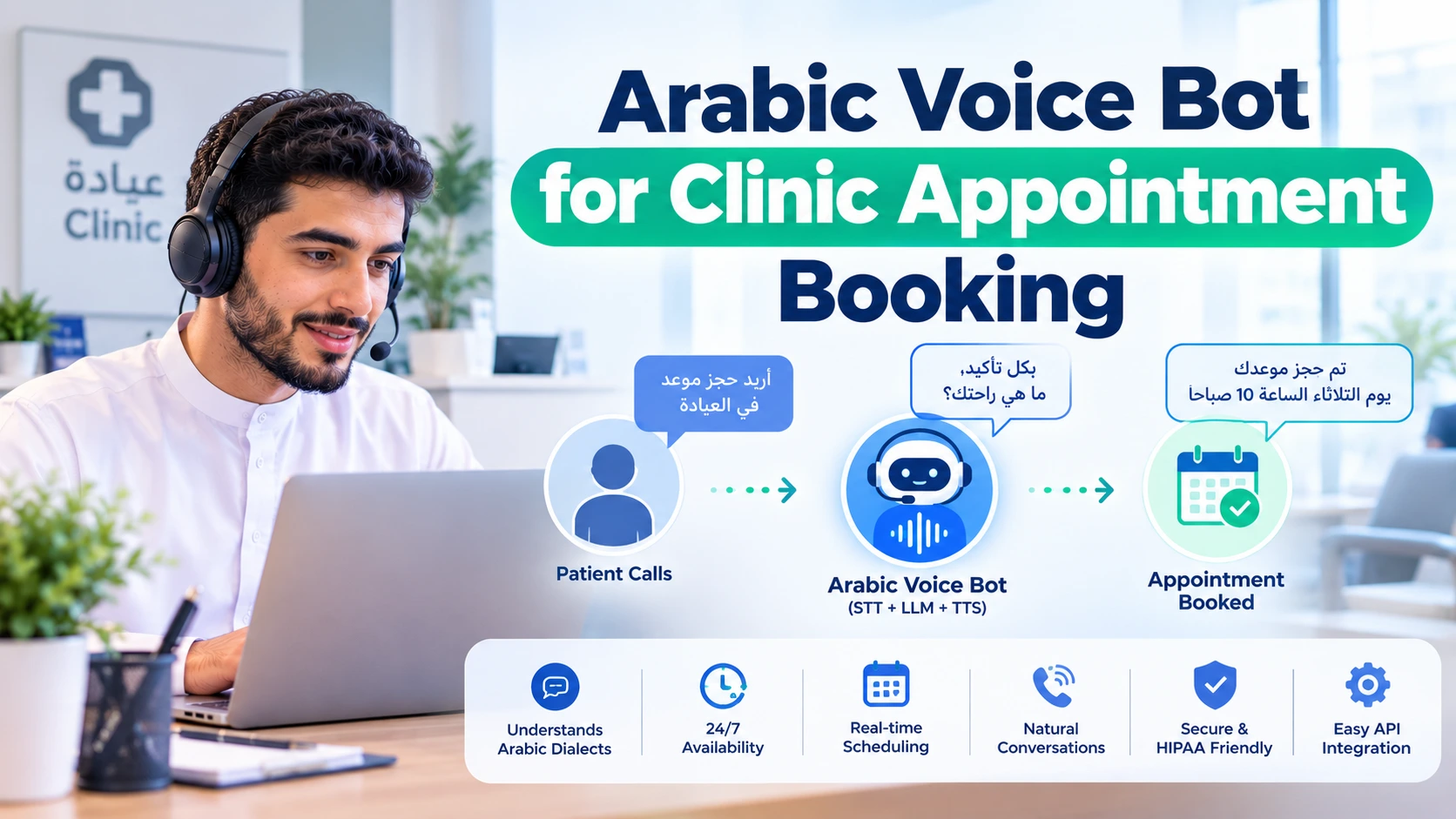
Intella Gulf dialects (call center focus) Cloud / On-Prem Contact centers, customer service IVR Custom enterprise pricing

Note: The competitor information in this article is based on publicly available sources at the time of writing. This article is intended to help readers make informed decisions and is not a criticism of any company or its products. Every tool mentioned has its own strengths depending on the use case. Always conduct your own research and speak directly with vendors before making any purchasing or technology decisions.

This is some text inside of a div block.

What Is an Arabic AI Voice Generator?

An Arabic AI voice generator is a text to speech (TTS) system that converts written Arabic text into spoken audio using deep neural networks trained on recordings of native Arabic speakers. Unlike earlier rule based or concatenative TTS systems that stitched together pre-recorded phoneme fragments, neural TTS models learn the statistical relationships between text and speech directly from thousands of hours of real human recordings.

The result is speech that captures natural prosody, intonation, rhythm, and dialect-specific pronunciation patterns. For Arabic specifically, this means handling optional diacritical marks (harakat), correctly pronouncing words that shift meaning based on vowel markers, managing the phonetic differences between Modern Standard Arabic (MSA) and regional dialects, and producing natural sounding output even when the input text contains mixed Arabic and English within the same sentence.

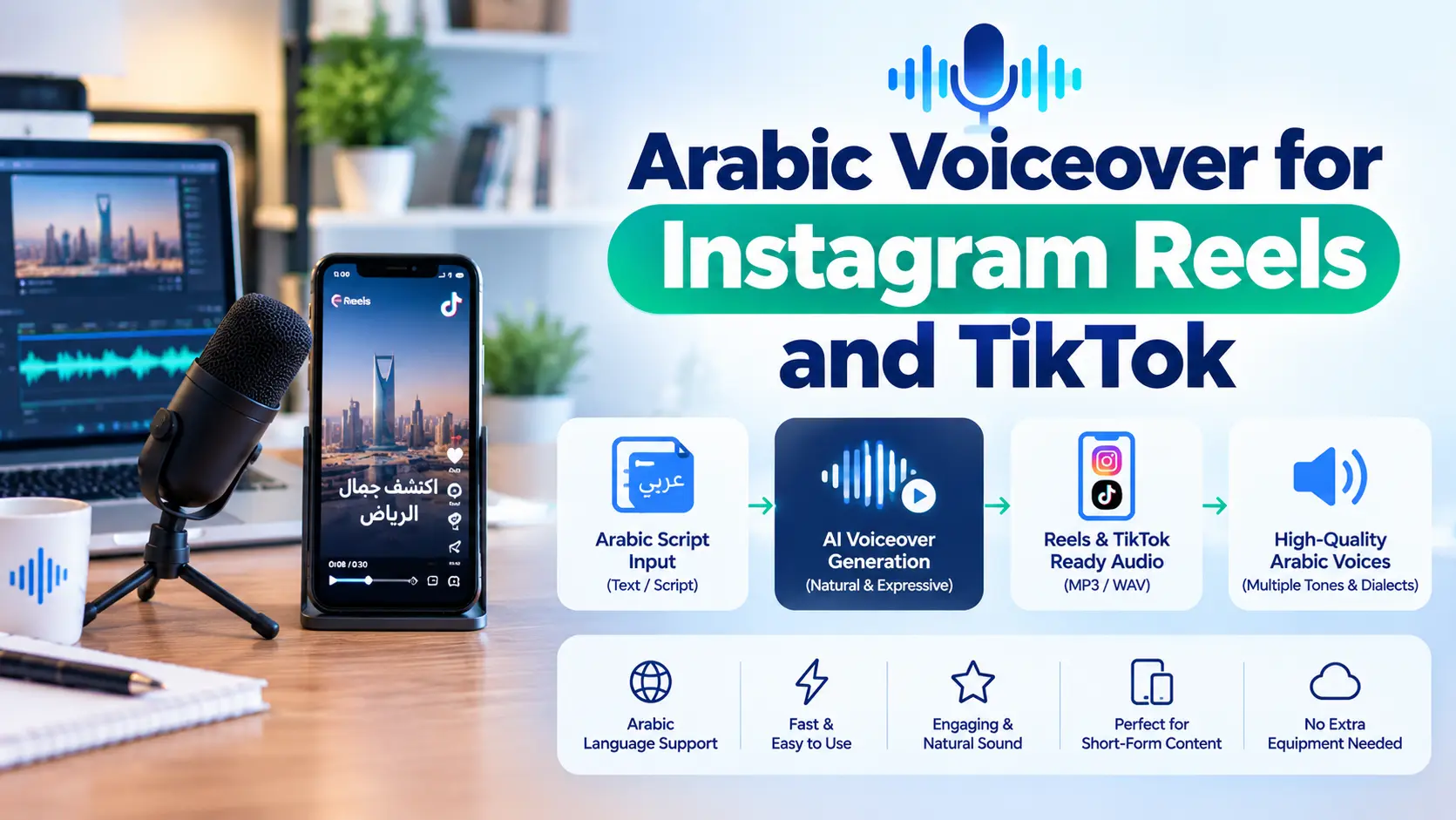
Arabic AI voice generators are used across use cases where human voiceover production would be too slow, expensive, or inconsistent at scale: IVR systems in contact centers, government service announcements, news broadcast automation, e-learning content, audiobook production, social media video voiceovers, and voice agent responses in customer service applications.

The defining technical challenge for Arabic TTS is that the language is not monolithic. A voice generator trained exclusively on Modern Standard Arabic will produce unnatural output when fed Emirati colloquial text. A generator optimized for Egyptian Arabic will mispronounce Gulf proper nouns and struggle with Khaleeji phonemes. Production-grade best Arabic TTS requires dialect specific acoustic models, not a single universal Arabic voice stretched across 25 regional varieties.

This is some text inside of a div block.

Heading

Lorem ipsum dolor sit amet, consectetur adipiscing elit. Suspendisse varius enim in eros elementum tristique. Duis cursus, mi quis viverra ornare, eros dolor interdum nulla, ut commodo diam libero vitae erat. Aenean faucibus nibh et justo cursus id rutrum lorem imperdiet. Nunc ut sem vitae risus tristique posuere.

Lorem ipsum dolor sit amet, consectetur adipiscing elit. Suspendisse varius enim in eros elementum tristique. Duis cursus, mi quis viverra ornare, eros dolor interdum nulla, ut commodo diam libero vitae erat. Aenean faucibus nibh et justo cursus id rutrum lorem imperdiet. Nunc ut sem vitae risus tristique posuere.

Lorem ipsum dolor sit amet, consectetur adipiscing elit. Suspendisse varius enim in eros elementum tristique. Duis cursus, mi quis viverra ornare, eros dolor interdum nulla, ut commodo diam libero vitae erat. Aenean faucibus nibh et justo cursus id rutrum lorem imperdiet. Nunc ut sem vitae risus tristique posuere.

Lorem ipsum dolor sit amet, consectetur adipiscing elit. Suspendisse varius enim in eros elementum tristique. Duis cursus, mi quis viverra ornare, eros dolor interdum nulla, ut commodo diam libero vitae erat. Aenean faucibus nibh et justo cursus id rutrum lorem imperdiet. Nunc ut sem vitae risus tristique posuere.

Detailed Comparison: Arabic AI Voice Generator Tools

1. Munsit (Faseeh TTS):  Best for GCC Enterprises and Sovereign Deployment

Munsit is an Arabic Voice AI platform built in the UAE by CNTXT AI. Its speech-recognition model independently benchmarks near the top of the Open Universal Arabic ASR Leaderboard, on the leaderboard’s multi-dialect test sets, Munsit-1 records a 26.68% average word error rate against 36.86% for OpenAI Whisper large-v3 on the same six test sets. That’s a speech-recognition benchmark, not a TTS-specific score, but it reflects the same underlying Arabic-first training approach behind Faseeh TTS, Munsit’s text-to-speech model,  both trained on 30,000+ hours of real-world Arabic audio across 25+ dialects per Munsit’s published materials. Verify the live leaderboard for current standing, since rankings shift as new models are submitted.

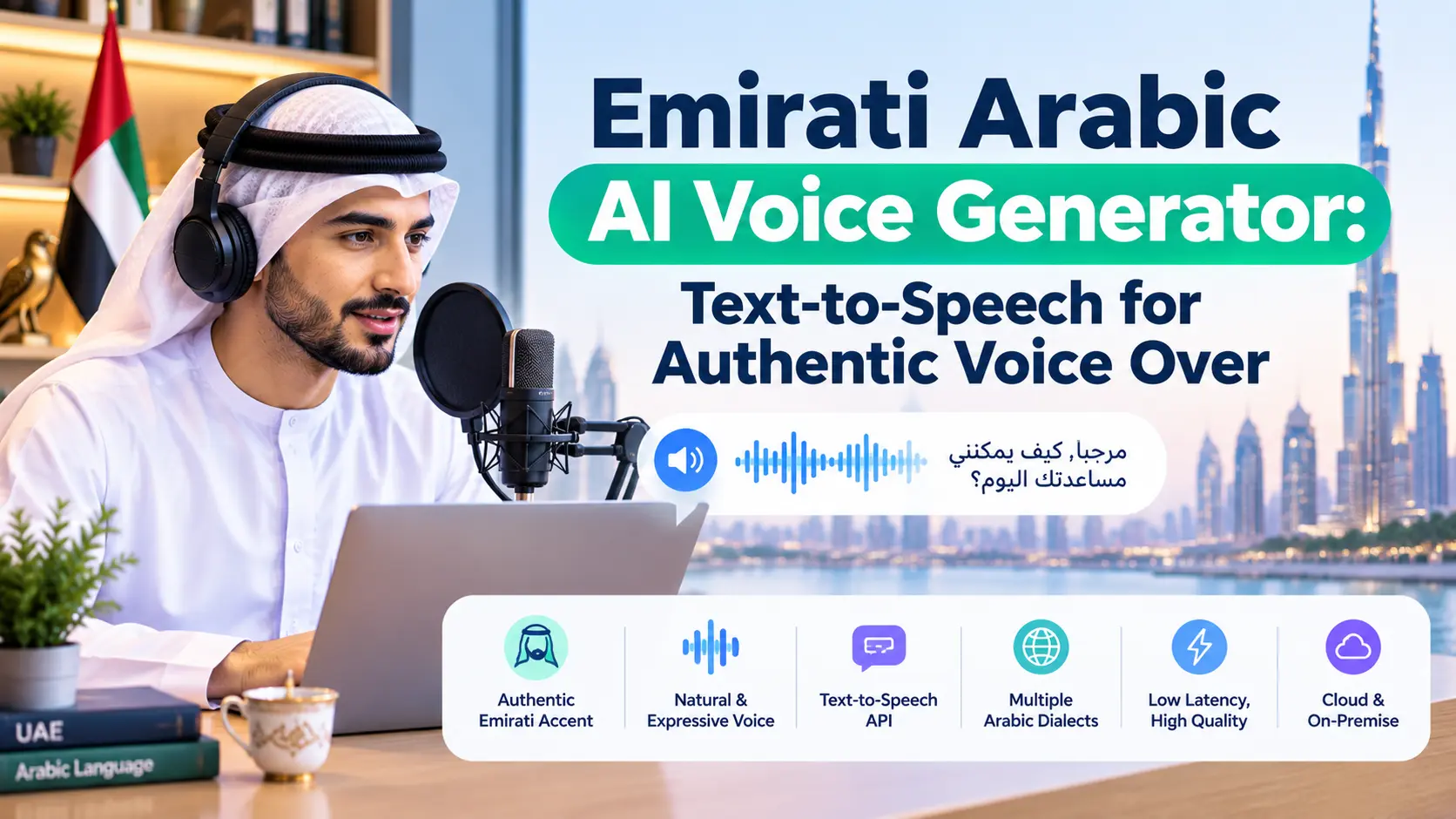
Arabic Dialect Coverage: Faseeh TTS covers 25+ Arabic dialects including Gulf varieties (Emirati, Khaleeji, Saudi Najdi, Hijazi), Levantine (Syrian, Lebanese, Jordanian, Palestinian), Egyptian, Sudanese, Iraqi, Moroccan, Tunisian, Algerian, Libyan, Yemeni, and Modern Standard Arabic (MSA). The platform handles code switching between Arabic and English within the same text input.

Deployment Options: Cloud API, sovereign cloud (VPC deployment within customer infrastructure), on-premises installation for air-gapped environments, and on-device SDK for iOS, Android, macOS, Windows, and Linux, a deployment range that spans both commercial SaaS workflows and government compliance requirements, and one that few Arabic TTS competitors match in full.

Voice Library and Cloning: 50+ pre-built voices across GCC dialects per Munsit’s published materials. Voice cloning is designed to work from short sample audio, with isolation tools to remove background noise, verify current minimum-sample guidance directly with Munsit before planning a production workflow.

Latency and Streaming: Streaming TTS designed for real-time voice-agent responses and live IVR systems, verify current documented latency figures directly with Munsit before citing a specific number, since real-world latency depends on network conditions and deployment configuration.

Pricing: Free plan with 10,000 credits (approximately 200 minutes of generated audio at standard settings). Pro plan from $8/month (billed yearly) includes 200,000 credits/month. Enterprise and government custom pricing available with dedicated infrastructure and regional deployment in UAE or KSA data centers. See current rates.

Pricing based on publicly available information at time of publication — verify current rates at munsit.com/pricing before making purchasing decisions.

Pros:

  •  Independently benchmarks near the top of Arabic ASR accuracy on the Open Universal Arabic ASR Leaderboard, the same Arabic-first training approach carries into Faseeh TTS; verify the live table for current standing
  • 25+ dialect coverage including Gulf, Levantine, Egyptian, Maghrebi with native speaker training data for each variety
  • Sovereign deployment options (VPC, on-premises, on-device) meet PDPL and NCA compliance requirements for regulated industries
  • Voice cloning with isolation tools allows creation of custom brand voices at production quality
  •  Streaming TTS under 150ms latency suitable for real time voice agent and IVR applications


Best For
: GCC enterprises and government institutions requiring dialect-accurate Arabic TTS with sovereign deployment options, contact centers needing low latency IVR voices, media organizations producing Arabic broadcast content, and developers building Arabic voice agents with regional dialect requirements.

2. Lahajati: Best for Content Creators and Dialect Variety

Lahajati is an Arabic TTS platform founded in Saudi Arabia, positioning itself as a specialist in dialect variety with claimed support for 192+ Arabic dialects. The platform is optimized for content creators, voiceover producers, and Arabic language educators who need access to a wide range of regional voices.

Arabic Dialect Coverage: Lahajati claims 192+ Arabic dialects across Gulf, Levantine, Egyptian, North African, and sub-regional varieties. The platform includes voices with emotional range (joy, sadness, anger) and style variations (formal, casual, storytelling, documentary narration).

Deployment Options: Cloud only. No on-premises or sovereign deployment options are advertised.

Voice Library: 600+ professional voices according to platform marketing materials. Voices are categorized by dialect, gender, age, and use case (commercial, educational, storytelling).

Latency and Streaming: Streaming TTS supported. Specific latency figures are not published.

Pricing: Free tier available. Paid plans start from $5/month according to platform website. Enterprise pricing available on request. Verify current rates at Lahajati pricing.

Pricing based on publicly available information at time of publication — verify current rates at lahajati.ai before making purchasing decisions.

Pros:

  • Largest claimed dialect variety (192+ dialects) among Arabic TTS specialists
  •  600+ pre-built voices with emotional and stylistic range suitable for creative content production
  •   Voices include performance styles (storytelling, documentary, commercial, educational) rather than neutral TTS only
  • Free tier allows testing across multiple dialects before committing to paid plan
  •  Platform built specifically for Arabic rather than multilingual tool with Arabic added


Cons
:

  • Lahajati publicly documents a hosted platform and secure-server storage, but does not currently document on-premises or sovereign deployment options, which may limit suitability for organisations with strict data-residency requirements.
  •  Dialect count of 192+ may include sub-regional variations that overlap significantly rather than distinct acoustic models
  •  No published benchmarks comparing output quality to competing platforms
  • Voice cloning capabilities not prominently advertised compared to pre-built voice library


Best For
: Arabic content creators producing social media videos, voiceover artists needing dialect variety for character work, educators creating Arabic language learning materials, and podcast producers requiring emotional and stylistic voice range.

3. ElevenLabs: Best for Multilingual Creators

ElevenLabs is a voice AI platform founded in 2022, known for high quality voice cloning and multilingual TTS across 90+ languages. Arabic was added as one of many supported languages. The platform is optimized for content creators, audiobook producers, and multilingual video producers working across multiple language markets.

Arabic Dialect Coverage: Arabic is supported with locale-specific variants labeled for Saudi Arabia and the UAE on ElevenLabs’ Multilingual v2 model, more granular than a single undifferentiated “Arabic” label, though it doesn’t extend to Levantine, Egyptian, or Maghrebi-specific voices the way Arabic-specialist platforms do.

Deployment Options: Cloud only. No on-premises or sovereign deployment options.

Voice Library and Cloning: Large library of pre-built voices across all supported languages. Voice cloning from user-provided samples is a core feature, marketed as “instant voice cloning” from minimal audio input.

Latency and Streaming: Streaming TTS supported with low latency optimized for real time applications.

Pricing: As of mid-2026, ElevenLabs’ published tiers run Free, Starter (~$6/month, adds commercial license), Creator (~$22/month), Pro (~$99/month), Scale (~$299/month), and Business (~$990/month), with custom Enterprise pricing above that. Verify current rates — ElevenLabs has restructured its tiers more than once in the past two years.

Pricing based on publicly available information at time of publication, verify current rates at elevenlabs.io/pricing before making purchasing decisions.

Pros:

  •  High quality voice cloning allows creation of custom voices from short audio samples source: ElevenLabs product page
  • 90+ language support useful for creators producing content in multiple markets including Arabic
  • Streaming TTS with low latency suitable for real time applications
  •  Large library of pre-built voices across all supported languages
  • Active developer community and frequent feature updates


Cons
:

  • Arabic dialect voices limited to Saudi Arabia and UAE locale variants, no Levantine, Egyptian, or Maghrebi-specific models
  •  No sovereign or on-premises deployment options for regulated industries
  •  Platform optimized for English-primary workflows, Arabic handling added later rather than core architecture
  • Voice cloning quality for Arabic not independently benchmarked against Arabic specialist platforms


Best For
: Multilingual content creators producing videos in both English and Arabic, audiobook producers working across language markets, podcasters creating multilingual series, and YouTube creators needing voiceovers in multiple languages.

4. Narakeet: Best for Media and E-Learning

Narakeet is a text to speech platform optimized for video production, e-learning content, and subtitle generation. The platform markets itself as a high quality TTS service with focus on media workflows rather than conversational AI or IVR systems.

Arabic Dialect Coverage: MSA-dominant, with select named regional voices including Emirati, Iraqi, Tunisian, Lebanese, Omani, and Egyptian options listed on the platform — coverage is MSA-primary with dialect voices as named exceptions rather than comprehensive regional depth.

Deployment Options: Cloud only.

Voice Library: 100+ Arabic voices listed across MSA and the select dialect options above, per male and female options.

Pricing: Pay as you go from $8.50 per audio hour. Monthly subscriptions available. Verify current rates at Narakeet pricing.

Pricing based on publicly available information at time of publication — verify current rates at narakeet.com/pricing before making purchasing decisions.

Pros:

  • Optimized for media workflows including subtitle generation and video voiceover synchronization
  •  Pay as you go pricing model allows usage without monthly commitment
  • Supports multiple media formats and integration with video editing tools
  • Clear pricing based on audio hours generated rather than character count


Cons
:

  • Arabic dialect voices are named exceptions (a handful of regional options) rather than comprehensive Gulf, Egyptian, Levantine, or Maghrebi coverage
  •  No sovereign or on-premises deployment options
  • Platform not specialized for Arabic, one of many supported languages


Best For
: Media producers creating Arabic video content, e-learning platforms generating Arabic course voiceovers, subtitle production teams, and video editors needing synchronized Arabic narration.

5. Google Cloud Text to Speech: Best for Google Cloud Native Stacks

Google Cloud Text to Speech is part of Google Cloud’s AI and machine learning portfolio, offering neural TTS through WaveNet and Neural2 voice models. Arabic support is included as part of the multilingual coverage across 50+ languages.

Arabic Dialect Coverage: Google’s TTS offering is ar-XA, Modern Standard Arabic, across the WaveNet, Neural2, and newer Chirp HD voice families. Note this is distinct from Google’s separate speech-to-text product, which supports many Arabic country locales; on the text-to-speech side specifically, Google’s own documentation lists ar-XA as denoting MSA, with no published Gulf-dialect-specific voice.

Deployment Options: Cloud API (global, regional endpoints), on-premises deployment available through Google Distributed Cloud for enterprise customers.

Voice Library: Multiple Arabic voices across WaveNet, Neural2, and Standard quality tiers. Male and female options available.

Pricing: Pay per character from $4 per 1 million characters (WaveNet voices), $16 per 1 million characters (Neural2 voices). First 1 million characters free per month. Verify current rates at Google Cloud TTS pricing.

Pricing based on publicly available information at time of publication, verify current rates at cloud.google.com/text-to-speech/pricing before making purchasing decisions.


Pros
:

  • Native integration with Google Cloud ecosystem (Cloud Functions, Cloud Run, Firebase, Android apps)
  • WaveNet voices provide high quality neural TTS at production scale
  • Pay per character pricing allows precise cost control based on actual usage
  • Free tier of 1 million characters per month suitable for development and testing
  •  On-premises deployment available through Google Distributed Cloud for regulated industries


Cons
:

  •  Google Cloud supports numerous Arabic regional variants, but its public documentation does not provide dialect-level accuracy benchmarks showing how well each variant performs against Arabic-specialist ASR platforms.
  •  Platform optimized for global multilingual use cases rather than Arabic depth
  • SSML markup support for Arabic prosody control not as extensive as for English


Best For
: Organizations already using Google Cloud infrastructure, Android app developers needing TTS for Arabic content, enterprises requiring on-premises deployment within Google Distributed Cloud, and projects where Arabic TTS is one component of a multilingual stack.

6. Microsoft Azure Cognitive Services Text to Speech: Best for Microsoft 365 Enterprises

Microsoft Azure TTS is part of Azure Cognitive Services, offering neural TTS across 100+ languages and variants through Neural voices. The platform is deeply integrated with Microsoft 365, Teams, and Azure infrastructure.

Arabic Dialect Coverage: Modern Standard Arabic (MSA) only via Neural voices. No Gulf, Egyptian, Levantine, or Maghrebi dialect models advertised.

Deployment Options: Cloud API (global Azure regions including UAE North and UAE Central), on-premises deployment through Azure Stack for government and regulated industries.

Voice Library: Multiple Arabic Neural voices across male and female options. Custom Neural Voice allows creation of brand-specific voices.

Pricing: Pay per character from $1 per 1 million characters (Standard voices), $16 per 1 million characters (Neural voices). Custom Neural Voice charged separately. Verify current rates at Azure TTS pricing.

Pricing based on publicly available information at time of publication, verify current rates at azure.microsoft.com before making purchasing decisions.

Pros:

  • Deep integration with Microsoft 365, Teams, SharePoint, and Azure services
  • Neural voices provide high quality TTS with natural prosody
  •  Custom Neural Voice allows creation of enterprise brand voices
  •  Regional data centers in UAE North and UAE Central for data residency requirements
  • On-premises deployment through Azure Stack for air-gapped environments


Cons
:

  • Azure supports a wide range of Arabic regional locales, but public documentation does not provide comprehensive dialect-level accuracy benchmarks across Gulf, Egyptian, Levantine and Maghrebi speech.
  • Platform optimized for global enterprise use cases rather than Arabic depth
  • Custom Neural Voice requires significant training data and separate pricing

Best For: Enterprises standardized on Microsoft 365, organizations requiring Azure-native integration, government institutions using Azure Stack, and contact centers integrating TTS into Microsoft Teams environments.

7. Amazon Polly: Best for AWS Native Applications

Amazon Polly is AWS’s text to speech service, offering neural TTS as part of the broader AWS AI services portfolio. Arabic is supported as one of 60+ languages through Neural and Standard voice types.

Arabic Dialect Coverage: MSA (Zeina, standard engine) plus Gulf Arabic,  ar-AE, through two dedicated neural voices: Hala (female, launched 2022) and Zayd (male, launched 2023), both of which also speak MSA via a language tag. This makes Polly the only one of the three global hyperscale clouds with dedicated Gulf-dialect neural voices, though two voices is still narrow next to Arabic-specialist platforms, and no Levantine, Egyptian, or Maghrebi variants exist.

Deployment Options: Cloud API (global AWS regions including Middle East - Bahrain and Middle East - UAE), on-premises deployment through AWS Outposts for regulated environments.

Voice Library: Multiple Arabic Neural voices across male and female options. Brand Voice allows creation of custom voices for enterprise use.

Pricing: Pay per character from $4 per 1 million characters (Neural voices). First 1 million characters free per month for 12 months. Verify current rates at Amazon Polly pricing.

Pricing based on publicly available information at time of publication — verify current rates at aws.amazon.com/polly/pricing before making purchasing decisions.

Pros:

  • Native integration with AWS ecosystem (Lambda, Connect, Lex, S3, CloudFront)
  • Neural voices provide natural TTS at cloud scale
  • Regional data centers in Bahrain and UAE for data residency
  •  Free tier allows testing and development without cost
  • On-premises deployment through AWS Outposts for regulated industries


Cons
:

  • Arabic dialect coverage limited to two Gulf neural voices (Hala, Zayd) plus MSA. No Levantine, Egyptian, or Maghrebi variants
  • Platform optimized for global multilingual use cases rather than Arabic specialization
  • Voice library smaller than dedicated Arabic TTS platforms
  • SSML controls for Arabic prosody less extensive than for English


Best For
: Organizations building on AWS infrastructure, contact centers using Amazon Connect, Alexa skill developers adding Arabic support, and enterprises requiring AWS-native TTS integration.

8. PlayHT: Best for Podcast and Audiobook Production

PlayHT is a text to speech platform optimized for long form content production including podcasts, audiobooks, and video narration. The platform offers ultra realistic voices and voice cloning capabilities across multiple languages including Arabic.

Arabic Dialect Coverage: Modern Standard Arabic (MSA) with limited dialect generalization according to platform documentation. Specific dialect models not advertised.

Deployment Options: Cloud only.

Voice Library: Large library of pre-built voices across all supported languages. Voice cloning allows creation of custom voices from user samples.

Pricing: Free tier available. Paid plans from $19/month (Creator) to $99/month (Pro) based on monthly word limits. Enterprise pricing available on request. Verify current rates at PlayHT pricing.

Pricing based on publicly available information at time of publication — verify current rates at play.ht/pricing before making purchasing decisions.

Pros:

  • Optimized for long form content production with natural prosody across extended audio
  • Voice cloning allows creation of custom podcast or audiobook voices
  •  Large pre-built voice library across multiple languages
  • Free tier allows testing before committing to paid plan


Cons
:

  • PlayHT supports Arabic, including through its PlayDialog Turbo model, but public documentation does not provide comprehensive Arabic dialect-specific coverage or separate Gulf, Egyptian, Levantine and Maghrebi model specifications.
  • No sovereign or on-premises deployment options
  •  Platform optimized for creative content rather than enterprise IVR or contact center use cases
  • Arabic voice quality not independently benchmarked against specialist platforms

Best For: Podcast producers creating Arabic episodes, audiobook publishers, YouTube creators producing long form Arabic narration, and content marketers generating Arabic video scripts.

9. Lahjty: Best for GCC Marketing Teams

Lahjty is an Arabic AI platform focused on advertising copywriting and voiceover production for GCC markets. The platform combines AI generated ad copy with TTS voices optimized for Gulf dialects.

Arabic Dialect Coverage: Gulf dialects including Saudi, Emirati, Khaleeji, with focus on advertising and marketing voice styles.

Deployment Options: Cloud only.

Voice Library: GCC-focused voices with advertising delivery styles. Specific voice count not published.

Pricing: Starter plan from $7.99/month. Higher tiers available. Verify current rates at Lahjty pricing.

Pricing based on publicly available information at time of publication — verify current rates at lahjty.com before making purchasing decisions.

Pros:

  • Platform built specifically for GCC advertising and marketing use cases
  • Voices optimized for Gulf dialects rather than MSA
  • Combined ad copy generation and voiceover in single workflow
  •  Pricing targeted at small and medium marketing teams


Cons
:

  • Narrow use case focus limits applicability outside advertising and marketing
  • No sovereign or on-premises deployment for regulated industries
  • Voice library smaller than general purpose TTS platforms
  • Platform newer with limited published customer case studies


Best For
: GCC marketing teams producing Arabic social media ads, regional advertising agencies creating Gulf dialect campaigns, and e-commerce brands targeting Saudi, UAE, and Kuwaiti markets.

10. Intella: Best for GCC Contact Centers

Intella is an Arabic Speech Intelligence platform focused on contact center and customer experience use cases in the GCC region. The platform includes both speech to text and text to speech capabilities optimized for Gulf Arabic dialects.

Arabic Dialect Coverage: Gulf Arabic dialects including Saudi, Emirati, Khaleeji, with focus on contact center and customer service scenarios.

Deployment Options: Cloud and on-premises deployment options available for enterprise customers.

Voice Library: Gulf-focused voices optimized for IVR and voice agent applications.

Pricing: Custom enterprise pricing based on deployment scale and requirements. Contact Intella sales for quotes.

Pricing based on publicly available information at time of publication — verify current rates directly with Intella before making purchasing decisions.

Pros:

  • Platform purpose built for GCC contact center and CX use cases
  • Gulf dialect focus aligns with regional call center requirements
  •  On-premises deployment option available for regulated industries
  • Platform includes both STT and TTS in integrated workflow for full contact center voice AI


Cons
:

  • Use case focus limited to contact center and customer service applications
  • No published pricing makes cost comparison difficult
  • Smaller platform with less public documentation than global cloud providers
  • Dialect coverage focused on Gulf, Levantine, Egyptian, Maghrebi coverage not advertised


Best For
: GCC contact centers requiring Arabic IVR systems, customer service teams automating voice agent responses, enterprises needing Gulf dialect call recording and transcription, and regulated industries requiring on-premises voice AI deployment.

Key Selection Criteria for Arabic AI Voice Generators

Choosing the right Arabic AI voice generator depends on matching platform capabilities to your specific deployment requirements, compliance constraints, and production quality standards. These criteria apply across enterprise, government, media, and developer use cases.

Dialect Coverage and Accuracy

Arabic is not a monolithic language. A TTS system optimized for Modern Standard Arabic will produce unnatural output when fed Emirati colloquial text, and a generator built for Egyptian Arabic will mispronounce Gulf proper nouns. Production deployments require dialect specific acoustic models, not a single universal Arabic voice.

Evaluate platforms on:

  • Number of distinct dialect models (not just claimed dialect support)
  • Phonetic accuracy for dialect-specific sounds (emphatic consonants, gemination, dialect phonemes like Gulf /g/ and /č/)
  • Handling of code switching between Arabic and English
  • Pronunciation of regional proper nouns and place names

A contact center in Dubai serving Emirati customers needs Emirati and Khaleeji voices. A Saudi government IVR needs Najdi and Hijazi coverage. A pan-Arab media organization needs MSA plus Egyptian and Levantine. Match the platform’s actual trained dialect models to your audience.

Deployment Flexibility and Data Sovereignty

GCC enterprises and government institutions face strict data residency requirements under PDPL (Saudi Arabia), NCA regulations, CBUAE directives, and other regional frameworks. Audio data containing customer voices or government communications often cannot leave national boundaries.

Evaluate platforms on:

  • Cloud deployment within UAE or KSA data centers
  • VPC deployment inside customer-controlled infrastructure
  • On-premises installation for air-gapped environments
  • On-device processing for mobile or embedded systems


Platforms offering only global cloud deployment force organizations to choose between compliance and capability. Sovereign deployment options allow production use in regulated industries.

Production Quality and Latency

Natural sounding TTS requires more than phonetically correct output. Production quality includes prosody, intonation, stress patterns, and absence of artifacts. Latency determines whether the platform works for real time applications like voice agents and IVR systems.

Evaluate platforms on:

  • Streaming TTS latency (under 200ms is acceptable for conversational AI)
  • Audio fidelity (sample rate, bit depth, codec support)
  • Naturalness of prosody and intonation across sentence types
  • Absence of robotic artifacts or uncanny valley effects
  • Consistency of voice identity across different text inputs

A voice agent that takes 2 seconds to respond breaks conversational flow. An IVR system that sounds robotic reduces customer satisfaction. Benchmark platforms on actual production scenarios, not marketing demos.

Voice Cloning and Customization

Enterprises often require consistent brand voices across all customer touchpoints. A bank’s IVR, voice agent, and automated announcement system should use the same recognizable voice, not random selections from a generic library.

Evaluate platforms on:

  • Quality of voice cloning from minimal sample audio
  • Tools to isolate and clean sample recordings
  • Control over prosody, speed, pitch, and emotional tone
  • Consistency of cloned voice across different text lengths and content types
  • Rights and usage terms for cloned voices

AI Voice cloning transforms generic TTS into a brand asset. The ability to create and control custom voices at production quality separates enterprise platforms from consumer tools.

See how Munsit performs on real Arabic speech

Evaluate dialect coverage, noise handling, and in-region deployment on data that reflects your customers.
Explore

Why GCC Enterprises Choose Munsit for Arabic Voice AI

Organizations across the UAE, Saudi Arabia, and broader GCC region select Munsit when Arabic voice accuracy, dialect coverage, and sovereign deployment are non-negotiable requirements.

Munsit’s speech-recognition model independently benchmarks near the top of the Open Universal Arabic ASR Leaderboard, Munsit-1 records a 26.68% average word error rate against 36.86% for OpenAI Whisper large-v3 on the same six test sets. Verify the live leaderboard for current standing, since rankings shift as new models are submitted. The same Arabic-first training approach carries into Faseeh TTS, Munsit’s text-to-speech model.

The platform covers 25+ Arabic dialects including Gulf varieties (Emirati, Khaleeji, Saudi Najdi, Hijazi), Levantine (Syrian, Lebanese, Jordanian, Palestinian), Egyptian, Sudanese, Iraqi, and North African varieties (Moroccan, Tunisian, Algerian). Each dialect is trained on native speaker recordings rather than an MSA model adapted for regional pronunciation.

Munsit offers a deployment range aimed at meeting PDPL and NCA compliance expectations:

  • Cloud: Managed API with regional endpoints
  • VPC: Deployed inside customer-controlled cloud infrastructure
  •  On-premises: Air-gapped installation for government and regulated industries
  • On-device: Runs locally on iOS, Android, macOS, Windows, Linux with no network connection required


Per independent reporting, Munsit serves more than 250 government and enterprise organizations across the region, including banks, telcos, broadcasters, healthcare groups, and government authorities.

Free plan with credits and no card required allows testing across dialects before committing to production. Pro plan from $8/month includes 200,000 credits. Enterprise pricing includes dedicated infrastructure, custom SLAs, and regional deployment. Verify current rates.

Try Munsit Free or Contact Sales for enterprise deployment.

FAQ

What is an Arabic AI voice generator?
How accurate are Arabic AI voice generators compared to human voiceover?
Can Arabic AI voice generators handle multiple dialects in the same project?

Powering the Future with AI

Join our newsletter for insights on cutting-edge technology built in the UAE
Thank you! Your submission has been received!
Oops! Something went wrong while submitting the form.
Last update :
August 17, 2026

Arabic AI Voice Generator: 10 Best Tools for GCC Enterprises in 2026

Product
Arabic Voice AI
Author
Sarra Turki
Rym Bachouche
5min read

Bring Arabic Voice AI to production

Native‑level Arabic STT & TTS
Built for GCC gov & enterprises
Sovereign and on‑prem deployment
Contact Sales
Thank you! Your submission has been received!
Oops! Something went wrong while submitting the form.

Key Takeaways

Arabic is not one language for TTS purposes. Dialect-specific acoustic models (Gulf, Levantine, Egyptian, Maghrebi) outperform generic MSA-only systems, which mispronounce colloquial and regional speech.

Deployment flexibility often decides the winner for GCC buyers. Sovereign cloud, VPC, on-premises, and on-device options matter most for organizations bound by PDPL and NCA data-residency rules.

Global hyperscalers (Google, Azure, AWS) lag on dialect depth. Most only offer MSA or, at best, one or two Gulf-specific voices, while Arabic-specialist platforms like Munsit and Lahajati cover 25+ to 190+ dialects.

Latency and voice cloning quality drive enterprise use cases. Sub-200ms streaming and consistent brand-voice cloning are critical for IVR systems, contact centers, and voice agents.

Compliance is a first-order filter, not an afterthought. Voice cloning consent and data-residency obligations under UAE and Saudi law shape which platforms are viable for regulated sectors like banking, healthcare, and government.

A Dubai-based investment firm processes 40 board meetings per year, each conducted in a mix of Emirati Arabic and English. Manual transcription followed by a separate Arabic voiceover pass for stakeholder distribution is a common two-step workflow in this scenario, and it’s slow, hours of transcription plus additional studio-booked voiceover production per meeting. In a Researchscape International survey reported by Arab News, 92% of UAE respondents said they would prefer an AI assistant designed specifically for the Middle East, and separately, GCC organizational AI adoption reached 84% in 2025, up from 62%, yet only 31% of organizations report reaching scaled deployment.

Arabic AI voice generators solve this gap by converting written Arabic text into natural, human sounding speech across regional dialects. This guide compares 10 Arabic AI voice generator platforms built for GCC enterprises, government institutions, media producers, and developers. It evaluates dialect coverage, deployment flexibility, pricing transparency, and production quality across Gulf, Levantine, Egyptian, and North African varieties.

Quick Comparison: Arabic AI Voice Generator Tools

Tool Arabic Dialect Coverage Deployment Best For Pricing
Munsit (Faseeh TTS) 25+ dialects including Emirati, Khaleeji, Najdi, Hijazi, Levantine, Egyptian, Maghrebi Cloud / Sovereign / On-Prem / On-Device GCC enterprises, government, IVR systems, sovereign deployment From $8/month
Lahajati 192+ dialects claimed (TTS specialist) Cloud only Content creators, voiceover production, dialect variety Free tier; from $6/month
ElevenLabs 90+ languages; Arabic incl. Saudi/UAE locale variants (not full dialect specialist) Cloud only Multilingual creators, English-primary workflows with Arabic voiceovers From ~$6/month
Narakeet MSA-dominant + select named dialect voices Cloud only Media producers, video subtitling, e-learning From INR 16/min
Google Cloud TTS MSA + limited Gulf support via WaveNet Cloud / On-Prem (Enterprise) Google Cloud native stacks, Android apps Pay per character from $0.006 per 15 seconds
Microsoft Azure TTS MSA only via Neural voices Cloud / On-Prem (Enterprise) Microsoft 365 enterprises, Azure-native apps Pay per character from $1/hr
Amazon Polly MSA + 2 Gulf Arabic (ar-AE) neural voices (Hala, Zayd) Cloud / On-Prem (via Outposts) AWS-native apps, Alexa skills Pay per character from $4/million
PlayHT MSA + limited dialect generalization Cloud only Podcast producers, audiobook creation From $31/month
Lahjty GCC dialects (ad copy + TTS) Cloud only GCC marketers, ad production From $7.99/month
Intella Gulf dialects (call center focus) Cloud / On-Prem Contact centers, customer service IVR Custom enterprise pricing

Note: The competitor information in this article is based on publicly available sources at the time of writing. This article is intended to help readers make informed decisions and is not a criticism of any company or its products. Every tool mentioned has its own strengths depending on the use case. Always conduct your own research and speak directly with vendors before making any purchasing or technology decisions.

Lorem ipsum dolor
Lorem ipsum dolor
Lorem ipsum dolor
Lorem ipsum dolor
Lorem ipsum dolor
Lorem ipsum dolor
Lorem ipsum dolor
Lorem ipsum dolor
Lorem ipsum dolor
Lorem ipsum dolor
Lorem ipsum dolor
Lorem ipsum dolor
Lorem ipsum dolor
Lorem ipsum dolor
Lorem ipsum dolor
Lorem ipsum dolor
Lorem ipsum dolor
Lorem ipsum dolor
Lorem ipsum dolor
Lorem ipsum dolor
Lorem ipsum dolor
Lorem ipsum dolor
Lorem ipsum dolor
Lorem ipsum dolor
Lorem ipsum dolor
Lorem ipsum dolor
Lorem ipsum dolor
Lorem ipsum dolor
Lorem ipsum dolor
Lorem ipsum dolor
Lorem ipsum dolor
Lorem ipsum dolor

What Is an Arabic AI Voice Generator?

Understanding the origins of AI hallucinations is the first step toward mitigating them. The phenomenon is not a single problem but rather a complex issue with multiple contributing factors.

1

Training Data Deficiencies

An Arabic AI voice generator is a text to speech (TTS) system that converts written Arabic text into spoken audio using deep neural networks trained on recordings of native Arabic speakers. Unlike earlier rule based or concatenative TTS systems that stitched together pre-recorded phoneme fragments, neural TTS models learn the statistical relationships between text and speech directly from thousands of hours of real human recordings.

The result is speech that captures natural prosody, intonation, rhythm, and dialect-specific pronunciation patterns. For Arabic specifically, this means handling optional diacritical marks (harakat), correctly pronouncing words that shift meaning based on vowel markers, managing the phonetic differences between Modern Standard Arabic (MSA) and regional dialects, and producing natural sounding output even when the input text contains mixed Arabic and English within the same sentence.

Arabic AI voice generators are used across use cases where human voiceover production would be too slow, expensive, or inconsistent at scale: IVR systems in contact centers, government service announcements, news broadcast automation, e-learning content, audiobook production, social media video voiceovers, and voice agent responses in customer service applications.

The defining technical challenge for Arabic TTS is that the language is not monolithic. A voice generator trained exclusively on Modern Standard Arabic will produce unnatural output when fed Emirati colloquial text. A generator optimized for Egyptian Arabic will mispronounce Gulf proper nouns and struggle with Khaleeji phonemes. Production-grade best Arabic TTS requires dialect specific acoustic models, not a single universal Arabic voice stretched across 25 regional varieties.

How Arabic AI Voice Generators Work

Arabic AI voice generators operate through a three stage pipeline. Each stage presents specific challenges for Arabic that generic multilingual models often fail to address.

Stage 1: Text Analysis and Normalization

The input text is analyzed to extract phonemes, expand abbreviations, resolve homographs, and convert punctuation into timing cues. For Arabic, this stage must handle:

Diacritical marks (harakat): Written Arabic typically omits short vowels. The model must infer correct pronunciation from context. The word “كتب” can be pronounced kataba (he wrote), kutiba (it was written), or kutub (books) depending on intended meaning. A TTS system trained only on diacriticized MSA corpora will fail when encountering undiacriticized colloquial text.

Numerals and dates: Arabic numerals are written left to right within right to left text flow. The number “2025” appears as ٢٠٢٥ in Eastern Arabic numerals but may be read aloud as “ألفان وخمسة وعشرون” or “عشرين خمسة وعشرين” depending on dialect. Currency amounts, percentages, and ordinal numbers follow different conventions across GCC, Levantine, and North African varieties.

Foreign words and proper nouns: Gulf Arabic incorporates English loanwords and proper nouns that must be pronounced with near-native English phonetics rather than Arabicized approximations. A contact center IVR announcing “Your Emirates ID has been processed” must pronounce “Emirates ID” clearly, not attempt to force it into Arabic phonology.

Stage 2: Acoustic Modeling

The phoneme sequence is converted into a mel-spectrogram, a visual representation of the sound wave that captures pitch, duration, and spectral characteristics. Arabic acoustic modeling must account for:

Emphatic consonants: Arabic includes a set of pharyngealized (emphatic) consonants like ص, ض, ط, ظ that do not exist in English or most European languages. These sounds affect the surrounding vowels and require dedicated training data. Models trained primarily on European languages and extended to Arabic often fail to produce these sounds correctly, resulting in audio that native speakers immediately recognize as synthetic.

Gemination (consonant doubling): The shadda diacritic marks geminated consonants, which are pronounced with roughly double the duration of their non-geminated counterparts. The difference between “علم” (he taught) and “عَلَّم” (flag) is a geminated versus non-geminated lam. Incorrect gemination produces not just unnatural prosody but semantic errors.

Dialect-specific phonemes: Khaleeji and Emirati Arabic use phonemes like /g/ (ق pronounced as hard g in many Gulf contexts) and /č/ (ك pronounced as ch in Kuwaiti and some Saudi contexts) that do not appear in MSA. A TTS model trained on MSA corpus data will either substitute MSA phonemes or fail to produce these sounds at all.

Stage 3: Waveform Generation

The mel-spectrogram is converted into an actual audio waveform. Modern neural TTS uses vocoder models like WaveNet, WaveGlow, or HiFi-GAN to generate high fidelity audio. Arabic waveform generation benefits from:

Dialect-native training data: A vocoder trained exclusively on Egyptian Arabic will produce natural Egyptian output but may introduce artifacts when synthesizing Gulf or Levantine speech. The prosodic contours, stress patterns, and vowel realizations differ enough that a single vocoder cannot generalize well across all Arabic varieties.

Speaker identity control: Enterprise use cases often require consistent voice identity across all generated audio. A bank’s IVR system should use the same voice across all customer interactions, not randomly select from a pool. Voice cloning capabilities allow organizations to create a custom brand voice and use it consistently at scale.

2

Training Data Deficiencies

The most significant contributor to AI hallucinations is the data on which the models are trained. LLMs learn from vast datasets scraped from the internet, which contain a mixture of factual information, opinions, misinformation, and biases. Several specific data-related issues can lead to hallucinations:

Enterprise Use Cases for Arabic Voice AI in 2025

The move to dialect-aware Arabic ASR is unlocking a new wave of enterprise applications across the GCC and MENA regions. Organizations are moving beyond basic transcription to sophisticated Arabic speech analytics.

Arabic speech technology is rapidly advancing in 2025, driven by massive multilingual models and new Arabic-centric foundation models.

Arabic speech technology is rapidly advancing in 2025, driven by massive multilingual models and new Arabic-centric foundation models.

Arabic speech technology is rapidly advancing in 2025, driven by massive multilingual models and new Arabic-centric foundation models.

Arabic speech technology is rapidly advancing in 2025, driven by massive multilingual models and new Arabic-centric foundation models.

Detailed Comparison: Arabic AI Voice Generator Tools

Understanding the origins of AI hallucinations is the first step toward mitigating them. The phenomenon is not a single problem but rather a complex issue with multiple contributing factors.

1

Training Data Deficiencies

1. Munsit (Faseeh TTS):  Best for GCC Enterprises and Sovereign Deployment

Munsit is an Arabic Voice AI platform built in the UAE by CNTXT AI. Its speech-recognition model independently benchmarks near the top of the Open Universal Arabic ASR Leaderboard, on the leaderboard’s multi-dialect test sets, Munsit-1 records a 26.68% average word error rate against 36.86% for OpenAI Whisper large-v3 on the same six test sets. That’s a speech-recognition benchmark, not a TTS-specific score, but it reflects the same underlying Arabic-first training approach behind Faseeh TTS, Munsit’s text-to-speech model,  both trained on 30,000+ hours of real-world Arabic audio across 25+ dialects per Munsit’s published materials. Verify the live leaderboard for current standing, since rankings shift as new models are submitted.

Arabic Dialect Coverage: Faseeh TTS covers 25+ Arabic dialects including Gulf varieties (Emirati, Khaleeji, Saudi Najdi, Hijazi), Levantine (Syrian, Lebanese, Jordanian, Palestinian), Egyptian, Sudanese, Iraqi, Moroccan, Tunisian, Algerian, Libyan, Yemeni, and Modern Standard Arabic (MSA). The platform handles code switching between Arabic and English within the same text input.

Deployment Options: Cloud API, sovereign cloud (VPC deployment within customer infrastructure), on-premises installation for air-gapped environments, and on-device SDK for iOS, Android, macOS, Windows, and Linux, a deployment range that spans both commercial SaaS workflows and government compliance requirements, and one that few Arabic TTS competitors match in full.

Voice Library and Cloning: 50+ pre-built voices across GCC dialects per Munsit’s published materials. Voice cloning is designed to work from short sample audio, with isolation tools to remove background noise, verify current minimum-sample guidance directly with Munsit before planning a production workflow.

Latency and Streaming: Streaming TTS designed for real-time voice-agent responses and live IVR systems, verify current documented latency figures directly with Munsit before citing a specific number, since real-world latency depends on network conditions and deployment configuration.

Pricing: Free plan with 10,000 credits (approximately 200 minutes of generated audio at standard settings). Pro plan from $8/month (billed yearly) includes 200,000 credits/month. Enterprise and government custom pricing available with dedicated infrastructure and regional deployment in UAE or KSA data centers. See current rates.

Pricing based on publicly available information at time of publication — verify current rates at munsit.com/pricing before making purchasing decisions.

Pros:

  •  Independently benchmarks near the top of Arabic ASR accuracy on the Open Universal Arabic ASR Leaderboard, the same Arabic-first training approach carries into Faseeh TTS; verify the live table for current standing
  • 25+ dialect coverage including Gulf, Levantine, Egyptian, Maghrebi with native speaker training data for each variety
  • Sovereign deployment options (VPC, on-premises, on-device) meet PDPL and NCA compliance requirements for regulated industries
  • Voice cloning with isolation tools allows creation of custom brand voices at production quality
  •  Streaming TTS under 150ms latency suitable for real time voice agent and IVR applications


Best For
: GCC enterprises and government institutions requiring dialect-accurate Arabic TTS with sovereign deployment options, contact centers needing low latency IVR voices, media organizations producing Arabic broadcast content, and developers building Arabic voice agents with regional dialect requirements.

2. Lahajati: Best for Content Creators and Dialect Variety

Lahajati is an Arabic TTS platform founded in Saudi Arabia, positioning itself as a specialist in dialect variety with claimed support for 192+ Arabic dialects. The platform is optimized for content creators, voiceover producers, and Arabic language educators who need access to a wide range of regional voices.

Arabic Dialect Coverage: Lahajati claims 192+ Arabic dialects across Gulf, Levantine, Egyptian, North African, and sub-regional varieties. The platform includes voices with emotional range (joy, sadness, anger) and style variations (formal, casual, storytelling, documentary narration).

Deployment Options: Cloud only. No on-premises or sovereign deployment options are advertised.

Voice Library: 600+ professional voices according to platform marketing materials. Voices are categorized by dialect, gender, age, and use case (commercial, educational, storytelling).

Latency and Streaming: Streaming TTS supported. Specific latency figures are not published.

Pricing: Free tier available. Paid plans start from $5/month according to platform website. Enterprise pricing available on request. Verify current rates at Lahajati pricing.

Pricing based on publicly available information at time of publication — verify current rates at lahajati.ai before making purchasing decisions.

Pros:

  • Largest claimed dialect variety (192+ dialects) among Arabic TTS specialists
  •  600+ pre-built voices with emotional and stylistic range suitable for creative content production
  •   Voices include performance styles (storytelling, documentary, commercial, educational) rather than neutral TTS only
  • Free tier allows testing across multiple dialects before committing to paid plan
  •  Platform built specifically for Arabic rather than multilingual tool with Arabic added


Cons
:

  • Lahajati publicly documents a hosted platform and secure-server storage, but does not currently document on-premises or sovereign deployment options, which may limit suitability for organisations with strict data-residency requirements.
  •  Dialect count of 192+ may include sub-regional variations that overlap significantly rather than distinct acoustic models
  •  No published benchmarks comparing output quality to competing platforms
  • Voice cloning capabilities not prominently advertised compared to pre-built voice library


Best For
: Arabic content creators producing social media videos, voiceover artists needing dialect variety for character work, educators creating Arabic language learning materials, and podcast producers requiring emotional and stylistic voice range.

3. ElevenLabs: Best for Multilingual Creators

ElevenLabs is a voice AI platform founded in 2022, known for high quality voice cloning and multilingual TTS across 90+ languages. Arabic was added as one of many supported languages. The platform is optimized for content creators, audiobook producers, and multilingual video producers working across multiple language markets.

Arabic Dialect Coverage: Arabic is supported with locale-specific variants labeled for Saudi Arabia and the UAE on ElevenLabs’ Multilingual v2 model, more granular than a single undifferentiated “Arabic” label, though it doesn’t extend to Levantine, Egyptian, or Maghrebi-specific voices the way Arabic-specialist platforms do.

Deployment Options: Cloud only. No on-premises or sovereign deployment options.

Voice Library and Cloning: Large library of pre-built voices across all supported languages. Voice cloning from user-provided samples is a core feature, marketed as “instant voice cloning” from minimal audio input.

Latency and Streaming: Streaming TTS supported with low latency optimized for real time applications.

Pricing: As of mid-2026, ElevenLabs’ published tiers run Free, Starter (~$6/month, adds commercial license), Creator (~$22/month), Pro (~$99/month), Scale (~$299/month), and Business (~$990/month), with custom Enterprise pricing above that. Verify current rates — ElevenLabs has restructured its tiers more than once in the past two years.

Pricing based on publicly available information at time of publication, verify current rates at elevenlabs.io/pricing before making purchasing decisions.

Pros:

  •  High quality voice cloning allows creation of custom voices from short audio samples source: ElevenLabs product page
  • 90+ language support useful for creators producing content in multiple markets including Arabic
  • Streaming TTS with low latency suitable for real time applications
  •  Large library of pre-built voices across all supported languages
  • Active developer community and frequent feature updates


Cons
:

  • Arabic dialect voices limited to Saudi Arabia and UAE locale variants, no Levantine, Egyptian, or Maghrebi-specific models
  •  No sovereign or on-premises deployment options for regulated industries
  •  Platform optimized for English-primary workflows, Arabic handling added later rather than core architecture
  • Voice cloning quality for Arabic not independently benchmarked against Arabic specialist platforms


Best For
: Multilingual content creators producing videos in both English and Arabic, audiobook producers working across language markets, podcasters creating multilingual series, and YouTube creators needing voiceovers in multiple languages.

4. Narakeet: Best for Media and E-Learning

Narakeet is a text to speech platform optimized for video production, e-learning content, and subtitle generation. The platform markets itself as a high quality TTS service with focus on media workflows rather than conversational AI or IVR systems.

Arabic Dialect Coverage: MSA-dominant, with select named regional voices including Emirati, Iraqi, Tunisian, Lebanese, Omani, and Egyptian options listed on the platform — coverage is MSA-primary with dialect voices as named exceptions rather than comprehensive regional depth.

Deployment Options: Cloud only.

Voice Library: 100+ Arabic voices listed across MSA and the select dialect options above, per male and female options.

Pricing: Pay as you go from $8.50 per audio hour. Monthly subscriptions available. Verify current rates at Narakeet pricing.

Pricing based on publicly available information at time of publication — verify current rates at narakeet.com/pricing before making purchasing decisions.

Pros:

  • Optimized for media workflows including subtitle generation and video voiceover synchronization
  •  Pay as you go pricing model allows usage without monthly commitment
  • Supports multiple media formats and integration with video editing tools
  • Clear pricing based on audio hours generated rather than character count


Cons
:

  • Arabic dialect voices are named exceptions (a handful of regional options) rather than comprehensive Gulf, Egyptian, Levantine, or Maghrebi coverage
  •  No sovereign or on-premises deployment options
  • Platform not specialized for Arabic, one of many supported languages


Best For
: Media producers creating Arabic video content, e-learning platforms generating Arabic course voiceovers, subtitle production teams, and video editors needing synchronized Arabic narration.

5. Google Cloud Text to Speech: Best for Google Cloud Native Stacks

Google Cloud Text to Speech is part of Google Cloud’s AI and machine learning portfolio, offering neural TTS through WaveNet and Neural2 voice models. Arabic support is included as part of the multilingual coverage across 50+ languages.

Arabic Dialect Coverage: Google’s TTS offering is ar-XA, Modern Standard Arabic, across the WaveNet, Neural2, and newer Chirp HD voice families. Note this is distinct from Google’s separate speech-to-text product, which supports many Arabic country locales; on the text-to-speech side specifically, Google’s own documentation lists ar-XA as denoting MSA, with no published Gulf-dialect-specific voice.

Deployment Options: Cloud API (global, regional endpoints), on-premises deployment available through Google Distributed Cloud for enterprise customers.

Voice Library: Multiple Arabic voices across WaveNet, Neural2, and Standard quality tiers. Male and female options available.

Pricing: Pay per character from $4 per 1 million characters (WaveNet voices), $16 per 1 million characters (Neural2 voices). First 1 million characters free per month. Verify current rates at Google Cloud TTS pricing.

Pricing based on publicly available information at time of publication, verify current rates at cloud.google.com/text-to-speech/pricing before making purchasing decisions.


Pros
:

  • Native integration with Google Cloud ecosystem (Cloud Functions, Cloud Run, Firebase, Android apps)
  • WaveNet voices provide high quality neural TTS at production scale
  • Pay per character pricing allows precise cost control based on actual usage
  • Free tier of 1 million characters per month suitable for development and testing
  •  On-premises deployment available through Google Distributed Cloud for regulated industries


Cons
:

  •  Google Cloud supports numerous Arabic regional variants, but its public documentation does not provide dialect-level accuracy benchmarks showing how well each variant performs against Arabic-specialist ASR platforms.
  •  Platform optimized for global multilingual use cases rather than Arabic depth
  • SSML markup support for Arabic prosody control not as extensive as for English


Best For
: Organizations already using Google Cloud infrastructure, Android app developers needing TTS for Arabic content, enterprises requiring on-premises deployment within Google Distributed Cloud, and projects where Arabic TTS is one component of a multilingual stack.

6. Microsoft Azure Cognitive Services Text to Speech: Best for Microsoft 365 Enterprises

Microsoft Azure TTS is part of Azure Cognitive Services, offering neural TTS across 100+ languages and variants through Neural voices. The platform is deeply integrated with Microsoft 365, Teams, and Azure infrastructure.

Arabic Dialect Coverage: Modern Standard Arabic (MSA) only via Neural voices. No Gulf, Egyptian, Levantine, or Maghrebi dialect models advertised.

Deployment Options: Cloud API (global Azure regions including UAE North and UAE Central), on-premises deployment through Azure Stack for government and regulated industries.

Voice Library: Multiple Arabic Neural voices across male and female options. Custom Neural Voice allows creation of brand-specific voices.

Pricing: Pay per character from $1 per 1 million characters (Standard voices), $16 per 1 million characters (Neural voices). Custom Neural Voice charged separately. Verify current rates at Azure TTS pricing.

Pricing based on publicly available information at time of publication, verify current rates at azure.microsoft.com before making purchasing decisions.

Pros:

  • Deep integration with Microsoft 365, Teams, SharePoint, and Azure services
  • Neural voices provide high quality TTS with natural prosody
  •  Custom Neural Voice allows creation of enterprise brand voices
  •  Regional data centers in UAE North and UAE Central for data residency requirements
  • On-premises deployment through Azure Stack for air-gapped environments


Cons
:

  • Azure supports a wide range of Arabic regional locales, but public documentation does not provide comprehensive dialect-level accuracy benchmarks across Gulf, Egyptian, Levantine and Maghrebi speech.
  • Platform optimized for global enterprise use cases rather than Arabic depth
  • Custom Neural Voice requires significant training data and separate pricing

Best For: Enterprises standardized on Microsoft 365, organizations requiring Azure-native integration, government institutions using Azure Stack, and contact centers integrating TTS into Microsoft Teams environments.

7. Amazon Polly: Best for AWS Native Applications

Amazon Polly is AWS’s text to speech service, offering neural TTS as part of the broader AWS AI services portfolio. Arabic is supported as one of 60+ languages through Neural and Standard voice types.

Arabic Dialect Coverage: MSA (Zeina, standard engine) plus Gulf Arabic,  ar-AE, through two dedicated neural voices: Hala (female, launched 2022) and Zayd (male, launched 2023), both of which also speak MSA via a language tag. This makes Polly the only one of the three global hyperscale clouds with dedicated Gulf-dialect neural voices, though two voices is still narrow next to Arabic-specialist platforms, and no Levantine, Egyptian, or Maghrebi variants exist.

Deployment Options: Cloud API (global AWS regions including Middle East - Bahrain and Middle East - UAE), on-premises deployment through AWS Outposts for regulated environments.

Voice Library: Multiple Arabic Neural voices across male and female options. Brand Voice allows creation of custom voices for enterprise use.

Pricing: Pay per character from $4 per 1 million characters (Neural voices). First 1 million characters free per month for 12 months. Verify current rates at Amazon Polly pricing.

Pricing based on publicly available information at time of publication — verify current rates at aws.amazon.com/polly/pricing before making purchasing decisions.

Pros:

  • Native integration with AWS ecosystem (Lambda, Connect, Lex, S3, CloudFront)
  • Neural voices provide natural TTS at cloud scale
  • Regional data centers in Bahrain and UAE for data residency
  •  Free tier allows testing and development without cost
  • On-premises deployment through AWS Outposts for regulated industries


Cons
:

  • Arabic dialect coverage limited to two Gulf neural voices (Hala, Zayd) plus MSA. No Levantine, Egyptian, or Maghrebi variants
  • Platform optimized for global multilingual use cases rather than Arabic specialization
  • Voice library smaller than dedicated Arabic TTS platforms
  • SSML controls for Arabic prosody less extensive than for English


Best For
: Organizations building on AWS infrastructure, contact centers using Amazon Connect, Alexa skill developers adding Arabic support, and enterprises requiring AWS-native TTS integration.

8. PlayHT: Best for Podcast and Audiobook Production

PlayHT is a text to speech platform optimized for long form content production including podcasts, audiobooks, and video narration. The platform offers ultra realistic voices and voice cloning capabilities across multiple languages including Arabic.

Arabic Dialect Coverage: Modern Standard Arabic (MSA) with limited dialect generalization according to platform documentation. Specific dialect models not advertised.

Deployment Options: Cloud only.

Voice Library: Large library of pre-built voices across all supported languages. Voice cloning allows creation of custom voices from user samples.

Pricing: Free tier available. Paid plans from $19/month (Creator) to $99/month (Pro) based on monthly word limits. Enterprise pricing available on request. Verify current rates at PlayHT pricing.

Pricing based on publicly available information at time of publication — verify current rates at play.ht/pricing before making purchasing decisions.

Pros:

  • Optimized for long form content production with natural prosody across extended audio
  • Voice cloning allows creation of custom podcast or audiobook voices
  •  Large pre-built voice library across multiple languages
  • Free tier allows testing before committing to paid plan


Cons
:

  • PlayHT supports Arabic, including through its PlayDialog Turbo model, but public documentation does not provide comprehensive Arabic dialect-specific coverage or separate Gulf, Egyptian, Levantine and Maghrebi model specifications.
  • No sovereign or on-premises deployment options
  •  Platform optimized for creative content rather than enterprise IVR or contact center use cases
  • Arabic voice quality not independently benchmarked against specialist platforms

Best For: Podcast producers creating Arabic episodes, audiobook publishers, YouTube creators producing long form Arabic narration, and content marketers generating Arabic video scripts.

9. Lahjty: Best for GCC Marketing Teams

Lahjty is an Arabic AI platform focused on advertising copywriting and voiceover production for GCC markets. The platform combines AI generated ad copy with TTS voices optimized for Gulf dialects.

Arabic Dialect Coverage: Gulf dialects including Saudi, Emirati, Khaleeji, with focus on advertising and marketing voice styles.

Deployment Options: Cloud only.

Voice Library: GCC-focused voices with advertising delivery styles. Specific voice count not published.

Pricing: Starter plan from $7.99/month. Higher tiers available. Verify current rates at Lahjty pricing.

Pricing based on publicly available information at time of publication — verify current rates at lahjty.com before making purchasing decisions.

Pros:

  • Platform built specifically for GCC advertising and marketing use cases
  • Voices optimized for Gulf dialects rather than MSA
  • Combined ad copy generation and voiceover in single workflow
  •  Pricing targeted at small and medium marketing teams


Cons
:

  • Narrow use case focus limits applicability outside advertising and marketing
  • No sovereign or on-premises deployment for regulated industries
  • Voice library smaller than general purpose TTS platforms
  • Platform newer with limited published customer case studies


Best For
: GCC marketing teams producing Arabic social media ads, regional advertising agencies creating Gulf dialect campaigns, and e-commerce brands targeting Saudi, UAE, and Kuwaiti markets.

10. Intella: Best for GCC Contact Centers

Intella is an Arabic Speech Intelligence platform focused on contact center and customer experience use cases in the GCC region. The platform includes both speech to text and text to speech capabilities optimized for Gulf Arabic dialects.

Arabic Dialect Coverage: Gulf Arabic dialects including Saudi, Emirati, Khaleeji, with focus on contact center and customer service scenarios.

Deployment Options: Cloud and on-premises deployment options available for enterprise customers.

Voice Library: Gulf-focused voices optimized for IVR and voice agent applications.

Pricing: Custom enterprise pricing based on deployment scale and requirements. Contact Intella sales for quotes.

Pricing based on publicly available information at time of publication — verify current rates directly with Intella before making purchasing decisions.

Pros:

  • Platform purpose built for GCC contact center and CX use cases
  • Gulf dialect focus aligns with regional call center requirements
  •  On-premises deployment option available for regulated industries
  • Platform includes both STT and TTS in integrated workflow for full contact center voice AI


Cons
:

  • Use case focus limited to contact center and customer service applications
  • No published pricing makes cost comparison difficult
  • Smaller platform with less public documentation than global cloud providers
  • Dialect coverage focused on Gulf, Levantine, Egyptian, Maghrebi coverage not advertised


Best For
: GCC contact centers requiring Arabic IVR systems, customer service teams automating voice agent responses, enterprises needing Gulf dialect call recording and transcription, and regulated industries requiring on-premises voice AI deployment.

2

Training Data Deficiencies

The most significant contributor to AI hallucinations is the data on which the models are trained. LLMs learn from vast datasets scraped from the internet, which contain a mixture of factual information, opinions, misinformation, and biases. Several specific data-related issues can lead to hallucinations:

Enterprise Use Cases for Arabic Voice AI in 2025

The move to dialect-aware Arabic ASR is unlocking a new wave of enterprise applications across the GCC and MENA regions. Organizations are moving beyond basic transcription to sophisticated Arabic speech analytics.

Arabic speech technology is rapidly advancing in 2025, driven by massive multilingual models and new Arabic-centric foundation models.

Arabic speech technology is rapidly advancing in 2025, driven by massive multilingual models and new Arabic-centric foundation models.

Arabic speech technology is rapidly advancing in 2025, driven by massive multilingual models and new Arabic-centric foundation models.

Arabic speech technology is rapidly advancing in 2025, driven by massive multilingual models and new Arabic-centric foundation models.

Building better AI systems takes the right approach

We help with custom solutions, data pipelines, and Arabic intelligence.

Key Selection Criteria for Arabic AI Voice Generators

Understanding the origins of AI hallucinations is the first step toward mitigating them. The phenomenon is not a single problem but rather a complex issue with multiple contributing factors.

1

Training Data Deficiencies

Choosing the right Arabic AI voice generator depends on matching platform capabilities to your specific deployment requirements, compliance constraints, and production quality standards. These criteria apply across enterprise, government, media, and developer use cases.

Dialect Coverage and Accuracy

Arabic is not a monolithic language. A TTS system optimized for Modern Standard Arabic will produce unnatural output when fed Emirati colloquial text, and a generator built for Egyptian Arabic will mispronounce Gulf proper nouns. Production deployments require dialect specific acoustic models, not a single universal Arabic voice.

Evaluate platforms on:

  • Number of distinct dialect models (not just claimed dialect support)
  • Phonetic accuracy for dialect-specific sounds (emphatic consonants, gemination, dialect phonemes like Gulf /g/ and /č/)
  • Handling of code switching between Arabic and English
  • Pronunciation of regional proper nouns and place names

A contact center in Dubai serving Emirati customers needs Emirati and Khaleeji voices. A Saudi government IVR needs Najdi and Hijazi coverage. A pan-Arab media organization needs MSA plus Egyptian and Levantine. Match the platform’s actual trained dialect models to your audience.

Deployment Flexibility and Data Sovereignty

GCC enterprises and government institutions face strict data residency requirements under PDPL (Saudi Arabia), NCA regulations, CBUAE directives, and other regional frameworks. Audio data containing customer voices or government communications often cannot leave national boundaries.

Evaluate platforms on:

  • Cloud deployment within UAE or KSA data centers
  • VPC deployment inside customer-controlled infrastructure
  • On-premises installation for air-gapped environments
  • On-device processing for mobile or embedded systems


Platforms offering only global cloud deployment force organizations to choose between compliance and capability. Sovereign deployment options allow production use in regulated industries.

Production Quality and Latency

Natural sounding TTS requires more than phonetically correct output. Production quality includes prosody, intonation, stress patterns, and absence of artifacts. Latency determines whether the platform works for real time applications like voice agents and IVR systems.

Evaluate platforms on:

  • Streaming TTS latency (under 200ms is acceptable for conversational AI)
  • Audio fidelity (sample rate, bit depth, codec support)
  • Naturalness of prosody and intonation across sentence types
  • Absence of robotic artifacts or uncanny valley effects
  • Consistency of voice identity across different text inputs

A voice agent that takes 2 seconds to respond breaks conversational flow. An IVR system that sounds robotic reduces customer satisfaction. Benchmark platforms on actual production scenarios, not marketing demos.

2

Training Data Deficiencies

The most significant contributor to AI hallucinations is the data on which the models are trained. LLMs learn from vast datasets scraped from the internet, which contain a mixture of factual information, opinions, misinformation, and biases. Several specific data-related issues can lead to hallucinations:

Voice Cloning and Customization

Enterprises often require consistent brand voices across all customer touchpoints. A bank’s IVR, voice agent, and automated announcement system should use the same recognizable voice, not random selections from a generic library.

Evaluate platforms on:

  • Quality of voice cloning from minimal sample audio
  • Tools to isolate and clean sample recordings
  • Control over prosody, speed, pitch, and emotional tone
  • Consistency of cloned voice across different text lengths and content types
  • Rights and usage terms for cloned voices

AI Voice cloning transforms generic TTS into a brand asset. The ability to create and control custom voices at production quality separates enterprise platforms from consumer tools.

Enterprise Use Cases for Arabic Voice AI in 2025

The move to dialect-aware Arabic ASR is unlocking a new wave of enterprise applications across the GCC and MENA regions. Organizations are moving beyond basic transcription to sophisticated Arabic speech analytics.

Arabic speech technology is rapidly advancing in 2025, driven by massive multilingual models and new Arabic-centric foundation models.

Arabic speech technology is rapidly advancing in 2025, driven by massive multilingual models and new Arabic-centric foundation models.

Arabic speech technology is rapidly advancing in 2025, driven by massive multilingual models and new Arabic-centric foundation models.

Arabic speech technology is rapidly advancing in 2025, driven by massive multilingual models and new Arabic-centric foundation models.

Why GCC Enterprises Choose Munsit for Arabic Voice AI

Understanding the origins of AI hallucinations is the first step toward mitigating them. The phenomenon is not a single problem but rather a complex issue with multiple contributing factors.

1

Training Data Deficiencies

Organizations across the UAE, Saudi Arabia, and broader GCC region select Munsit when Arabic voice accuracy, dialect coverage, and sovereign deployment are non-negotiable requirements.

Munsit’s speech-recognition model independently benchmarks near the top of the Open Universal Arabic ASR Leaderboard, Munsit-1 records a 26.68% average word error rate against 36.86% for OpenAI Whisper large-v3 on the same six test sets. Verify the live leaderboard for current standing, since rankings shift as new models are submitted. The same Arabic-first training approach carries into Faseeh TTS, Munsit’s text-to-speech model.

The platform covers 25+ Arabic dialects including Gulf varieties (Emirati, Khaleeji, Saudi Najdi, Hijazi), Levantine (Syrian, Lebanese, Jordanian, Palestinian), Egyptian, Sudanese, Iraqi, and North African varieties (Moroccan, Tunisian, Algerian). Each dialect is trained on native speaker recordings rather than an MSA model adapted for regional pronunciation.

Munsit offers a deployment range aimed at meeting PDPL and NCA compliance expectations:

  • Cloud: Managed API with regional endpoints
  • VPC: Deployed inside customer-controlled cloud infrastructure
  •  On-premises: Air-gapped installation for government and regulated industries
  • On-device: Runs locally on iOS, Android, macOS, Windows, Linux with no network connection required


Per independent reporting, Munsit serves more than 250 government and enterprise organizations across the region, including banks, telcos, broadcasters, healthcare groups, and government authorities.

Free plan with credits and no card required allows testing across dialects before committing to production. Pro plan from $8/month includes 200,000 credits. Enterprise pricing includes dedicated infrastructure, custom SLAs, and regional deployment. Verify current rates.

Try Munsit Free or Contact Sales for enterprise deployment.

2

Training Data Deficiencies

The most significant contributor to AI hallucinations is the data on which the models are trained. LLMs learn from vast datasets scraped from the internet, which contain a mixture of factual information, opinions, misinformation, and biases. Several specific data-related issues can lead to hallucinations:

Enterprise Use Cases for Arabic Voice AI in 2025

The move to dialect-aware Arabic ASR is unlocking a new wave of enterprise applications across the GCC and MENA regions. Organizations are moving beyond basic transcription to sophisticated Arabic speech analytics.

Arabic speech technology is rapidly advancing in 2025, driven by massive multilingual models and new Arabic-centric foundation models.

Arabic speech technology is rapidly advancing in 2025, driven by massive multilingual models and new Arabic-centric foundation models.

Arabic speech technology is rapidly advancing in 2025, driven by massive multilingual models and new Arabic-centric foundation models.

Arabic speech technology is rapidly advancing in 2025, driven by massive multilingual models and new Arabic-centric foundation models.

UAE and Saudi Compliance: What to Verify Before Deploying

Understanding the origins of AI hallucinations is the first step toward mitigating them. The phenomenon is not a single problem but rather a complex issue with multiple contributing factors.

1

Training Data Deficiencies

Arabic TTS and voice-cloning projects in the Gulf carry obligations beyond picking an accurate platform:

Personal data and residency. Voice recordings, cloned-voice samples, and generated audio can involve personal data under the UAE PDPL (Federal Decree-Law No. 45 of 2021), in force since January 2022, and under Saudi Arabia’s PDPL, fully enforced since September 2024. For government, banking, healthcare, and telecom projects, sovereign VPC or on-premises processing is frequently the binding requirement, not a nice-to-have, which is why the deployment column in the comparison table above is often the first filter GCC procurement teams apply.

Voice cloning consent. If a platform’s voice-cloning feature is used to clone a specific person’s voice, that person’s voice is personal, biometric-adjacent data. Cloning your own voice for your own business use is generally straightforward; cloning someone else’s, an employee, a public figure, requires their documented, explicit consent, and misuse of a cloned voice to impersonate or deceive can trigger liability under the UAE Cybercrimes Law (Federal Decree-Law No. 34 of 2021), which addresses manipulated and fabricated digital content.

This section is general information, not legal advice, consult qualified UAE or Saudi counsel for guidance specific to your use case.

2

Training Data Deficiencies

The most significant contributor to AI hallucinations is the data on which the models are trained. LLMs learn from vast datasets scraped from the internet, which contain a mixture of factual information, opinions, misinformation, and biases. Several specific data-related issues can lead to hallucinations:

Enterprise Use Cases for Arabic Voice AI in 2025

The move to dialect-aware Arabic ASR is unlocking a new wave of enterprise applications across the GCC and MENA regions. Organizations are moving beyond basic transcription to sophisticated Arabic speech analytics.

Arabic speech technology is rapidly advancing in 2025, driven by massive multilingual models and new Arabic-centric foundation models.

Arabic speech technology is rapidly advancing in 2025, driven by massive multilingual models and new Arabic-centric foundation models.

Arabic speech technology is rapidly advancing in 2025, driven by massive multilingual models and new Arabic-centric foundation models.

Arabic speech technology is rapidly advancing in 2025, driven by massive multilingual models and new Arabic-centric foundation models.

Conclusion

Understanding the origins of AI hallucinations is the first step toward mitigating them. The phenomenon is not a single problem but rather a complex issue with multiple contributing factors.

1

Training Data Deficiencies

Arabic AI voice generators have reached production quality for many use cases, but platform selection requires matching dialect coverage, deployment flexibility, and production latency to actual requirements. Generic multilingual platforms offer Arabic as one of 100+ languages, often limited to Modern Standard Arabic with minimal dialect depth. Arabic specialist platforms prioritize Gulf, Levantine, Egyptian, and Maghrebi varieties, but vary widely in sovereign deployment options and enterprise readiness.

For GCC enterprises and government institutions where dialect accuracy and data sovereignty are mandatory, platforms offering VPC, on-premises, or on-device deployment eliminate the compliance versus capability trade-off. For content creators and media producers prioritizing voice variety and creative range, platforms with large voice libraries and emotional styling provide production flexibility. For contact centers requiring sub-200ms latency and consistent brand voices, platforms optimized for real time streaming and voice cloning enable conversational AI at scale.

The right Arabic AI voice generator depends on where and how it will be deployed. Evaluate actual dialect coverage, not marketing claims. Test production latency on real scenarios, not synthetic demos. Verify deployment options meet your compliance requirements before committing to a platform.


Disclaimer: Benchmark accuracy figures referenced in this article are based on the Open Universal Arabic ASR Leaderboard and vendor-published materials at time of writing, leaderboard results change as new models are evaluated, and real-world performance varies by dialect, audio quality, and use case. Pricing information reflects publicly available rates at time of publication and may have changed, verify current rates at each vendor’s pricing page. Competitor information is based on publicly available sources and does not constitute an endorsement or criticism of any vendor. Regulatory information is provided for general awareness only and does not constitute legal advice, consult qualified legal counsel for compliance decisions specific to your organization.

2

Training Data Deficiencies

The most significant contributor to AI hallucinations is the data on which the models are trained. LLMs learn from vast datasets scraped from the internet, which contain a mixture of factual information, opinions, misinformation, and biases. Several specific data-related issues can lead to hallucinations:

Enterprise Use Cases for Arabic Voice AI in 2025

The move to dialect-aware Arabic ASR is unlocking a new wave of enterprise applications across the GCC and MENA regions. Organizations are moving beyond basic transcription to sophisticated Arabic speech analytics.

Arabic speech technology is rapidly advancing in 2025, driven by massive multilingual models and new Arabic-centric foundation models.

Arabic speech technology is rapidly advancing in 2025, driven by massive multilingual models and new Arabic-centric foundation models.

Arabic speech technology is rapidly advancing in 2025, driven by massive multilingual models and new Arabic-centric foundation models.

Arabic speech technology is rapidly advancing in 2025, driven by massive multilingual models and new Arabic-centric foundation models.

Understanding the origins of AI hallucinations is the first step toward mitigating them. The phenomenon is not a single problem but rather a complex issue with multiple contributing factors.

1

Training Data Deficiencies

2

Training Data Deficiencies

The most significant contributor to AI hallucinations is the data on which the models are trained. LLMs learn from vast datasets scraped from the internet, which contain a mixture of factual information, opinions, misinformation, and biases. Several specific data-related issues can lead to hallucinations:

Enterprise Use Cases for Arabic Voice AI in 2025

The move to dialect-aware Arabic ASR is unlocking a new wave of enterprise applications across the GCC and MENA regions. Organizations are moving beyond basic transcription to sophisticated Arabic speech analytics.

Arabic speech technology is rapidly advancing in 2025, driven by massive multilingual models and new Arabic-centric foundation models.

Arabic speech technology is rapidly advancing in 2025, driven by massive multilingual models and new Arabic-centric foundation models.

Arabic speech technology is rapidly advancing in 2025, driven by massive multilingual models and new Arabic-centric foundation models.

Arabic speech technology is rapidly advancing in 2025, driven by massive multilingual models and new Arabic-centric foundation models.

Understanding the origins of AI hallucinations is the first step toward mitigating them. The phenomenon is not a single problem but rather a complex issue with multiple contributing factors.

1

Training Data Deficiencies

2

Training Data Deficiencies

The most significant contributor to AI hallucinations is the data on which the models are trained. LLMs learn from vast datasets scraped from the internet, which contain a mixture of factual information, opinions, misinformation, and biases. Several specific data-related issues can lead to hallucinations:

Enterprise Use Cases for Arabic Voice AI in 2025

The move to dialect-aware Arabic ASR is unlocking a new wave of enterprise applications across the GCC and MENA regions. Organizations are moving beyond basic transcription to sophisticated Arabic speech analytics.

Arabic speech technology is rapidly advancing in 2025, driven by massive multilingual models and new Arabic-centric foundation models.

Arabic speech technology is rapidly advancing in 2025, driven by massive multilingual models and new Arabic-centric foundation models.

Arabic speech technology is rapidly advancing in 2025, driven by massive multilingual models and new Arabic-centric foundation models.

Arabic speech technology is rapidly advancing in 2025, driven by massive multilingual models and new Arabic-centric foundation models.

Understanding the origins of AI hallucinations is the first step toward mitigating them. The phenomenon is not a single problem but rather a complex issue with multiple contributing factors.

1

Training Data Deficiencies

2

Training Data Deficiencies

The most significant contributor to AI hallucinations is the data on which the models are trained. LLMs learn from vast datasets scraped from the internet, which contain a mixture of factual information, opinions, misinformation, and biases. Several specific data-related issues can lead to hallucinations:

Enterprise Use Cases for Arabic Voice AI in 2025

The move to dialect-aware Arabic ASR is unlocking a new wave of enterprise applications across the GCC and MENA regions. Organizations are moving beyond basic transcription to sophisticated Arabic speech analytics.

Arabic speech technology is rapidly advancing in 2025, driven by massive multilingual models and new Arabic-centric foundation models.

Arabic speech technology is rapidly advancing in 2025, driven by massive multilingual models and new Arabic-centric foundation models.

Arabic speech technology is rapidly advancing in 2025, driven by massive multilingual models and new Arabic-centric foundation models.

Arabic speech technology is rapidly advancing in 2025, driven by massive multilingual models and new Arabic-centric foundation models.

FAQ
What is an Arabic AI voice generator?
How accurate are Arabic AI voice generators compared to human voiceover?
Can Arabic AI voice generators handle multiple dialects in the same project?
Do Arabic AI voice generators require cloud connectivity or can they run offline?
What is the difference between Modern Standard Arabic and dialect-specific Arabic TTS?
How much does Arabic AI voice generation cost?
Can I create a custom Arabic voice that sounds like a specific person?

Bring Arabic Voice AI to production

Native‑level Arabic STT & TTS
Built for GCC gov & enterprises
Sovereign and on‑prem deployment
Contact Sales
Thank you! Your submission has been received!
Oops! Something went wrong while submitting the form.

Start free.  
Pay when you are ready.

10,000 credits. Test Munsit with your own audio, in your own dialect, and see the accuracy for yourself.