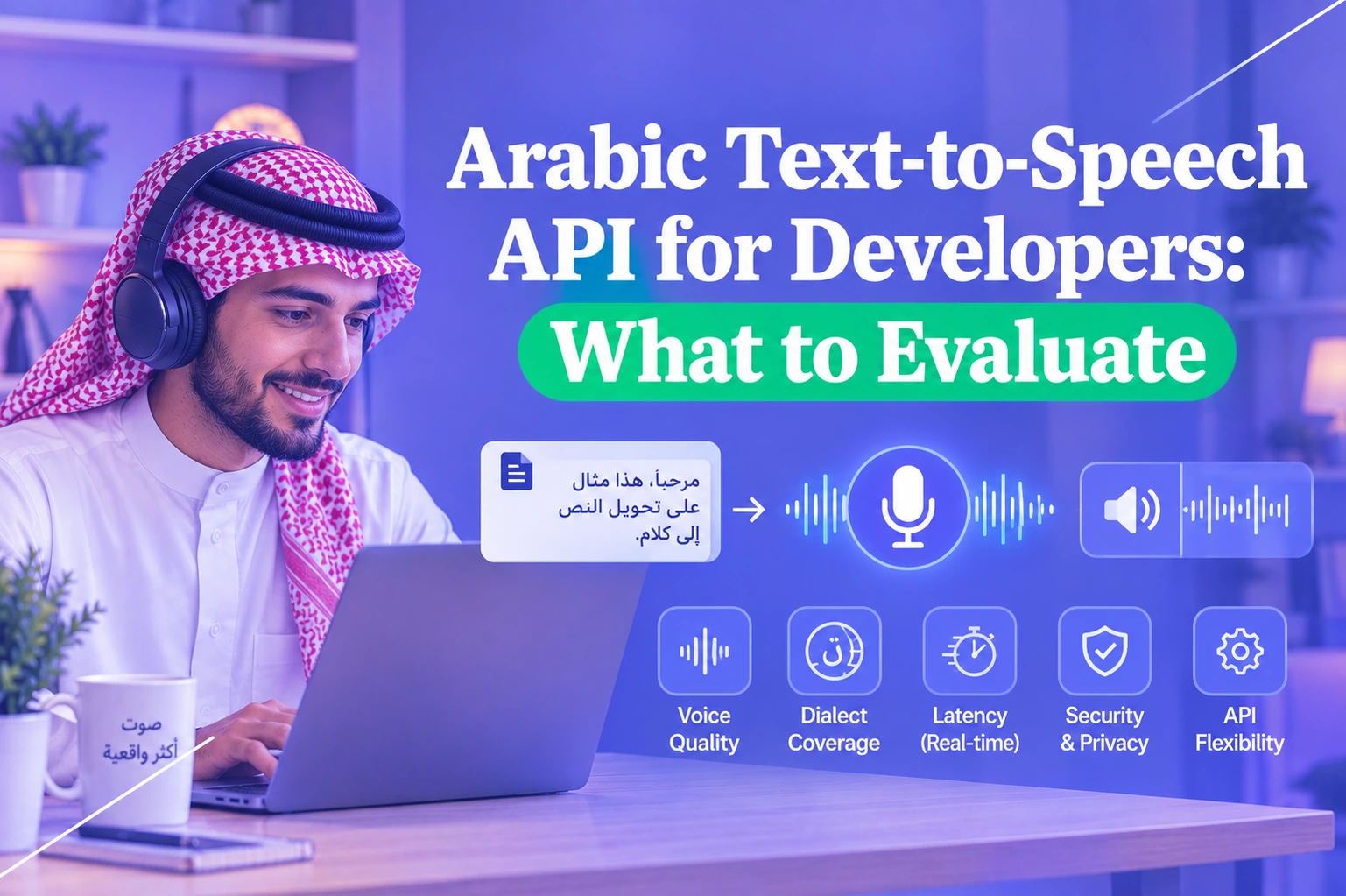
REST vs. streaming output. A REST endpoint that returns a complete audio file is fine for pre-generated content e-learning modules, IVR prompts recorded once and cached, narration rendered ahead of time. A conversational voice agent needs audio streamed back as it’s generated, typically over WebSocket, so playback can start before synthesis finishes. Building a voice agent against a REST-only TTS API means bolting on your own chunking and buffering logic, or living with a noticeable pause before the agent speaks.
Time-to-first-byte (TTFB), not just “fast.” Vendors advertise “low latency” without a shared definition. What matters for a voice agent is TTFB the delay between sending text and receiving the first audio chunk, not total synthesis time for a long passage. Ask for TTFB benchmarks on short utterances, the kind a voice agent actually sends turn by turn, not marketing demos built around long paragraphs.
Dialect and voice selection. Does the API expose Gulf, Egyptian, or Levantine voices as distinct options, or is “Arabic” a single Modern Standard Arabic (MSA) voice with no regional variants? For a UAE or Saudi consumer product, an MSA-only voice reads as formal and slightly foreign the equivalent of a customer service line that only speaks textbook, broadcast-register English. This is one of the more overlooked evaluation criteria because most vendor docs list “Arabic” as a single checkbox rather than breaking out which variety is actually being synthesized.
Voice cloning through the API, not just a dashboard. Some vendors treat cloning as a dashboard feature gated behind an enterprise sales conversation or an approval process; others expose it as a documented endpoint you can call programmatically. If a product needs custom or branded voices at scale, not just a handful set up manually by a vendor’s team API-level cloning is the difference between an automatable pipeline and a manual bottleneck every time a new voice is needed.
Diacritization as a controllable step, specific to Arabic. Arabic script is normally written without short-vowel diacritics (tashkīl), which means the same written word can be pronounced multiple ways depending on context, a structural ambiguity with no real equivalent in English TTS.
A synthesis engine has to resolve that ambiguity somehow, and for names, technical terms, or domain vocabulary, an automatic guess can land wrong. Whether a vendor exposes diacritization as its own inspectable or correctable step, rather than only handling it invisibly inside synthesis, matters more for Arabic than it would for almost any other language.
Output format and audio controls. Check supported formats (WAV, MP3, PCM, Opus), sample rate options, and whether SSML or an equivalent markup is supported for pronunciation control, pauses, and emphasis.
Authentication, SDKs, and spec publication. A single API key vs. OAuth flows, official SDKs vs. community wrappers, and for teams generating their own clients whether the vendor publishes an OpenAPI or AsyncAPI spec you can point a codegen tool at instead of hand-writing request and response types.
Rate limits and concurrency. Documented rate limits (requests per minute, concurrent streams) that you can plan capacity around, rather than limits you only discover in production.
Deployment model. Cloud-only is fine for most consumer apps. Government, banking, and healthcare integrations in the UAE and Saudi Arabia frequently require sovereign cloud (VPC), on-premises, or on-device deployment worth confirming before an architecture decision locks a product into a cloud-only vendor.







.webp)

.webp)





%20for%20Arabic%20Conversational%20AI%20%20%20.png)








.svg)
.svg)