المنتج
لتر 5 دقيقة

7 Best ElevenLabs™ Alternatives in 2026 (Tested & Compared)

التقنيات الصوتية بالذكاء الاصطناعي
المؤلف
ريم باشوش

تعزيز المستقبل باستخدام الذكاء الاصطناعي

انضم إلى النشرة الإخبارية للحصول على رؤى حول أحدث التقنيات المبنية في الإمارات العربية المتحدة

الوجبات السريعة الرئيسية

1

ElevenLabs' Arabic gap is structural. Training data skews predominantly English, so diacritics, hamza, and numerals can misrender in Arabic output, issues that voice settings alone don't resolve.

2

Dialect depth matters more than language count for UAE deployments. A single undifferentiated "Arabic" parameter doesn't distinguish Gulf, Egyptian, or Levantine speech patterns, which can affect how natural a voice agent feels to local users.

3

Data residency is worth checking with your compliance team before procurement. Organizations in regulated UAE sectors (finance, government, healthcare) should confirm their own data-handling obligations and verify any vendor's hosting location and certifications directly, rather than relying on a comparison article.

4

No single alternative wins every use case. Munsit leans toward Arabic-first, in-region deployments; Murf AI and PlayHT serve multilingual content teams; Intella and Nabrah serve enterprise and Saudi-specific voice agents respectively.

Most users do not leave ElevenLabs because the platform is weak; they leave because their requirements eventually stop matching its structure. As AI voice adoption expands across content creation, customer support, gaming, and real-time applications, many businesses look looking for alternatives that offer better scalability, lower generation costs, faster inference speeds, or more flexible commercial licensing. 

But several recurring friction points push users toward alternatives: Credits vanish fast on the Starter tier, the jump to Creator costs $22/month for features many workflows barely use, and real-time low-latency deployment remains friction-heavy for developers.

The need for alternatives has also grown because AI voice use cases themselves have changed. Many teams now prioritise ultra-low-latency voice agents, on-premise deployment, multilingual localisation, API flexibility, custom licensing, or cheaper long-form generation for audiobooks and dubbing, areas where specialised competitors often outperform general-purpose platforms. 


This article covers 7 tested ElevenLabs alternatives, each matched to a specific scenario, budget constraints, language coverage gaps, developer API needs, or real-time deployment, so you can switch with precision, not guesswork. 

Where ElevenLabs May Not Be the Right Fit?

ElevenLabs dominates global TTS conversations, but global rarely means regional. For businesses that want Arabic voice experiences in the UAE, three structural differences continue to surface after deployment, not before.

Here is where the platform consistently falls short:

1. The English Phonetic Bias Problem

ElevenLabs' models are trained predominantly on English data, and Arabic pays the price. Teams discover this post-integration:

  • Diacritics get misread or ignored entirely
  • Hamza's drop of words, altering meaning
  • Numerals render with English phonetics rather than Arabic ones

This is not a configuration issue; it is a training data issue, and no voice setting corrects it at the root.

2. Dialect Handling Is Inconsistent

Arabic is not one language in practice. Gulf Arabic, spoken across the UAE, Saudi Arabia, and Kuwait, differs from Egyptian or Levantine in rhythm, vowel sounds, and everyday vocabulary. Yet ElevenLabs offers a single undifferentiated "Arabic" parameter:

  • No native Gulf Arabic voice model
  • No dialect-level training on actual regional speech data

For a UAE brand running an IVR or voice agent, this is the difference between a customer feeling understood and simply hanging up.

3. The Data Sovereignty Gap

UAE government entities and financial institutions operating under sector-specific data residency requirements (e.g., Central Bank of UAE, DIFC, ADGM) may require voice data to be processed within UAE borders or on-premise. ElevenLabs infrastructure is US-based, which means:

  • Sensitive voice data must cross borders to be processed
  • Compliance clearance is required before deployment in regulated sectors
  • Procurement stalls before pilots even begin

This is some text inside of a div block.

What to Look for in an ElevenLabs Alternative

Not every ElevenLabs alternative solves the same problem. Before switching, evaluate any tool against these five criteria:

  • Voice naturalness at scale. A 30-second demo is not the same as a 20-minute training module. Pacing irregularities, missing breath patterns, and tonal drift only surface after extended output; test long-form before committing.
  • Latency profile. A sub-200ms response is non-negotiable for conversational agents. Content creators working in batch generation can tolerate higher latency without any real workflow impact.
  • Licensing clarity. Who legally owns the synthesised output? What commercial reuse rights apply at each tier? This is the criterion most comparison articles quietly skip and the one that creates legal exposure if ignored.
  • Language and accent depth. The headline count of supported languages matters less than whether accents within a language are actually controllable. Hindi alone has regionally distinct accent profiles; most tools flatten entirely.
  • Pricing predictability. Per-character, per-minute, and flat-tier models produce dramatically different cost curves at scale. Know which model you're buying into before your monthly output grows past a few hours.

With the evaluation criteria set, here's how the top alternatives actually compare.

This is some text inside of a div block.

Heading

Lorem ipsum dolor sit amet, consectetur adipiscing elit. Suspendisse varius enim in eros elementum tristique. Duis cursus, mi quis viverra ornare, eros dolor interdum nulla, ut commodo diam libero vitae erat. Aenean faucibus nibh et justo cursus id rutrum lorem imperdiet. Nunc ut sem vitae risus tristique posuere.

Lorem ipsum dolor sit amet, consectetur adipiscing elit. Suspendisse varius enim in eros elementum tristique. Duis cursus, mi quis viverra ornare, eros dolor interdum nulla, ut commodo diam libero vitae erat. Aenean faucibus nibh et justo cursus id rutrum lorem imperdiet. Nunc ut sem vitae risus tristique posuere.

Lorem ipsum dolor sit amet, consectetur adipiscing elit. Suspendisse varius enim in eros elementum tristique. Duis cursus, mi quis viverra ornare, eros dolor interdum nulla, ut commodo diam libero vitae erat. Aenean faucibus nibh et justo cursus id rutrum lorem imperdiet. Nunc ut sem vitae risus tristique posuere.

Lorem ipsum dolor sit amet, consectetur adipiscing elit. Suspendisse varius enim in eros elementum tristique. Duis cursus, mi quis viverra ornare, eros dolor interdum nulla, ut commodo diam libero vitae erat. Aenean faucibus nibh et justo cursus id rutrum lorem imperdiet. Nunc ut sem vitae risus tristique posuere.

7 Best ElevenLabs Alternatives in 2026

The seven tools listed below have been evaluated in terms of voice quality, latency, licensing, and cost predictability, so you can match the right tool to your specific use case instead of going with the top option on a generic list.

Here's how each one stacks up, starting with the strongest overall fit.

1. Munsit: Best ElevenLabs Alternative for Arabic Dialect Voice AI

If your use case involves Arabic-language content, Munsit is a specialised Arabic speech-to-text platform, one of the strongest alternatives for Arabic-language voice AI use cases particularly for organisations that require deep Arabic dialect coverage.

Munsit is a UAE-built Arabic Voice AI suite covering 25+ dialects, from Gulf Arabic to Moroccan Darija, with capabilities spanning real-time speech-to-text, natural Arabic text-to-speech, and voice cloning, built specifically for enterprise accuracy where generic multilingual models fall short. 

  • Voice quality and dialect depth. Where general-purpose multilingual models may offer broader language coverage, Munsit focuses specifically on Arabic dialect variation. For long-form narration in Arabic, this approach can help maintain consistency across longer Arabic-language recordings. 
  • Code-switching support. Munsit handles live mixed Arabic-English sentences in real time, the Hinglish equivalent problem for Arabic speakers, which is particularly valuable for applications involving frequent Arabic-English code-switching.
  • Developer API and deployment. Munsit provides a clean API with quickstart documentation; supports on-premise self-hosting for data-sensitive deployments; and is SOC 2 and GDPR compliant, which may suit organisations that require self-hosted deployment options or stricter data-governance controls. 
  • Honest limitation. Munsit is Arabic-first by design. If your content is English, Hindi, or any non-Arabic language, this is not your tool. The platform's primary strength is its focus on Arabic dialect coverage across more than 25 dialects.

Best for: Media production teams working in Arabic, GCC enterprise deployments, contact centres serving MENA audiences, and developers building Arabic-language voice agents.

2. Intella: Worth Evaluating for Enterprise Arabic Deployments

Intella is the most commercially validated Arabic speech intelligence company on this list. Founded in Egypt in 2021 by CEO Nour Taher and CTO Omar Mansour, it has since relocated its headquarters to Riyadh, Saudi Arabia, and raised a total of $16.9 million, with participation from 500 Global, Wa'ed Ventures (Saudi Aramco), Hala Ventures, Idrisi Ventures, and HearstLab.

  • Dialect coverage. Intella's models cover 25 Arabic dialects, including Khaleeji, Egyptian, Levantine, and Maghrebi, built specifically for enterprise accuracy where generic multilingual models fail.
  • Product suite. intellaCX handles call-center transcription and analytics. Ziila is Intella's Arabic-born conversational AI agent; it debuted in a real-world deployment with Jumia, powering voice-ordering for millions of customers in Egyptian Arabic, the first commercially deployed Arabic voice commerce system at scale.
  • Enterprise positioning. Serves finance, telecom, and government clients across MENA. API available for enterprise integration; contact sales for pricing.
  • Honest limitation. Intella is primarily an enterprise STT and conversational-agent platform, not a self-serve TTS studio for content creators. Pricing is enterprise-negotiated, not publicly listed.

Best for: GCC enterprises needing Arabic call-centre analytics, conversational AI agents, and dialect-accurate transcription across Egypt, Saudi Arabia, and the UAE.

3. Nabarati: Built for Arabic Content Creation and Dubbing

Nabarati (نبراتي) is a MENA-focused AI voice platform built specifically for Arabic content production, offering 1,000+ dialect tones and hundreds of diverse voices spanning Gulf dialects (Saudi, Emirati, Kuwaiti), Egyptian, Levantine (Syrian, Lebanese, Palestinian, Jordanian), Maghrebi (Moroccan, Algerian, Tunisian, Libyan), Iraqi, Yemeni, and more.

  • Arabic voice library. Nabarati offers what is arguably the largest dedicated Arabic voice library available today, with support for emotion control and voice cloning from short audio samples.
  • Audio production studio. Nabarati Studio combines voice generation, background music creation, mixing, and mastering in a single browser-based interface, purpose-built for Arabic content creators, educators, and marketers.
  • Voice cloning. Users can record a short voice sample and create a personal voice clone with high accuracy and natural tone, as described in Nabarati's official product pages.
  •  Commercial licensing. Paid plans may include commercial rights for advertising, marketing videos, podcasts, and media content.
  • Honest limitation. Nabarati is a consumer and creator-facing TTS platform, not an enterprise API or on-premise deployment solution. Detailed API documentation and data residency guarantees are not publicly available.

Best for: Arabic content creators, social media teams, educators, and marketers producing Arabic voiceovers, dubbing, or educational audio.

4. Resemble AI: Voice Cloning, Deepfake Detection & Enterprise Compliance

Resemble AI is a Santa Clara-based voice AI platform that combines high-quality TTS and voice cloning with a deepfake detection and watermarking suite, making it one of the most compliance-ready alternatives to ElevenLabs for enterprise and security-conscious teams.

Resemble AI’s open-source Chatterbox model has been benchmarked against leading closed-source TTS systems including ElevenLabs and is consistently preferred in side-by-side evaluations, according to Resemble AI’s Hugging Face model card. Chatterbox is MIT-licensed and available on GitHub and Hugging Face.

  • Voice cloning and TTS. Resemble AI supports zero-shot voice cloning from as little as 5–10 seconds of reference audio, with identity retained across 23 languages including Arabic. The Chatterbox Turbo model delivers sub-200ms time-to-first-speech for real-time voice agent deployments.
  • Deepfake detection and watermarking. Resemble Detect screens audio, video, and images for synthetic content in real time (under 300ms), battle-tested against 160+ generative AI models. Every output is automatically watermarked with PerTh neural watermarks, imperceptible, persistent through re-encoding, and verifiable on demand.
  • Developer API. One API with three delivery modes, WebSocket streaming (200ms TTFS) for conversational agents, HTTP streaming for longer-form content, and synchronous responses for notifications. Supports cloud, on-premise, and air-gapped deployment
  • Honest limitation. Resemble AI supports Arabic as part of its multilingual Chatterbox model, but it does not offer Arabic dialect differentiation (Gulf, Egyptian, Levantine). For teams whose primary use case is Arabic-dialect-specific content or MENA-focused voice agents, purpose-built Arabic platforms like Munsit or Nabarati are stronger fits.

Best for: Enterprises, developers, and security teams needing voice cloning with built-in deepfake detection and watermarking, compliant on-premise deployment, and multilingual TTS across 100+ languages.

5. PlayHT: Positioned for Multilingual Content at Scale

The main benefit of PlayHT is its coverage depth across languages. Teams creating content in several languages can choose between regional voice options without keeping separate models thanks to the 142 languages and regional accent variations.

  • Voice library. 600+ voices with significantly improved emotional range in PlayHT 3.0 over its predecessor.
  • API access. Available for production apps, though unlocking full API features requires a steep plan jump.
  • Pricing. A free tier is available; the creator plan is at $39/mo (annual), and the business plan is at $79.20/mo (annual).
  • Honest limitation. The UI is noticeably less polished than ElevenLabs, and the plan structure penalises developers who need API depth without enterprise budgets.

Best for: Global content teams, multilingual SaaS products, and marketing agencies producing localised audio at volume.

6. Murf AI: Geared Toward Video Voiceovers and E-Learning

Murf combines video sync, a voice changer, and royalty-free music into a single interface, functioning more as a voiceover studio than a voice API. This makes it distinctively suited to content production workflows where those tools are all needed.

  • Video sync. Align audio directly to a video timeline without external editing software, genuinely uncommon among TTS tools.
  • Voice changer. Record your own voice and output it as a polished AI voice, useful for creators who want consistency without a studio setup.
  • Pricing. Free tier (10 minutes); Creator at $19/user/mo; Business at $66/user/mo; enterprise pricing available. Rated 4.7/5 on G2.
  • Honest limitation. No real-time API; generation is slower than ElevenLabs, not suited to developer workflows.

Best for: E-learning teams, YouTubers, and corporate L&D departments.

7. Nabrah: Geared Toward Saudi-Focused Arabic Voice Agents

Nabrah is a Riyadh-based voice AI company founded in 2024 that provides TTS, STT, voice cloning, and AI-powered voice agents built for Arabic, with a particular focus on Saudi dialect and business automation workflows.

  • Voice agents. Nabrah's platform automates appointment scheduling, customer support, FAQ resolution, lead scoring, order confirmation, and feedback collection via voice. Agent and studio pricing are offered on separate transparent plans.
  • STT and TTS. Transcribes spoken Arabic into text with dialect awareness for captions, records, and AI workflows. Offers a simple developer API for integration. 
  • Pricing. Free tier available (no credit card required). Individual, growth, and production plans are available with transparent tiers. Contact Nabrah for enterprise pricing.
  • Honest limitation. Nabrah was founded in 2024; as of [June 2026], no public funding has been disclosed. Best suited for Saudi-market automation use cases; enterprise buyers should verify SLA and support terms before procurement. 

Best for: Saudi businesses and developers building automated voice interactions for customer service, real estate, healthcare scheduling, and retail.

The ElevenLabs gaps above are not isolated quirks; they point to a deeper, industry-wide problem that every global voice AI platform shares when entering the Arabic market.

The Arabic Voice AI Problem That All Global Tools Share

Arabic is one of the world's most linguistically complex languages and one of the most underserved by global AI infrastructure. Understanding why this gap exists at the architecture level, not just the feature level, helps teams set realistic expectations before selecting any platform.

1. The Training Data Problem

Every major TTS platform was built on predominantly English audio data. Arabic was added later, and the quality gap shows. Arabic poses unique challenges due to its complex morphology, optional diacritics, and wide dialectal variation, and publicly available Arabic datasets remain scarce compared to English. Default voices carry English phonetic bias into all languages due to training data composition; no dropdown setting fixes that.

2. Why Dialects Matter for the UAE Specifically

The UAE is linguistically complex: Emirati Gulf Arabic, Egyptian, Levantine, and North African dialects coexist daily. MSA will be understood, but not trusted. Failing to address distinct Arabic dialects creates significant engagement gaps, eroding trust and reducing conversions in the UAE and KSA markets. Gulf Arabic dominates consumer marketing, social media, and customer service; MSA is for formal documents, not IVR systems.

3. The Sovereignty Dimension

The UAE's PDPL (Federal Decree-Law No. 45 of 2021) restricts cross-border transfers of personal data unless approved safeguards are applied (e.g., standard contractual clauses, binding corporate rules), adequate protection exists in the destination country, or explicit consent is obtained. US-hosted platforms trigger those approvals. In-region infrastructure does not, and that is why it wins procurement decisions before voice quality is even evaluated.

Every platform covered in this guide solves a different problem; the section below maps each one to the use case it actually fits.

Munsit addresses gaps ElevenLabs was never built for: Arabic-native training across 25+ dialects, a dedicated Emirati TTS model tuned for local speech patterns, and UAE-based private or on-premise deployment for data sovereignty and compliance-sensitive organisations. Download the Munsit app today to experience Arabic voice AI built for the UAE and MENA region.

شاهد أداء Munsit في الكلام العربي الحقيقي

قم بتقييم تغطية اللهجة ومعالجة الضوضاء والنشر داخل المنطقة على البيانات التي تعكس عملائك.
اكتشف

How to Choose the Right ElevenLabs Alternative for Your Use Case

The right platform depends entirely on what you are building, who you are regulated by, and where your data can travel. Here is how to cut through the noise.

  • UAE government, finance, or healthcare: Evaluation starts and ends with data residency. Munsit offers UAE-region cloud deployment, private cloud, and fully on-premise deployment options for data sovereignty compliance, deployment, and a model trained on Gulf and Emirati Arabic. For your requirements, it is the right tool, full stop.
  • Content creators, marketers, e-learning teams: Murf AI gives you the fastest path from script to published Arabic audio. For agencies producing content across multiple Arabic dialects, PlayHT's language breadth makes it the stronger choice.
  • Engineering teams building Arabic voice products: You likely need two tools, Munsit for dialect-accurate Arabic speech-to-text input, paired with Munsit's Faseeh TTS or Nabrah for low-latency output. Intella for enterprise transcription and conversational agents. 
  • Saudi-market automation: Nabrah provides voice agent infrastructure tailored to Saudi dialect and business workflows. Intella, with its Riyadh HQ and Saudi enterprise clients, is the stronger choice for regulated sectors.

التعليمات

What is the best ElevenLabs alternative for Arabic in the UAE?
Does ElevenLabs support Gulf Arabic or the Emirati dialect?
Which AI voice tools comply with UAE data sovereignty requirements?

Powering the Future with AI

Join our newsletter for insights on cutting-edge technology built in the UAE
Thank you! Your submission has been received!
Oops! Something went wrong while submitting the form.
آخر تحديث:
June 30, 2026

7 Best ElevenLabs™ Alternatives in 2026 (Tested & Compared)

المنتج
التقنيات الصوتية بالذكاء الاصطناعي
المؤلف
سارة تركي
ريم باشوش
قراءة في 5 دقائق

اطرح الذكاء الاصطناعي الصوتي العربي في الإنتاج

تحويل الكلام إلى نص والنص إلى كلام باللغة العربية بمستوى أصلي
مصمم لحكومات وشركات دول مجلس التعاون الخليجي
استضافة محلية وسحابة سيادية
احجز عرضاً توضيحياً
شكرًا لك! لقد تم استلام طلبك!
عذرًا! حدث خطأ ما أثناء إرسال النموذج.

أبرز النقاط

ElevenLabs' Arabic gap is structural. Training data skews predominantly English, so diacritics, hamza, and numerals can misrender in Arabic output, issues that voice settings alone don't resolve.

Dialect depth matters more than language count for UAE deployments. A single undifferentiated "Arabic" parameter doesn't distinguish Gulf, Egyptian, or Levantine speech patterns, which can affect how natural a voice agent feels to local users.

Data residency is worth checking with your compliance team before procurement. Organizations in regulated UAE sectors (finance, government, healthcare) should confirm their own data-handling obligations and verify any vendor's hosting location and certifications directly, rather than relying on a comparison article.

No single alternative wins every use case. Munsit leans toward Arabic-first, in-region deployments; Murf AI and PlayHT serve multilingual content teams; Intella and Nabrah serve enterprise and Saudi-specific voice agents respectively.

Test with your own script and dialect before committing. A polished demo reel isn't a substitute for running your actual content through a tool in your target dialect.

Most users do not leave ElevenLabs because the platform is weak; they leave because their requirements eventually stop matching its structure. As AI voice adoption expands across content creation, customer support, gaming, and real-time applications, many businesses look looking for alternatives that offer better scalability, lower generation costs, faster inference speeds, or more flexible commercial licensing. 

But several recurring friction points push users toward alternatives: Credits vanish fast on the Starter tier, the jump to Creator costs $22/month for features many workflows barely use, and real-time low-latency deployment remains friction-heavy for developers.

The need for alternatives has also grown because AI voice use cases themselves have changed. Many teams now prioritise ultra-low-latency voice agents, on-premise deployment, multilingual localisation, API flexibility, custom licensing, or cheaper long-form generation for audiobooks and dubbing, areas where specialised competitors often outperform general-purpose platforms. 


This article covers 7 tested ElevenLabs alternatives, each matched to a specific scenario, budget constraints, language coverage gaps, developer API needs, or real-time deployment, so you can switch with precision, not guesswork. 

Where ElevenLabs May Not Be the Right Fit?

ElevenLabs dominates global TTS conversations, but global rarely means regional. For businesses that want Arabic voice experiences in the UAE, three structural differences continue to surface after deployment, not before.

Here is where the platform consistently falls short:

1. The English Phonetic Bias Problem

ElevenLabs' models are trained predominantly on English data, and Arabic pays the price. Teams discover this post-integration:

  • Diacritics get misread or ignored entirely
  • Hamza's drop of words, altering meaning
  • Numerals render with English phonetics rather than Arabic ones

This is not a configuration issue; it is a training data issue, and no voice setting corrects it at the root.

2. Dialect Handling Is Inconsistent

Arabic is not one language in practice. Gulf Arabic, spoken across the UAE, Saudi Arabia, and Kuwait, differs from Egyptian or Levantine in rhythm, vowel sounds, and everyday vocabulary. Yet ElevenLabs offers a single undifferentiated "Arabic" parameter:

  • No native Gulf Arabic voice model
  • No dialect-level training on actual regional speech data

For a UAE brand running an IVR or voice agent, this is the difference between a customer feeling understood and simply hanging up.

3. The Data Sovereignty Gap

UAE government entities and financial institutions operating under sector-specific data residency requirements (e.g., Central Bank of UAE, DIFC, ADGM) may require voice data to be processed within UAE borders or on-premise. ElevenLabs infrastructure is US-based, which means:

  • Sensitive voice data must cross borders to be processed
  • Compliance clearance is required before deployment in regulated sectors
  • Procurement stalls before pilots even begin

Lorem ipsum dolor
لوريم إيبسوم ألم
لوريم إيبسوم ألم
لوريم إيبسوم ألم
لوريم إيبسوم ألم
لوريم إيبسوم ألم
لوريم إيبسوم ألم
لوريم إيبسوم ألم
لوريم إيبسوم ألم
لوريم إيبسوم ألم
لوريم إيبسوم ألم
لوريم إيبسوم ألم
لوريم إيبسوم ألم
لوريم إيبسوم ألم
لوريم إيبسوم ألم
لوريم إيبسوم ألم
لوريم إيبسوم ألم
لوريم إيبسوم ألم
لوريم إيبسوم ألم
لوريم إيبسوم ألم
لوريم إيبسوم ألم
Lorem ipsum dolor
Lorem ipsum dolor
Lorem ipsum dolor
Lorem ipsum dolor
Lorem ipsum dolor
Lorem ipsum dolor
Lorem ipsum dolor
Lorem ipsum dolor
Lorem ipsum dolor
Lorem ipsum dolor
Lorem ipsum dolor

What to Look for in an ElevenLabs Alternative

فهم أصول هلوسات الذكاء الاصطناعي هو الخطوة الأولى نحو التخفيف منها. هذه الظاهرة ليست مشكلة واحدة، بل هي قضية معقدة ذات عوامل متعددة تساهم فيها.

1

أوجه القصور في بيانات التدريب

Not every ElevenLabs alternative solves the same problem. Before switching, evaluate any tool against these five criteria:

  • Voice naturalness at scale. A 30-second demo is not the same as a 20-minute training module. Pacing irregularities, missing breath patterns, and tonal drift only surface after extended output; test long-form before committing.
  • Latency profile. A sub-200ms response is non-negotiable for conversational agents. Content creators working in batch generation can tolerate higher latency without any real workflow impact.
  • Licensing clarity. Who legally owns the synthesised output? What commercial reuse rights apply at each tier? This is the criterion most comparison articles quietly skip and the one that creates legal exposure if ignored.
  • Language and accent depth. The headline count of supported languages matters less than whether accents within a language are actually controllable. Hindi alone has regionally distinct accent profiles; most tools flatten entirely.
  • Pricing predictability. Per-character, per-minute, and flat-tier models produce dramatically different cost curves at scale. Know which model you're buying into before your monthly output grows past a few hours.

With the evaluation criteria set, here's how the top alternatives actually compare.

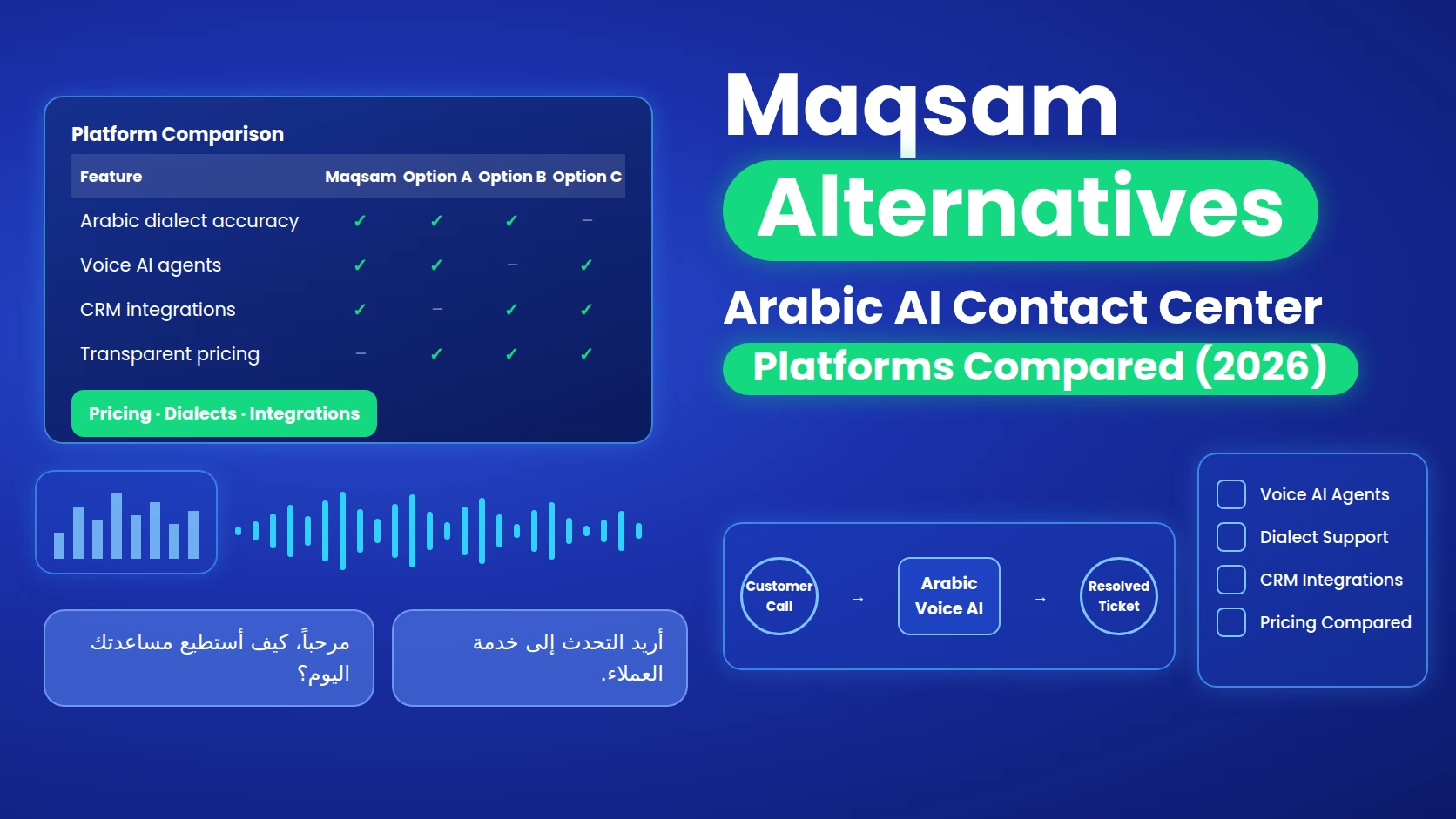
Quick Comparison Table

Before discussing each tool in detail, here's how the seven alternatives compare across the criteria that matter most.

Purple Table — Arabic Voice AI Tools Comparison
Tool Best For Languages Arabic / Dialect Depth Key Differentiator Starting Price
Munsit Arabic voice AI — UAE & MENA Arabic + 25+ 25+ dialects — Gulf, Emirati, Levantine, Egyptian, Maghrebi Only STT/TTS built from scratch for Arabic; dialect-level accuracy Contact for API pricing
Intella Enterprise Arabic STT + conversational agents Arabic 25+ dialects 25+ dialects incl. Khaleeji, Egyptian, Levantine Series A-backed ($16.9M); Ziila digital human; intellaCX analytics Contact sales
Nabarati Arabic content creators & dubbing Arabic dialects 1,000+ dialect tones; Gulf, Egyptian, Levantine, Maghrebi, Iraqi Largest Arabic voice library; full audio production studio; emotion control Free tier available, Basic plan $10/month
Resemble AI Enterprise & branded voice cloning 23 languages No dialect control Advanced voice cloning; custom model training $0.0005/sec
PlayHT Global multilingual content creation 142+ languages Arabic MSA; no dialect control Large language count; PlayDialogArabic model; strong cloning Free; Creator $39/mo
Murf AI Video voiceovers, e-learning & API 20+ languages Arabic MSA only; no dialect depth Studio + Falcon API (55ms latency); 4.7/5 on G2 (1,000+ reviews) Free; from $19/mo
Nabrah Saudi-focused voice agents Arabic + English Saudi dialect focus Voice agent automation; STT + TTS + cloning; developer API Free tier; paid plans start from $10.62/month

With the criteria clear, here's how the seven alternatives actually perform, starting with the strongest overall fit.

2

أوجه القصور في بيانات التدريب

العامل الأكثر أهمية في هلوسات الذكاء الاصطناعي هو البيانات التي تُدرّب عليها النماذج. تتعلم النماذج اللغوية الكبيرة (LLMs) من مجموعات بيانات ضخمة مجمعة من الإنترنت، والتي تحتوي على مزيج من المعلومات الواقعية والآراء والمعلومات المضللة والتحيزات. يمكن أن تؤدي العديد من المشكلات المحددة المتعلقة بالبيانات إلى الهلوسات:

حالات استخدام الذكاء الاصطناعي الصوتي العربي في الشركات لعام 2025

يفتح التحول نحو أنظمة التعرف التلقائي على الكلام (ASR) العربية التي تراعي اللهجات، آفاقاً جديدة لتطبيقات الشركات في جميع أنحاء منطقة الخليج والشرق الأوسط وشمال إفريقيا. تتجاوز المؤسسات الآن النسخ الأساسي لتصل إلى تحليلات كلام عربية متطورة.

تشهد تقنية الكلام العربية تطوراً سريعاً في عام 2025، مدفوعة بالنماذج اللغوية الضخمة متعددة اللغات والنماذج الأساسية الجديدة التي تركز على اللغة العربية.

تتقدم تقنية الكلام العربية بسرعة في عام 2025، مدفوعة بالنماذج اللغوية الضخمة متعددة اللغات ونماذج الأساس الجديدة المرتكزة على اللغة العربية.

تتقدم تقنية الكلام العربية بسرعة في عام 2025، مدفوعة بالنماذج اللغوية الضخمة متعددة اللغات ونماذج الأساس الجديدة المرتكزة على اللغة العربية.

تتقدم تقنية الكلام العربية بسرعة في عام 2025، مدفوعة بالنماذج اللغوية الضخمة متعددة اللغات ونماذج الأساس الجديدة المرتكزة على اللغة العربية.

7 Best ElevenLabs Alternatives in 2026

فهم أصول هلوسات الذكاء الاصطناعي هو الخطوة الأولى نحو التخفيف منها. هذه الظاهرة ليست مشكلة واحدة بل هي قضية معقدة ذات عوامل متعددة تساهم فيها.

1

أوجه القصور في بيانات التدريب

The seven tools listed below have been evaluated in terms of voice quality, latency, licensing, and cost predictability, so you can match the right tool to your specific use case instead of going with the top option on a generic list.

Here's how each one stacks up, starting with the strongest overall fit.

1. Munsit: Best ElevenLabs Alternative for Arabic Dialect Voice AI

If your use case involves Arabic-language content, Munsit is a specialised Arabic speech-to-text platform, one of the strongest alternatives for Arabic-language voice AI use cases particularly for organisations that require deep Arabic dialect coverage.

Munsit is a UAE-built Arabic Voice AI suite covering 25+ dialects, from Gulf Arabic to Moroccan Darija, with capabilities spanning real-time speech-to-text, natural Arabic text-to-speech, and voice cloning, built specifically for enterprise accuracy where generic multilingual models fall short. 

  • Voice quality and dialect depth. Where general-purpose multilingual models may offer broader language coverage, Munsit focuses specifically on Arabic dialect variation. For long-form narration in Arabic, this approach can help maintain consistency across longer Arabic-language recordings. 
  • Code-switching support. Munsit handles live mixed Arabic-English sentences in real time, the Hinglish equivalent problem for Arabic speakers, which is particularly valuable for applications involving frequent Arabic-English code-switching.
  • Developer API and deployment. Munsit provides a clean API with quickstart documentation; supports on-premise self-hosting for data-sensitive deployments; and is SOC 2 and GDPR compliant, which may suit organisations that require self-hosted deployment options or stricter data-governance controls. 
  • Honest limitation. Munsit is Arabic-first by design. If your content is English, Hindi, or any non-Arabic language, this is not your tool. The platform's primary strength is its focus on Arabic dialect coverage across more than 25 dialects.

Best for: Media production teams working in Arabic, GCC enterprise deployments, contact centres serving MENA audiences, and developers building Arabic-language voice agents.

2. Intella: Worth Evaluating for Enterprise Arabic Deployments

Intella is the most commercially validated Arabic speech intelligence company on this list. Founded in Egypt in 2021 by CEO Nour Taher and CTO Omar Mansour, it has since relocated its headquarters to Riyadh, Saudi Arabia, and raised a total of $16.9 million, with participation from 500 Global, Wa'ed Ventures (Saudi Aramco), Hala Ventures, Idrisi Ventures, and HearstLab.

  • Dialect coverage. Intella's models cover 25 Arabic dialects, including Khaleeji, Egyptian, Levantine, and Maghrebi, built specifically for enterprise accuracy where generic multilingual models fail.
  • Product suite. intellaCX handles call-center transcription and analytics. Ziila is Intella's Arabic-born conversational AI agent; it debuted in a real-world deployment with Jumia, powering voice-ordering for millions of customers in Egyptian Arabic, the first commercially deployed Arabic voice commerce system at scale.
  • Enterprise positioning. Serves finance, telecom, and government clients across MENA. API available for enterprise integration; contact sales for pricing.
  • Honest limitation. Intella is primarily an enterprise STT and conversational-agent platform, not a self-serve TTS studio for content creators. Pricing is enterprise-negotiated, not publicly listed.

Best for: GCC enterprises needing Arabic call-centre analytics, conversational AI agents, and dialect-accurate transcription across Egypt, Saudi Arabia, and the UAE.

3. Nabarati: Built for Arabic Content Creation and Dubbing

Nabarati (نبراتي) is a MENA-focused AI voice platform built specifically for Arabic content production, offering 1,000+ dialect tones and hundreds of diverse voices spanning Gulf dialects (Saudi, Emirati, Kuwaiti), Egyptian, Levantine (Syrian, Lebanese, Palestinian, Jordanian), Maghrebi (Moroccan, Algerian, Tunisian, Libyan), Iraqi, Yemeni, and more.

  • Arabic voice library. Nabarati offers what is arguably the largest dedicated Arabic voice library available today, with support for emotion control and voice cloning from short audio samples.
  • Audio production studio. Nabarati Studio combines voice generation, background music creation, mixing, and mastering in a single browser-based interface, purpose-built for Arabic content creators, educators, and marketers.
  • Voice cloning. Users can record a short voice sample and create a personal voice clone with high accuracy and natural tone, as described in Nabarati's official product pages.
  •  Commercial licensing. Paid plans may include commercial rights for advertising, marketing videos, podcasts, and media content.
  • Honest limitation. Nabarati is a consumer and creator-facing TTS platform, not an enterprise API or on-premise deployment solution. Detailed API documentation and data residency guarantees are not publicly available.

Best for: Arabic content creators, social media teams, educators, and marketers producing Arabic voiceovers, dubbing, or educational audio.

4. Resemble AI: Voice Cloning, Deepfake Detection & Enterprise Compliance

Resemble AI is a Santa Clara-based voice AI platform that combines high-quality TTS and voice cloning with a deepfake detection and watermarking suite, making it one of the most compliance-ready alternatives to ElevenLabs for enterprise and security-conscious teams.

Resemble AI’s open-source Chatterbox model has been benchmarked against leading closed-source TTS systems including ElevenLabs and is consistently preferred in side-by-side evaluations, according to Resemble AI’s Hugging Face model card. Chatterbox is MIT-licensed and available on GitHub and Hugging Face.

  • Voice cloning and TTS. Resemble AI supports zero-shot voice cloning from as little as 5–10 seconds of reference audio, with identity retained across 23 languages including Arabic. The Chatterbox Turbo model delivers sub-200ms time-to-first-speech for real-time voice agent deployments.
  • Deepfake detection and watermarking. Resemble Detect screens audio, video, and images for synthetic content in real time (under 300ms), battle-tested against 160+ generative AI models. Every output is automatically watermarked with PerTh neural watermarks, imperceptible, persistent through re-encoding, and verifiable on demand.
  • Developer API. One API with three delivery modes, WebSocket streaming (200ms TTFS) for conversational agents, HTTP streaming for longer-form content, and synchronous responses for notifications. Supports cloud, on-premise, and air-gapped deployment
  • Honest limitation. Resemble AI supports Arabic as part of its multilingual Chatterbox model, but it does not offer Arabic dialect differentiation (Gulf, Egyptian, Levantine). For teams whose primary use case is Arabic-dialect-specific content or MENA-focused voice agents, purpose-built Arabic platforms like Munsit or Nabarati are stronger fits.

Best for: Enterprises, developers, and security teams needing voice cloning with built-in deepfake detection and watermarking, compliant on-premise deployment, and multilingual TTS across 100+ languages.

5. PlayHT: Positioned for Multilingual Content at Scale

The main benefit of PlayHT is its coverage depth across languages. Teams creating content in several languages can choose between regional voice options without keeping separate models thanks to the 142 languages and regional accent variations.

  • Voice library. 600+ voices with significantly improved emotional range in PlayHT 3.0 over its predecessor.
  • API access. Available for production apps, though unlocking full API features requires a steep plan jump.
  • Pricing. A free tier is available; the creator plan is at $39/mo (annual), and the business plan is at $79.20/mo (annual).
  • Honest limitation. The UI is noticeably less polished than ElevenLabs, and the plan structure penalises developers who need API depth without enterprise budgets.

Best for: Global content teams, multilingual SaaS products, and marketing agencies producing localised audio at volume.

6. Murf AI: Geared Toward Video Voiceovers and E-Learning

Murf combines video sync, a voice changer, and royalty-free music into a single interface, functioning more as a voiceover studio than a voice API. This makes it distinctively suited to content production workflows where those tools are all needed.

  • Video sync. Align audio directly to a video timeline without external editing software, genuinely uncommon among TTS tools.
  • Voice changer. Record your own voice and output it as a polished AI voice, useful for creators who want consistency without a studio setup.
  • Pricing. Free tier (10 minutes); Creator at $19/user/mo; Business at $66/user/mo; enterprise pricing available. Rated 4.7/5 on G2.
  • Honest limitation. No real-time API; generation is slower than ElevenLabs, not suited to developer workflows.

Best for: E-learning teams, YouTubers, and corporate L&D departments.

7. Nabrah: Geared Toward Saudi-Focused Arabic Voice Agents

Nabrah is a Riyadh-based voice AI company founded in 2024 that provides TTS, STT, voice cloning, and AI-powered voice agents built for Arabic, with a particular focus on Saudi dialect and business automation workflows.

  • Voice agents. Nabrah's platform automates appointment scheduling, customer support, FAQ resolution, lead scoring, order confirmation, and feedback collection via voice. Agent and studio pricing are offered on separate transparent plans.
  • STT and TTS. Transcribes spoken Arabic into text with dialect awareness for captions, records, and AI workflows. Offers a simple developer API for integration. 
  • Pricing. Free tier available (no credit card required). Individual, growth, and production plans are available with transparent tiers. Contact Nabrah for enterprise pricing.
  • Honest limitation. Nabrah was founded in 2024; as of [June 2026], no public funding has been disclosed. Best suited for Saudi-market automation use cases; enterprise buyers should verify SLA and support terms before procurement. 

Best for: Saudi businesses and developers building automated voice interactions for customer service, real estate, healthcare scheduling, and retail.

The ElevenLabs gaps above are not isolated quirks; they point to a deeper, industry-wide problem that every global voice AI platform shares when entering the Arabic market.

2

أوجه القصور في بيانات التدريب

أكبر عامل مساهم في هلوسات الذكاء الاصطناعي هو البيانات التي تُدرب عليها النماذج. تتعلم نماذج اللغة الكبيرة (LLMs) من مجموعات بيانات ضخمة مجمعة من الإنترنت، والتي تحتوي على مزيج من المعلومات الواقعية والآراء والمعلومات المضللة والتحيزات. يمكن أن تؤدي العديد من المشكلات المحددة المتعلقة بالبيانات إلى الهلوسات:

حالات استخدام المؤسسات للذكاء الاصطناعي الصوتي العربي في عام 2025

يفتح الانتقال إلى أنظمة التعرف التلقائي على الكلام (ASR) العربية المدركة للهجات موجة جديدة من تطبيقات المؤسسات عبر مناطق مجلس التعاون الخليجي والشرق الأوسط وشمال إفريقيا. تتجاوز المؤسسات الآن النسخ الأساسي لتصل إلى تحليلات الكلام العربية المتطورة.

تتقدم تقنية الكلام العربية بسرعة في عام 2025، مدفوعة بالنماذج اللغوية الضخمة متعددة اللغات ونماذج الأساس الجديدة المرتكزة على اللغة العربية.

تتقدم تقنية الكلام العربية بسرعة في عام 2025، مدفوعة بالنماذج اللغوية الضخمة متعددة اللغات ونماذج الأساس الجديدة المرتكزة على اللغة العربية.

تتقدم تقنية الكلام العربية بسرعة في عام 2025، مدفوعة بالنماذج اللغوية الضخمة متعددة اللغات ونماذج الأساس الجديدة المرتكزة على اللغة العربية.

تتقدم تقنية الكلام العربية بسرعة في عام 2025، مدفوعة بالنماذج اللغوية الضخمة متعددة اللغات ونماذج الأساس الجديدة المرتكزة على اللغة العربية.

بناء أنظمة ذكاء اصطناعي أفضل يتطلب المنهجية الصحيحة

نحن نساعدك في تصميم حلول مخصصة، وبناء مسارات البيانات (Data Pipelines)، وتقديم ذكاء اصطناعي عربي متطور.

The Arabic Voice AI Problem That All Global Tools Share

فهم أصول هلوسات الذكاء الاصطناعي هو الخطوة الأولى نحو التخفيف منها. هذه الظاهرة ليست مشكلة واحدة بل هي قضية معقدة ذات عوامل متعددة تساهم فيها.

1

أوجه القصور في بيانات التدريب

Arabic is one of the world's most linguistically complex languages and one of the most underserved by global AI infrastructure. Understanding why this gap exists at the architecture level, not just the feature level, helps teams set realistic expectations before selecting any platform.

1. The Training Data Problem

Every major TTS platform was built on predominantly English audio data. Arabic was added later, and the quality gap shows. Arabic poses unique challenges due to its complex morphology, optional diacritics, and wide dialectal variation, and publicly available Arabic datasets remain scarce compared to English. Default voices carry English phonetic bias into all languages due to training data composition; no dropdown setting fixes that.

2. Why Dialects Matter for the UAE Specifically

The UAE is linguistically complex: Emirati Gulf Arabic, Egyptian, Levantine, and North African dialects coexist daily. MSA will be understood, but not trusted. Failing to address distinct Arabic dialects creates significant engagement gaps, eroding trust and reducing conversions in the UAE and KSA markets. Gulf Arabic dominates consumer marketing, social media, and customer service; MSA is for formal documents, not IVR systems.

3. The Sovereignty Dimension

The UAE's PDPL (Federal Decree-Law No. 45 of 2021) restricts cross-border transfers of personal data unless approved safeguards are applied (e.g., standard contractual clauses, binding corporate rules), adequate protection exists in the destination country, or explicit consent is obtained. US-hosted platforms trigger those approvals. In-region infrastructure does not, and that is why it wins procurement decisions before voice quality is even evaluated.

Every platform covered in this guide solves a different problem; the section below maps each one to the use case it actually fits.

2

أوجه القصور في بيانات التدريب

المساهم الأكبر في هلوسات الذكاء الاصطناعي هو البيانات التي تُدرّب عليها النماذج. تتعلم النماذج اللغوية الكبيرة (LLMs) من مجموعات بيانات ضخمة مجمعة من الإنترنت، والتي تحتوي على مزيج من المعلومات الواقعية والآراء والمعلومات المضللة والتحيزات. يمكن أن تؤدي عدة مشكلات محددة متعلقة بالبيانات إلى الهلوسات:

Munsit addresses gaps ElevenLabs was never built for: Arabic-native training across 25+ dialects, a dedicated Emirati TTS model tuned for local speech patterns, and UAE-based private or on-premise deployment for data sovereignty and compliance-sensitive organisations. Download the Munsit app today to experience Arabic voice AI built for the UAE and MENA region.

حالات الاستخدام المؤسسية للذكاء الاصطناعي الصوتي العربي في عام 2025

يفتح الانتقال إلى تقنية التعرف التلقائي على الكلام (ASR) للغة العربية المدركة للهجات آفاقًا جديدة لتطبيقات الشركات في جميع أنحاء منطقة الخليج والشرق الأوسط وشمال إفريقيا. تتجاوز المؤسسات النسخ الأساسي لتصل إلى تحليلات الكلام العربية المتطورة.

تتطور تقنية الكلام العربية بسرعة في عام 2025، مدفوعة بالنماذج اللغوية الضخمة متعددة اللغات والنماذج التأسيسية الجديدة المرتكزة على اللغة العربية.

تتطور تقنية الكلام العربية بسرعة في عام 2025، مدفوعة بالنماذج اللغوية الضخمة متعددة اللغات والنماذج التأسيسية الجديدة المرتكزة على اللغة العربية.

تتطور تقنية الكلام العربية بسرعة في عام 2025، مدفوعة بالنماذج اللغوية الضخمة متعددة اللغات والنماذج التأسيسية الجديدة المرتكزة على اللغة العربية.

تتطور تقنية الكلام العربية بسرعة في عام 2025، مدفوعة بالنماذج اللغوية الضخمة متعددة اللغات والنماذج التأسيسية الجديدة المرتكزة على اللغة العربية.

How to Choose the Right ElevenLabs Alternative for Your Use Case

يُعد فهم أصول هلوسات الذكاء الاصطناعي الخطوة الأولى نحو التخفيف منها. هذه الظاهرة ليست مشكلة واحدة بل قضية معقدة ذات عوامل متعددة تساهم فيها.

1

أوجه القصور في بيانات التدريب

The right platform depends entirely on what you are building, who you are regulated by, and where your data can travel. Here is how to cut through the noise.

  • UAE government, finance, or healthcare: Evaluation starts and ends with data residency. Munsit offers UAE-region cloud deployment, private cloud, and fully on-premise deployment options for data sovereignty compliance, deployment, and a model trained on Gulf and Emirati Arabic. For your requirements, it is the right tool, full stop.
  • Content creators, marketers, e-learning teams: Murf AI gives you the fastest path from script to published Arabic audio. For agencies producing content across multiple Arabic dialects, PlayHT's language breadth makes it the stronger choice.
  • Engineering teams building Arabic voice products: You likely need two tools, Munsit for dialect-accurate Arabic speech-to-text input, paired with Munsit's Faseeh TTS or Nabrah for low-latency output. Intella for enterprise transcription and conversational agents. 
  • Saudi-market automation: Nabrah provides voice agent infrastructure tailored to Saudi dialect and business workflows. Intella, with its Riyadh HQ and Saudi enterprise clients, is the stronger choice for regulated sectors.
2

أوجه القصور في بيانات التدريب

المساهم الأكبر في هلوسات الذكاء الاصطناعي هو البيانات التي تُدرّب عليها النماذج. تتعلم النماذج اللغوية الكبيرة (LLMs) من مجموعات بيانات ضخمة مجمعة من الإنترنت، والتي تحتوي على مزيج من المعلومات الواقعية والآراء والمعلومات المضللة والتحيزات. يمكن أن تؤدي عدة مشكلات محددة متعلقة بالبيانات إلى الهلوسات:

حالات الاستخدام المؤسسية للذكاء الاصطناعي الصوتي العربي في عام 2025

يفتح الانتقال إلى تقنية التعرف التلقائي على الكلام (ASR) للغة العربية المدركة للهجات آفاقًا جديدة لتطبيقات الشركات في جميع أنحاء منطقة الخليج والشرق الأوسط وشمال إفريقيا. تتجاوز المؤسسات النسخ الأساسي لتصل إلى تحليلات الكلام العربية المتطورة.

تتطور تقنية الكلام العربية بسرعة في عام 2025، مدفوعة بالنماذج اللغوية الضخمة متعددة اللغات والنماذج التأسيسية الجديدة المرتكزة على اللغة العربية.

تتطور تقنية الكلام العربية بسرعة في عام 2025، مدفوعة بالنماذج اللغوية الضخمة متعددة اللغات والنماذج التأسيسية الجديدة المرتكزة على اللغة العربية.

تتقدم تقنية الكلام العربية بسرعة في عام 2025، مدفوعة بالنماذج اللغوية المتعددة الضخمة والنماذج التأسيسية الجديدة المرتكزة على اللغة العربية.

تتقدم تقنية الكلام العربية بسرعة في عام 2025، مدفوعة بالنماذج اللغوية المتعددة الضخمة والنماذج التأسيسية الجديدة المرتكزة على اللغة العربية.

Conclusion

Understanding the origins of AI hallucinations is the first step toward mitigating them. The phenomenon is not a single problem but rather a complex issue with multiple contributing factors.

1

Training Data Deficiencies

No single ElevenLabs alternative fits every use case, but for UAE teams, the evaluation should start with a question Western comparison articles never ask: does this tool actually understand how Arabic is spoken here?

ElevenLabs is excellent for English-first workflows. For teams where dialect accuracy, data sovereignty, and in-region deployment are live requirements, purpose-built tools outperform general-purpose competitors in production, consistently.

Munsit is the clearest choice where Arabic is the primary deployment language and data governance is non-negotiable. Murf AI and PlayHT serve multilingual content workflows. 

The best way to validate any tool is not a demo; it is your script, your dialect, and your audience.

Hear the difference Gulf Arabic actually sounds like in practice.

Try Munsit for free; no integration is required. Run your script, hear your dialect, and decide with your own ears.

Legal Disclaimer: This article is for informational purposes only and does not constitute legal advice. UAE data protection, telecoms, and sector-specific regulations may change; consult qualified legal counsel before deploying AI voice solutions in regulated UAE environments. Verify all vendor claims (hosting regions, compliance certifications, licensing terms) through signed agreements and vendor documentation before procurement.

2

Training Data Deficiencies

The most significant contributor to AI hallucinations is the data on which the models are trained. LLMs learn from vast datasets scraped from the internet, which contain a mixture of factual information, opinions, misinformation, and biases. Several specific data-related issues can lead to hallucinations:

Enterprise Use Cases for Arabic Voice AI in 2025

The move to dialect-aware Arabic ASR is unlocking a new wave of enterprise applications across the GCC and MENA regions. Organizations are moving beyond basic transcription to sophisticated Arabic speech analytics.

Arabic speech technology is rapidly advancing in 2025, driven by massive multilingual models and new Arabic-centric foundation models.

Arabic speech technology is rapidly advancing in 2025, driven by massive multilingual models and new Arabic-centric foundation models.

Arabic speech technology is rapidly advancing in 2025, driven by massive multilingual models and new Arabic-centric foundation models.

Arabic speech technology is rapidly advancing in 2025, driven by massive multilingual models and new Arabic-centric foundation models.

Understanding the origins of AI hallucinations is the first step toward mitigating them. The phenomenon is not a single problem but rather a complex issue with multiple contributing factors.

1

Training Data Deficiencies

2

Training Data Deficiencies

The most significant contributor to AI hallucinations is the data on which the models are trained. LLMs learn from vast datasets scraped from the internet, which contain a mixture of factual information, opinions, misinformation, and biases. Several specific data-related issues can lead to hallucinations:

Enterprise Use Cases for Arabic Voice AI in 2025

The move to dialect-aware Arabic ASR is unlocking a new wave of enterprise applications across the GCC and MENA regions. Organizations are moving beyond basic transcription to sophisticated Arabic speech analytics.

Arabic speech technology is rapidly advancing in 2025, driven by massive multilingual models and new Arabic-centric foundation models.

Arabic speech technology is rapidly advancing in 2025, driven by massive multilingual models and new Arabic-centric foundation models.

Arabic speech technology is rapidly advancing in 2025, driven by massive multilingual models and new Arabic-centric foundation models.

Arabic speech technology is rapidly advancing in 2025, driven by massive multilingual models and new Arabic-centric foundation models.

Understanding the origins of AI hallucinations is the first step toward mitigating them. The phenomenon is not a single problem but rather a complex issue with multiple contributing factors.

1

Training Data Deficiencies

2

Training Data Deficiencies

The most significant contributor to AI hallucinations is the data on which the models are trained. LLMs learn from vast datasets scraped from the internet, which contain a mixture of factual information, opinions, misinformation, and biases. Several specific data-related issues can lead to hallucinations:

Enterprise Use Cases for Arabic Voice AI in 2025

The move to dialect-aware Arabic ASR is unlocking a new wave of enterprise applications across the GCC and MENA regions. Organizations are moving beyond basic transcription to sophisticated Arabic speech analytics.

Arabic speech technology is rapidly advancing in 2025, driven by massive multilingual models and new Arabic-centric foundation models.

Arabic speech technology is rapidly advancing in 2025, driven by massive multilingual models and new Arabic-centric foundation models.

Arabic speech technology is rapidly advancing in 2025, driven by massive multilingual models and new Arabic-centric foundation models.

Arabic speech technology is rapidly advancing in 2025, driven by massive multilingual models and new Arabic-centric foundation models.

Understanding the origins of AI hallucinations is the first step toward mitigating them. The phenomenon is not a single problem but rather a complex issue with multiple contributing factors.

1

Training Data Deficiencies

2

Training Data Deficiencies

The most significant contributor to AI hallucinations is the data on which the models are trained. LLMs learn from vast datasets scraped from the internet, which contain a mixture of factual information, opinions, misinformation, and biases. Several specific data-related issues can lead to hallucinations:

Enterprise Use Cases for Arabic Voice AI in 2025

The move to dialect-aware Arabic ASR is unlocking a new wave of enterprise applications across the GCC and MENA regions. Organizations are moving beyond basic transcription to sophisticated Arabic speech analytics.

Arabic speech technology is rapidly advancing in 2025, driven by massive multilingual models and new Arabic-centric foundation models.

Arabic speech technology is rapidly advancing in 2025, driven by massive multilingual models and new Arabic-centric foundation models.

Arabic speech technology is rapidly advancing in 2025, driven by massive multilingual models and new Arabic-centric foundation models.

Arabic speech technology is rapidly advancing in 2025, driven by massive multilingual models and new Arabic-centric foundation models.

Understanding the origins of AI hallucinations is the first step toward mitigating them. The phenomenon is not a single problem but rather a complex issue with multiple contributing factors.

1

Training Data Deficiencies

2

Training Data Deficiencies

The most significant contributor to AI hallucinations is the data on which the models are trained. LLMs learn from vast datasets scraped from the internet, which contain a mixture of factual information, opinions, misinformation, and biases. Several specific data-related issues can lead to hallucinations:

Enterprise Use Cases for Arabic Voice AI in 2025

The move to dialect-aware Arabic ASR is unlocking a new wave of enterprise applications across the GCC and MENA regions. Organizations are moving beyond basic transcription to sophisticated Arabic speech analytics.

Arabic speech technology is rapidly advancing in 2025, driven by massive multilingual models and new Arabic-centric foundation models.

Arabic speech technology is rapidly advancing in 2025, driven by massive multilingual models and new Arabic-centric foundation models.

Arabic speech technology is rapidly advancing in 2025, driven by massive multilingual models and new Arabic-centric foundation models.

Arabic speech technology is rapidly advancing in 2025, driven by massive multilingual models and new Arabic-centric foundation models.

الأسئلة الشائعة
What is the best ElevenLabs alternative for Arabic in the UAE?
Does ElevenLabs support Gulf Arabic or the Emirati dialect?
Which AI voice tools comply with UAE data sovereignty requirements?
Is there a free Arabic text-to-speech tool for UAE users?
How does Munsit compare to ElevenLabs for Arabic voice generation?
What Arabic dialects do AI voice tools support in 2026?

اجعل الذكاء الاصطناعي الصوتي العربي جاهزًا للإنتاج

تقنية تحويل الكلام إلى نص (STT) والنص إلى كلام (TTS) باللغة العربية بمستوى أصلي
مصمم لحكومات وشركات دول مجلس التعاون الخليجي
نشر سيادي ومحلي
احجز عرضًا توضيحيًا
شكرًا لك! تم استلام طلبك بنجاح!
عذرًا! حدث خطأ ما أثناء إرسال النموذج.

ابدأ مجاناً. وادفع عندما تكون مستعداً.

10,000 رصيد. اختبر Munsit بصوتك ولهجتك، واختبر الدقة الفائقة بنفسك.