
l 5min

Arabic Media Monitoring: Transcribing News Broadcasts at Scale

Author

Key Takeaways

1

Arabic media monitoring is more than transcription: It requires live processing, archives, searchability, alerts, speaker identification, sentiment, and translation.

2

Dialect coverage is critical: Arabic broadcasts can shift between MSA and multiple regional dialects, making generic ASR less reliable for unscripted content.

3

Speaker diarization adds monitoring value: It helps identify who said what during interviews, panels, and call-in shows.

4

Keyword extraction enables real-time monitoring: Brands, competitors, policies, and other important topics can be identified automatically.

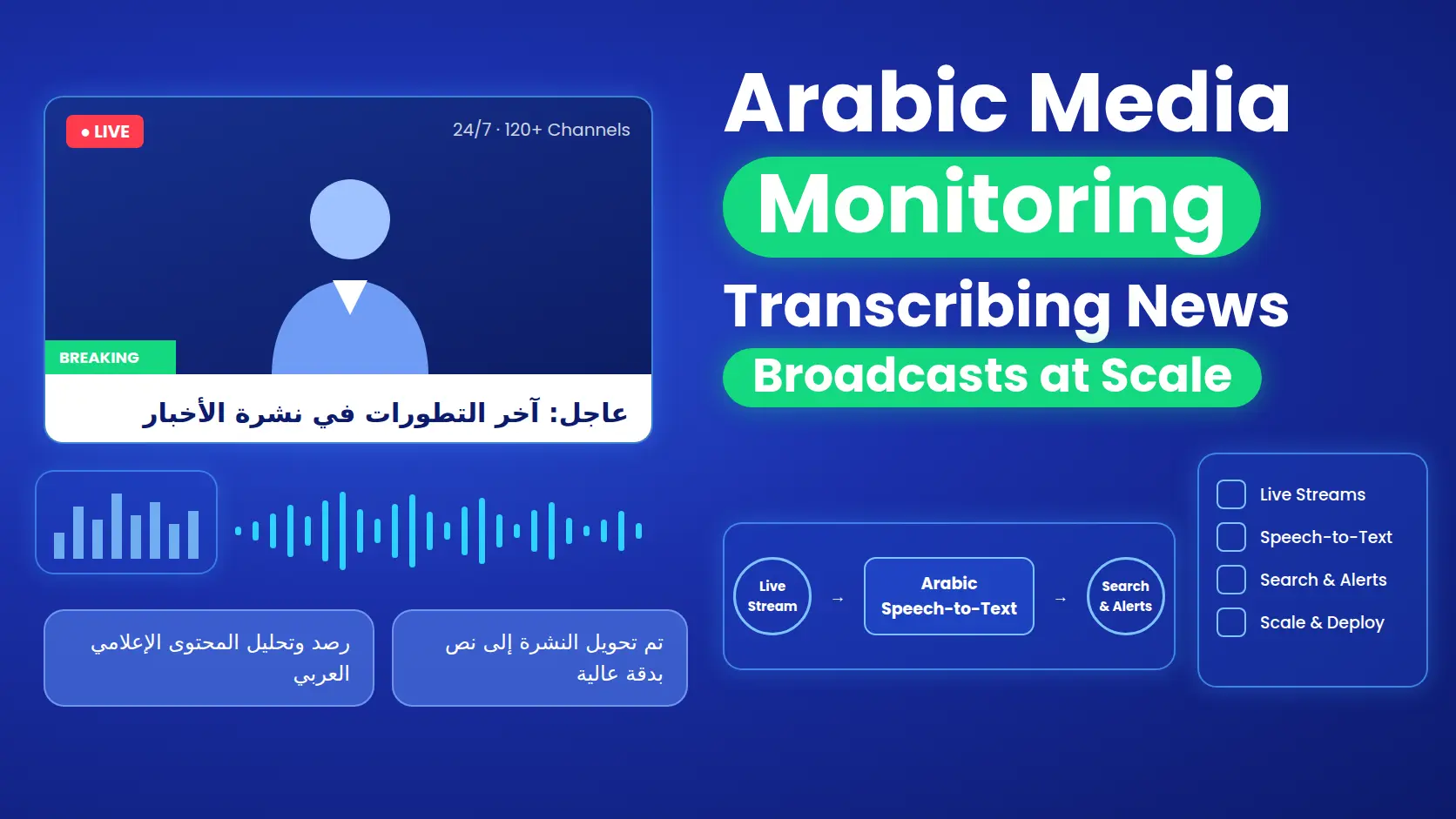
Arabic media monitoring involves continuously converting TV, radio, and other broadcast content into searchable, timestamped text while identifying important mentions for clients. Unlike one-off transcription, large-scale monitoring requires infrastructure capable of handling live streams and archives, multiple speakers, keyword alerts, sentiment analysis, translation, and searchable transcripts. Arabic Media Monitoring (1)

A major challenge is Arabic dialect diversity. Broadcasts can move between Modern Standard Arabic and regional varieties such as Gulf, Levantine, Egyptian, and Maghrebi Arabic. Generic ASR systems that primarily perform well on Modern Standard Arabic may struggle with unscripted dialectal speech, particularly during interviews, call-ins, and panel discussions.


‍

Arabic Media Monitoring: Transcribing News Broadcasts at Scale

A media monitoring operation doesn’t transcribe one file and stop. It watches dozens of channels around the clock, turns every hour of broadcast into searchable, timestamped text, flags the mentions a client pays to know about, and does it again the next hour for years. For Arabic-language broadcast, that steady-state workload runs into a problem most speech-to-text engines weren’t built to solve: a single news segment can open with an anchor reading Modern Standard Arabic off a script, cut to a Gulf-dialect call-in from a viewer, and close with a Levantine-accented analyst three different registers of the same language inside one three-minute clip, with no cue in the audio to tell a generic ASR model which one is coming next.

This is some text inside of a div block.

What Media Monitoring at Scale Actually Requires

Monitoring one broadcast is a transcription problem. Monitoring a media landscape is an infrastructure problem, and it has a different shape than a one-off transcription job:
‍

•A live feed and a growing archive, at the same time. A 24-hour news channel never stops producing audio, and a monitoring desk needs both the real-time stream (for same-day alerts) and the backlog (for research, compliance review, and competitive tracking) transcribed on an ongoing basis  not a batch job run once against a fixed file.
‍

•Speaker separation on panel and call-in formats. Political talk shows, call-in radio, and multi-guest panels are standard broadcast formats across Arabic media, and a transcript that doesn’t attribute each line to a speaker is far less useful for a monitoring client trying to track who said what.

•Keyword and topic alerting, not just raw text. Clients pay media monitoring firms to tell them when their brand, a competitor, or a named policy issue comes up  which means the transcript has to feed a search/alert layer, not just sit as a text file.
‍

•Tone, not just content. Whether a brand mention on air was framed positively, neutrally, or critically is often the actual deliverable a monitoring client wants, which requires sentiment analysis layered on top of the raw transcript.
‍

•Cross-market and cross-language reach. A monitoring firm covering MENA alongside European or Asian markets needs translation in the pipeline so an Arabic broadcast mention can land in an English report alongside everything else being tracked that day.
‍

•Searchability over raw audio. The entire value of monitoring is being able to query “every mention of X across every channel this month” in seconds  which means consistent timestamping and structured output, not just a folder of transcripts.

‍

This is some text inside of a div block.

Heading

Lorem ipsum dolor sit amet, consectetur adipiscing elit. Suspendisse varius enim in eros elementum tristique. Duis cursus, mi quis viverra ornare, eros dolor interdum nulla, ut commodo diam libero vitae erat. Aenean faucibus nibh et justo cursus id rutrum lorem imperdiet. Nunc ut sem vitae risus tristique posuere.

Lorem ipsum dolor sit amet, consectetur adipiscing elit. Suspendisse varius enim in eros elementum tristique. Duis cursus, mi quis viverra ornare, eros dolor interdum nulla, ut commodo diam libero vitae erat. Aenean faucibus nibh et justo cursus id rutrum lorem imperdiet. Nunc ut sem vitae risus tristique posuere.

Lorem ipsum dolor sit amet, consectetur adipiscing elit. Suspendisse varius enim in eros elementum tristique. Duis cursus, mi quis viverra ornare, eros dolor interdum nulla, ut commodo diam libero vitae erat. Aenean faucibus nibh et justo cursus id rutrum lorem imperdiet. Nunc ut sem vitae risus tristique posuere.

Lorem ipsum dolor sit amet, consectetur adipiscing elit. Suspendisse varius enim in eros elementum tristique. Duis cursus, mi quis viverra ornare, eros dolor interdum nulla, ut commodo diam libero vitae erat. Aenean faucibus nibh et justo cursus id rutrum lorem imperdiet. Nunc ut sem vitae risus tristique posuere.

Why Generic ASR Struggles With Arabic Broadcast Content

Most general-purpose speech-to-text engines were trained primarily on Modern Standard Arabic, the register used in written Arabic, formal news scripts, and official speech because it’s the most abundant and most consistently transcribed Arabic data available. Real broadcast audio doesn’t stay in that register. Anchors read MSA; the guests, call-ins, and vox-pop interviews that make up a large share of broadcast minutes speak in regional dialect, and a model tuned mainly on MSA tends to degrade noticeably the moment a segment shifts into Gulf, Levantine, Egyptian, or Maghrebi speech exactly the segments a media monitoring client is often most interested in, since that’s where unscripted opinion and reaction get captured.

‍

This isn’t a hypothetical gap. Deepgram’s Nova-3 model, for example, specifically expanded to cover 17 Arabic language variants across major regional dialect groups Gulf, Levantine, Egyptian, Maghrebi, Mesopotamian, and others and the company reports up to roughly 40% lower word error rates against competing engines on conversational (i.e., dialectal) Arabic specifically, a vendor-reported figure rather than an independently audited one, but directionally consistent with the industry’s broader move toward dedicated dialect coverage rather than a single generic multilingual model a challenge that also applies to Arabic Text to speech.

‍

Arabic Broadcast Transcription Is an Established, Documented Problem

The need for dialect-aware Arabic broadcast transcription predates current-generation AI speech models by years. Qatar Computing Research Institute (QCRI) built QATS (the QCRI Advanced Transcription System) specifically to handle Modern Standard Arabic plus four major dialect groups  Egyptian, Levantine, North African, and Gulf  trained on more than 2,000 hours of Arabic speech and licensed commercially through a partnership with UK-based Speechmatics.
‍

Al Jazeera’s own media network had already used QATS to transcribe more than 3,000 hours of its own broadcast archive by the time that partnership was announced. Today, Speechmatics markets a dedicated media and communications monitoring product built around the same core requirement this article opened with  accurate transcription regardless of dialect or accent, paired with translation, sentiment analysis, and topic detection in one pipeline  and its published case study with global media intelligence firm Media Track (monitoring 3,000+ broadcast channels and 2+ million print pages monthly across 20+ languages) is a useful real-world reference point for what “monitoring at scale” actually looks like operationally, even though that particular case study isn’t Arabic-specific.
‍

The practical takeaway for anyone evaluating a vendor for Arabic media monitoring: ask what dialect coverage actually means in their documentation (a named list of dialect groups, not just “Arabic” as a single checkbox), and ask whether diarization, sentiment, and keyword extraction are available as part of the same API rather than separate tools you’d have to stitch together yourself.

‍

See how Munsit performs on real Arabic speech

Evaluate dialect coverage, noise handling, and in-region deployment on data that reflects your customers.
Explore

How Munsit’s API Addresses Arabic Media Monitoring

Munsit’s documented Arabic voice AI API surface maps directly onto the requirements above, as a single integrated set of endpoints rather than a transcription engine you’d need to pair with separate sentiment, translation, and diarization tools:

‍

•Transcription and live streaming. Munsit’s /audio/transcribe endpoint handles archive material, and the WebSocket streaming endpoint (/websocket/speech-to-text) handles live feeds  covering both the backlog and the real-time side of a monitoring operation from the same vendor.
‍

•Diarization, and diarization with sentiment. Munsit’s diarization endpoint separates and labels individual speakers in multi-speaker audio, directly addressing the panel-show and call-in-radio case, and a combined diarization-plus-sentiment endpoint attaches a tone read to each speaker’s segments rather than just the broadcast as a whole.
‍

•Sentiment analysis and keyword extraction. Available as dedicated endpoints under Munsit’s “Understanding” layer, these map directly to the alerting and tone-tracking requirements a monitoring client actually pays for, rather than leaving a monitoring team to build that layer themselves on top of raw transcripts.
‍

•Translation. Munsit’s translation endpoint lets an Arabic broadcast mention be surfaced in English (or vice versa) within the same pipeline, relevant for any monitoring operation covering Arabic-language media alongside other-language markets.
‍

•Voice isolation. Broadcast audio  especially call-in segments, field reporting, and studio crosstalk  is frequently noisier than a clean studio recording, and a dedicated denoising/voice-isolation step ahead of transcription is documented separately from the core transcribe endpoint, rather than being left to the client to handle in a separate tool.
‍

•Dialect handling across Gulf, Levantine, Egyptian, and other regional varieties, consistent with the dialect-coverage expectation raised above, rather than a single MSA-only model.
‍

Munsit’s deployment options  cloud API, sovereign VPC, or on-premises  are also relevant for monitoring operations working with government or public-sector clients where audio has to stay within a defined jurisdiction, a consideration covered further below.

‍

FAQ

Why can’t a generic multilingual speech-to-text API handle Arabic broadcast monitoring well?
Does media monitoring require consent under UAE/Saudi data protection law?
Can one API handle both live broadcast feeds and an existing archive of recorded content?

Powering the Future with AI

Join our newsletter for insights on cutting-edge technology built in the UAE
Thank you! Your submission has been received!
Oops! Something went wrong while submitting the form.
Last update :
October 5, 2026

Arabic Media Monitoring: Transcribing News Broadcasts at Scale

Author
Sarra Turki
5min read

Bring Arabic Voice AI to production

Native‑level Arabic STT & TTS
Built for GCC gov & enterprises
Sovereign and on‑prem deployment
Contact Sales
Thank you! Your submission has been received!
Oops! Something went wrong while submitting the form.

Key Takeaways

Arabic media monitoring is more than transcription: It requires live processing, archives, searchability, alerts, speaker identification, sentiment, and translation.

Dialect coverage is critical: Arabic broadcasts can shift between MSA and multiple regional dialects, making generic ASR less reliable for unscripted content.

Speaker diarization adds monitoring value: It helps identify who said what during interviews, panels, and call-in shows.

Keyword extraction enables real-time monitoring: Brands, competitors, policies, and other important topics can be identified automatically.

Munsit provides an integrated workflow: Transcription, streaming, diarization, sentiment, keyword extraction, translation, and voice isolation are available within its API ecosystem.

Deployment flexibility matters: Cloud, sovereign VPC, and on-premises options can support organizations with stricter data-residency or security requirements.

Compliance should not be overlooked: Transcripts containing identifiable individuals may create data-protection considerations, while broadcast content can involve separate copyright questions.

Arabic media monitoring involves continuously converting TV, radio, and other broadcast content into searchable, timestamped text while identifying important mentions for clients. Unlike one-off transcription, large-scale monitoring requires infrastructure capable of handling live streams and archives, multiple speakers, keyword alerts, sentiment analysis, translation, and searchable transcripts. Arabic Media Monitoring (1)

A major challenge is Arabic dialect diversity. Broadcasts can move between Modern Standard Arabic and regional varieties such as Gulf, Levantine, Egyptian, and Maghrebi Arabic. Generic ASR systems that primarily perform well on Modern Standard Arabic may struggle with unscripted dialectal speech, particularly during interviews, call-ins, and panel discussions.
‍

Arabic Media Monitoring: Transcribing News Broadcasts at Scale

A media monitoring operation doesn’t transcribe one file and stop. It watches dozens of channels around the clock, turns every hour of broadcast into searchable, timestamped text, flags the mentions a client pays to know about, and does it again the next hour for years. For Arabic-language broadcast, that steady-state workload runs into a problem most speech-to-text engines weren’t built to solve: a single news segment can open with an anchor reading Modern Standard Arabic off a script, cut to a Gulf-dialect call-in from a viewer, and close with a Levantine-accented analyst three different registers of the same language inside one three-minute clip, with no cue in the audio to tell a generic ASR model which one is coming next.

Lorem ipsum dolor
Lorem ipsum dolor
Lorem ipsum dolor
Lorem ipsum dolor
Lorem ipsum dolor
Lorem ipsum dolor
Lorem ipsum dolor
Lorem ipsum dolor
Lorem ipsum dolor
Lorem ipsum dolor
Lorem ipsum dolor
Lorem ipsum dolor
Lorem ipsum dolor
Lorem ipsum dolor
Lorem ipsum dolor
Lorem ipsum dolor
Lorem ipsum dolor
Lorem ipsum dolor
Lorem ipsum dolor
Lorem ipsum dolor
Lorem ipsum dolor
Lorem ipsum dolor
Lorem ipsum dolor
Lorem ipsum dolor
Lorem ipsum dolor
Lorem ipsum dolor
Lorem ipsum dolor
Lorem ipsum dolor
Lorem ipsum dolor
Lorem ipsum dolor
Lorem ipsum dolor
Lorem ipsum dolor

What Media Monitoring at Scale Actually Requires

Understanding the origins of AI hallucinations is the first step toward mitigating them. The phenomenon is not a single problem but rather a complex issue with multiple contributing factors.

1

Training Data Deficiencies

Monitoring one broadcast is a transcription problem. Monitoring a media landscape is an infrastructure problem, and it has a different shape than a one-off transcription job:
‍

•A live feed and a growing archive, at the same time. A 24-hour news channel never stops producing audio, and a monitoring desk needs both the real-time stream (for same-day alerts) and the backlog (for research, compliance review, and competitive tracking) transcribed on an ongoing basis  not a batch job run once against a fixed file.
‍

•Speaker separation on panel and call-in formats. Political talk shows, call-in radio, and multi-guest panels are standard broadcast formats across Arabic media, and a transcript that doesn’t attribute each line to a speaker is far less useful for a monitoring client trying to track who said what.

•Keyword and topic alerting, not just raw text. Clients pay media monitoring firms to tell them when their brand, a competitor, or a named policy issue comes up  which means the transcript has to feed a search/alert layer, not just sit as a text file.
‍

•Tone, not just content. Whether a brand mention on air was framed positively, neutrally, or critically is often the actual deliverable a monitoring client wants, which requires sentiment analysis layered on top of the raw transcript.
‍

•Cross-market and cross-language reach. A monitoring firm covering MENA alongside European or Asian markets needs translation in the pipeline so an Arabic broadcast mention can land in an English report alongside everything else being tracked that day.
‍

•Searchability over raw audio. The entire value of monitoring is being able to query “every mention of X across every channel this month” in seconds  which means consistent timestamping and structured output, not just a folder of transcripts.

‍

2

Training Data Deficiencies

The most significant contributor to AI hallucinations is the data on which the models are trained. LLMs learn from vast datasets scraped from the internet, which contain a mixture of factual information, opinions, misinformation, and biases. Several specific data-related issues can lead to hallucinations:

Enterprise Use Cases for Arabic Voice AI in 2025

The move to dialect-aware Arabic ASR is unlocking a new wave of enterprise applications across the GCC and MENA regions. Organizations are moving beyond basic transcription to sophisticated Arabic speech analytics.

Arabic speech technology is rapidly advancing in 2025, driven by massive multilingual models and new Arabic-centric foundation models.

Arabic speech technology is rapidly advancing in 2025, driven by massive multilingual models and new Arabic-centric foundation models.

Arabic speech technology is rapidly advancing in 2025, driven by massive multilingual models and new Arabic-centric foundation models.

Arabic speech technology is rapidly advancing in 2025, driven by massive multilingual models and new Arabic-centric foundation models.

Why Generic ASR Struggles With Arabic Broadcast Content

Understanding the origins of AI hallucinations is the first step toward mitigating them. The phenomenon is not a single problem but rather a complex issue with multiple contributing factors.

1

Training Data Deficiencies

Most general-purpose speech-to-text engines were trained primarily on Modern Standard Arabic, the register used in written Arabic, formal news scripts, and official speech because it’s the most abundant and most consistently transcribed Arabic data available. Real broadcast audio doesn’t stay in that register. Anchors read MSA; the guests, call-ins, and vox-pop interviews that make up a large share of broadcast minutes speak in regional dialect, and a model tuned mainly on MSA tends to degrade noticeably the moment a segment shifts into Gulf, Levantine, Egyptian, or Maghrebi speech exactly the segments a media monitoring client is often most interested in, since that’s where unscripted opinion and reaction get captured.

‍

This isn’t a hypothetical gap. Deepgram’s Nova-3 model, for example, specifically expanded to cover 17 Arabic language variants across major regional dialect groups Gulf, Levantine, Egyptian, Maghrebi, Mesopotamian, and others and the company reports up to roughly 40% lower word error rates against competing engines on conversational (i.e., dialectal) Arabic specifically, a vendor-reported figure rather than an independently audited one, but directionally consistent with the industry’s broader move toward dedicated dialect coverage rather than a single generic multilingual model a challenge that also applies to Arabic Text to speech.

‍

2

Training Data Deficiencies

The most significant contributor to AI hallucinations is the data on which the models are trained. LLMs learn from vast datasets scraped from the internet, which contain a mixture of factual information, opinions, misinformation, and biases. Several specific data-related issues can lead to hallucinations:

Enterprise Use Cases for Arabic Voice AI in 2025

The move to dialect-aware Arabic ASR is unlocking a new wave of enterprise applications across the GCC and MENA regions. Organizations are moving beyond basic transcription to sophisticated Arabic speech analytics.

Arabic speech technology is rapidly advancing in 2025, driven by massive multilingual models and new Arabic-centric foundation models.

Arabic speech technology is rapidly advancing in 2025, driven by massive multilingual models and new Arabic-centric foundation models.

Arabic speech technology is rapidly advancing in 2025, driven by massive multilingual models and new Arabic-centric foundation models.

Arabic speech technology is rapidly advancing in 2025, driven by massive multilingual models and new Arabic-centric foundation models.

Building better AI systems takes the right approach

We help with custom solutions, data pipelines, and Arabic intelligence.

Arabic Broadcast Transcription Is an Established, Documented Problem

Understanding the origins of AI hallucinations is the first step toward mitigating them. The phenomenon is not a single problem but rather a complex issue with multiple contributing factors.

1

Training Data Deficiencies

The need for dialect-aware Arabic broadcast transcription predates current-generation AI speech models by years. Qatar Computing Research Institute (QCRI) built QATS (the QCRI Advanced Transcription System) specifically to handle Modern Standard Arabic plus four major dialect groups  Egyptian, Levantine, North African, and Gulf  trained on more than 2,000 hours of Arabic speech and licensed commercially through a partnership with UK-based Speechmatics.
‍

Al Jazeera’s own media network had already used QATS to transcribe more than 3,000 hours of its own broadcast archive by the time that partnership was announced. Today, Speechmatics markets a dedicated media and communications monitoring product built around the same core requirement this article opened with  accurate transcription regardless of dialect or accent, paired with translation, sentiment analysis, and topic detection in one pipeline  and its published case study with global media intelligence firm Media Track (monitoring 3,000+ broadcast channels and 2+ million print pages monthly across 20+ languages) is a useful real-world reference point for what “monitoring at scale” actually looks like operationally, even though that particular case study isn’t Arabic-specific.
‍

The practical takeaway for anyone evaluating a vendor for Arabic media monitoring: ask what dialect coverage actually means in their documentation (a named list of dialect groups, not just “Arabic” as a single checkbox), and ask whether diarization, sentiment, and keyword extraction are available as part of the same API rather than separate tools you’d have to stitch together yourself.

‍

2

Training Data Deficiencies

The most significant contributor to AI hallucinations is the data on which the models are trained. LLMs learn from vast datasets scraped from the internet, which contain a mixture of factual information, opinions, misinformation, and biases. Several specific data-related issues can lead to hallucinations:

Enterprise Use Cases for Arabic Voice AI in 2025

The move to dialect-aware Arabic ASR is unlocking a new wave of enterprise applications across the GCC and MENA regions. Organizations are moving beyond basic transcription to sophisticated Arabic speech analytics.

Arabic speech technology is rapidly advancing in 2025, driven by massive multilingual models and new Arabic-centric foundation models.

Arabic speech technology is rapidly advancing in 2025, driven by massive multilingual models and new Arabic-centric foundation models.

Arabic speech technology is rapidly advancing in 2025, driven by massive multilingual models and new Arabic-centric foundation models.

Arabic speech technology is rapidly advancing in 2025, driven by massive multilingual models and new Arabic-centric foundation models.

How Munsit’s API Addresses Arabic Media Monitoring

Understanding the origins of AI hallucinations is the first step toward mitigating them. The phenomenon is not a single problem but rather a complex issue with multiple contributing factors.

1

Training Data Deficiencies

Munsit’s documented Arabic voice AI API surface maps directly onto the requirements above, as a single integrated set of endpoints rather than a transcription engine you’d need to pair with separate sentiment, translation, and diarization tools:

‍

•Transcription and live streaming. Munsit’s /audio/transcribe endpoint handles archive material, and the WebSocket streaming endpoint (/websocket/speech-to-text) handles live feeds  covering both the backlog and the real-time side of a monitoring operation from the same vendor.
‍

•Diarization, and diarization with sentiment. Munsit’s diarization endpoint separates and labels individual speakers in multi-speaker audio, directly addressing the panel-show and call-in-radio case, and a combined diarization-plus-sentiment endpoint attaches a tone read to each speaker’s segments rather than just the broadcast as a whole.
‍

•Sentiment analysis and keyword extraction. Available as dedicated endpoints under Munsit’s “Understanding” layer, these map directly to the alerting and tone-tracking requirements a monitoring client actually pays for, rather than leaving a monitoring team to build that layer themselves on top of raw transcripts.
‍

•Translation. Munsit’s translation endpoint lets an Arabic broadcast mention be surfaced in English (or vice versa) within the same pipeline, relevant for any monitoring operation covering Arabic-language media alongside other-language markets.
‍

•Voice isolation. Broadcast audio  especially call-in segments, field reporting, and studio crosstalk  is frequently noisier than a clean studio recording, and a dedicated denoising/voice-isolation step ahead of transcription is documented separately from the core transcribe endpoint, rather than being left to the client to handle in a separate tool.
‍

•Dialect handling across Gulf, Levantine, Egyptian, and other regional varieties, consistent with the dialect-coverage expectation raised above, rather than a single MSA-only model.
‍

Munsit’s deployment options  cloud API, sovereign VPC, or on-premises  are also relevant for monitoring operations working with government or public-sector clients where audio has to stay within a defined jurisdiction, a consideration covered further below.

‍

2

Training Data Deficiencies

The most significant contributor to AI hallucinations is the data on which the models are trained. LLMs learn from vast datasets scraped from the internet, which contain a mixture of factual information, opinions, misinformation, and biases. Several specific data-related issues can lead to hallucinations:

Enterprise Use Cases for Arabic Voice AI in 2025

The move to dialect-aware Arabic ASR is unlocking a new wave of enterprise applications across the GCC and MENA regions. Organizations are moving beyond basic transcription to sophisticated Arabic speech analytics.

Arabic speech technology is rapidly advancing in 2025, driven by massive multilingual models and new Arabic-centric foundation models.

Arabic speech technology is rapidly advancing in 2025, driven by massive multilingual models and new Arabic-centric foundation models.

Arabic speech technology is rapidly advancing in 2025, driven by massive multilingual models and new Arabic-centric foundation models.

Arabic speech technology is rapidly advancing in 2025, driven by massive multilingual models and new Arabic-centric foundation models.

UAE and Saudi Compliance Considerations for Media Monitoring

Understanding the origins of AI hallucinations is the first step toward mitigating them. The phenomenon is not a single problem but rather a complex issue with multiple contributing factors.

1

Training Data Deficiencies

Media monitoring sits at an interesting intersection of content that’s already public (a broadcast anyone could have watched or listened to) and processing that can still touch personal data and copyright, depending on exactly what’s being monitored:
‍

Broadcast content itself isn’t personal data, but call-ins, interviews, and named individuals quoted on air can trigger PDPL considerations in the derived data. The UAE’s Federal Decree-Law No. 45/2021 (PDPL) and Saudi Arabia’s PDPL (enforced since September 2024) apply to identifiable personal data  a transcript segment that names and quotes a private individual (as opposed to a public broadcaster or on-air personality acting in that professional capacity) is personal data once transcribed, diarized, and attributed, and that applies equally if your monitoring scope extends beyond broadcast into call-quality or customer-call monitoring, which raises consent considerations the broadcast-only use case doesn’t.
‍

Broadcast content carries copyright, independent of transcription technology. Transcribing a channel’s content for internal research, alerting, or archival search is a different legal question from republishing or redistributing substantial portions of that transcribed content commercially. A monitoring operation’s right to transcribe and search broadcast content for its own analysis purposes is generally a separate question from what it can legally republish or resell to clients verbatim  worth confirming with legal counsel against the specific broadcasters being monitored, rather than assuming transcription technology itself resolves the underlying rights question.
‍

UAE media activity, broadly, operates under Federal Decree-Law No. 55 of 2023, which consolidated oversight of broadcast, print, and digital media activity under the UAE Media Council and Media Regulatory Office. That law governs media content and licensing within the UAE rather than specifically addressing third-party media monitoring firms, but it’s the relevant regulatory backdrop to be aware of if a monitoring operation is based in, or serving clients in, the UAE.
‍

Sovereign deployment matters for government and public-sector monitoring work. Media monitoring for government communications offices, security-adjacent clients, or regulated sectors often needs audio and transcript data to stay within a defined jurisdiction. Munsit documents cloud, sovereign VPC, and on-premises deployment options beyond the standard cloud API referenced above  confirm which model fits the sensitivity of the client and content before assuming cloud-only is sufficient.
‍

This section provides general information, not legal advice. Consult qualified legal counsel for compliance decisions specific to your monitoring operation, its clients, and its jurisdiction.

‍

2

Training Data Deficiencies

The most significant contributor to AI hallucinations is the data on which the models are trained. LLMs learn from vast datasets scraped from the internet, which contain a mixture of factual information, opinions, misinformation, and biases. Several specific data-related issues can lead to hallucinations:

Enterprise Use Cases for Arabic Voice AI in 2025

The move to dialect-aware Arabic ASR is unlocking a new wave of enterprise applications across the GCC and MENA regions. Organizations are moving beyond basic transcription to sophisticated Arabic speech analytics.

Arabic speech technology is rapidly advancing in 2025, driven by massive multilingual models and new Arabic-centric foundation models.

Arabic speech technology is rapidly advancing in 2025, driven by massive multilingual models and new Arabic-centric foundation models.

Arabic speech technology is rapidly advancing in 2025, driven by massive multilingual models and new Arabic-centric foundation models.

Arabic speech technology is rapidly advancing in 2025, driven by massive multilingual models and new Arabic-centric foundation models.

Understanding the origins of AI hallucinations is the first step toward mitigating them. The phenomenon is not a single problem but rather a complex issue with multiple contributing factors.

1

Training Data Deficiencies

2

Training Data Deficiencies

The most significant contributor to AI hallucinations is the data on which the models are trained. LLMs learn from vast datasets scraped from the internet, which contain a mixture of factual information, opinions, misinformation, and biases. Several specific data-related issues can lead to hallucinations:

Enterprise Use Cases for Arabic Voice AI in 2025

The move to dialect-aware Arabic ASR is unlocking a new wave of enterprise applications across the GCC and MENA regions. Organizations are moving beyond basic transcription to sophisticated Arabic speech analytics.

Arabic speech technology is rapidly advancing in 2025, driven by massive multilingual models and new Arabic-centric foundation models.

Arabic speech technology is rapidly advancing in 2025, driven by massive multilingual models and new Arabic-centric foundation models.

Arabic speech technology is rapidly advancing in 2025, driven by massive multilingual models and new Arabic-centric foundation models.

Arabic speech technology is rapidly advancing in 2025, driven by massive multilingual models and new Arabic-centric foundation models.

Understanding the origins of AI hallucinations is the first step toward mitigating them. The phenomenon is not a single problem but rather a complex issue with multiple contributing factors.

1

Training Data Deficiencies

2

Training Data Deficiencies

The most significant contributor to AI hallucinations is the data on which the models are trained. LLMs learn from vast datasets scraped from the internet, which contain a mixture of factual information, opinions, misinformation, and biases. Several specific data-related issues can lead to hallucinations:

Enterprise Use Cases for Arabic Voice AI in 2025

The move to dialect-aware Arabic ASR is unlocking a new wave of enterprise applications across the GCC and MENA regions. Organizations are moving beyond basic transcription to sophisticated Arabic speech analytics.

Arabic speech technology is rapidly advancing in 2025, driven by massive multilingual models and new Arabic-centric foundation models.

Arabic speech technology is rapidly advancing in 2025, driven by massive multilingual models and new Arabic-centric foundation models.

Arabic speech technology is rapidly advancing in 2025, driven by massive multilingual models and new Arabic-centric foundation models.

Arabic speech technology is rapidly advancing in 2025, driven by massive multilingual models and new Arabic-centric foundation models.

Understanding the origins of AI hallucinations is the first step toward mitigating them. The phenomenon is not a single problem but rather a complex issue with multiple contributing factors.

1

Training Data Deficiencies

2

Training Data Deficiencies

The most significant contributor to AI hallucinations is the data on which the models are trained. LLMs learn from vast datasets scraped from the internet, which contain a mixture of factual information, opinions, misinformation, and biases. Several specific data-related issues can lead to hallucinations:

Enterprise Use Cases for Arabic Voice AI in 2025

The move to dialect-aware Arabic ASR is unlocking a new wave of enterprise applications across the GCC and MENA regions. Organizations are moving beyond basic transcription to sophisticated Arabic speech analytics.

Arabic speech technology is rapidly advancing in 2025, driven by massive multilingual models and new Arabic-centric foundation models.

Arabic speech technology is rapidly advancing in 2025, driven by massive multilingual models and new Arabic-centric foundation models.

Arabic speech technology is rapidly advancing in 2025, driven by massive multilingual models and new Arabic-centric foundation models.

Arabic speech technology is rapidly advancing in 2025, driven by massive multilingual models and new Arabic-centric foundation models.

Understanding the origins of AI hallucinations is the first step toward mitigating them. The phenomenon is not a single problem but rather a complex issue with multiple contributing factors.

1

Training Data Deficiencies

2

Training Data Deficiencies

The most significant contributor to AI hallucinations is the data on which the models are trained. LLMs learn from vast datasets scraped from the internet, which contain a mixture of factual information, opinions, misinformation, and biases. Several specific data-related issues can lead to hallucinations:

Enterprise Use Cases for Arabic Voice AI in 2025

The move to dialect-aware Arabic ASR is unlocking a new wave of enterprise applications across the GCC and MENA regions. Organizations are moving beyond basic transcription to sophisticated Arabic speech analytics.

Arabic speech technology is rapidly advancing in 2025, driven by massive multilingual models and new Arabic-centric foundation models.

Arabic speech technology is rapidly advancing in 2025, driven by massive multilingual models and new Arabic-centric foundation models.

Arabic speech technology is rapidly advancing in 2025, driven by massive multilingual models and new Arabic-centric foundation models.

Arabic speech technology is rapidly advancing in 2025, driven by massive multilingual models and new Arabic-centric foundation models.

FAQ
Why can’t a generic multilingual speech-to-text API handle Arabic broadcast monitoring well?
Does media monitoring require consent under UAE/Saudi data protection law?
Can one API handle both live broadcast feeds and an existing archive of recorded content?
What’s the difference between diarization and diarization-with-sentiment?
Is keyword/topic alerting built into the transcription API, or does it need a separate tool?

Bring Arabic Voice AI to production

Native‑level Arabic STT & TTS
Built for GCC gov & enterprises
Sovereign and on‑prem deployment
Contact Sales
Thank you! Your submission has been received!
Oops! Something went wrong while submitting the form.

Start free.  
Pay when you are ready.

10,000 credits. Test Munsit with your own audio, in your own dialect, and see the accuracy for yourself.