
l 5min

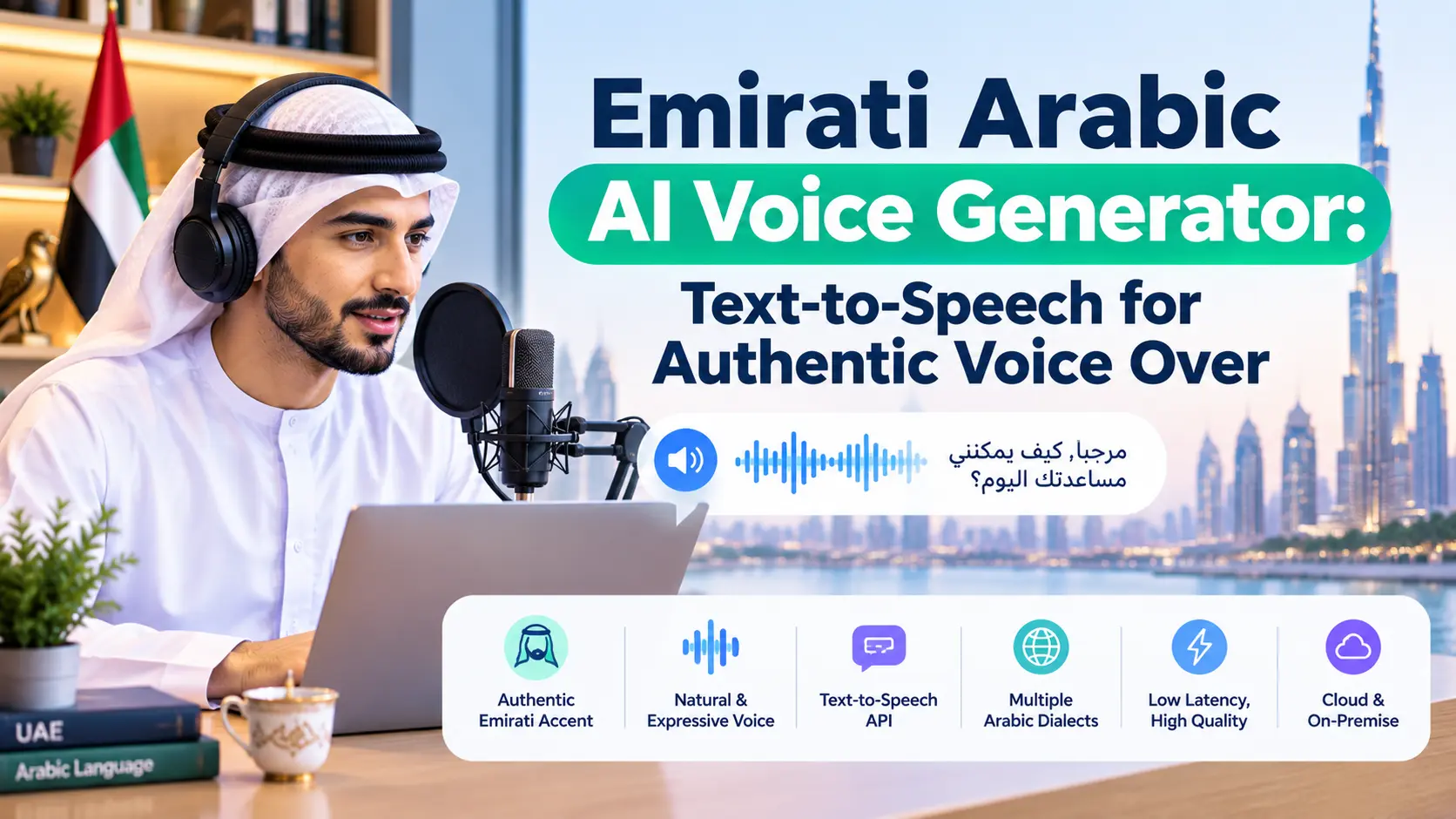
Emirati Arabic AI Voice Generator & Text-to-Speech for Voice Over

Arabic Voice AI
Author
Rym Bachouche

Key Takeaways

1

Emirati Arabic is distinct from generic Gulf Arabic: Emirati belongs to the broader Gulf dialect family but has its own pronunciation and grammatical characteristics, so a broadly trained Gulf voice may not sound authentically Emirati.

2

An ar-AE locale does not guarantee an Emirati accent: Country-specific locale codes can indicate regional targeting without proving that the underlying voice was trained specifically for Emirati pronunciation.

3

Test Emirati speech directly: Buyers should request Emirati-specific samples and, ideally, have native Emirati speakers evaluate pronunciation, intonation, and overall naturalness instead of relying on vendor labels.

4

Code-switching is an important quality test: Emirati business and casual speech can mix Arabic and English, so the voice should be tested on sentences containing English terms rather than only clean Arabic scripts

The article explains why Emirati Arabic is not simply interchangeable with generic Gulf Arabic, even when a TTS platform uses the ar-AE locale. It compares major voice platforms and highlights the importance of testing Emirati-specific pronunciation, intonation, English-Arabic code-switching, and actual voice samples rather than relying on locale labels or total dialect counts.

It also explains how Munsit’s Faseeh TTS approaches Emirati Arabic with a named Emirati dialect option, purpose-built dialectal speech data, voice cloning, Tashkīl, and cloud or sovereign/on-premises deployment. The article also covers UAE considerations around voice-cloning consent and data residency, while noting that Munsit’s Emirati benchmark is promising but based on only 25 native Emirati raters and therefore should be treated as directional rather than conclusive


Emirati Arabic AI Voice Generator: Text-to-Speech for Authentic Voice Over

Emirati nationals make up a small minority of the UAE’s own resident population roughly 11–12%, the flip side of the 88% expatriate share reported by Khaleej Times from UAE census figures. That makes Emirati Arabic an unusual case among Arabic dialects: numerically small as a share of daily spoken Arabic in the country, but disproportionately important in government communications, official media, cultural content, and any product that wants to sound authentically local to Emirati citizens rather than generically Gulf-accented to the wider Gulf Cooperation Council audience.

That distinction authentically Emirati versus generically Gulf is exactly where most AI voice generators and text-to-speech tools blur the line, often without saying so. It matters whether the output is for a chatbot prompt, an IVR menu, or a voice over for an ad, a corporate video, or a documentary any use case where the audience is specifically meant to hear an Emirati voice rather than a regionally-accurate-enough Gulf one.

‍

This is some text inside of a div block.

What Makes Emirati Arabic Distinct

Emirati Arabic belongs to the broader Gulf (Khaleeji) dialect family shared loosely with Kuwaiti, Qatari, Bahraini, and Saudi Eastern Province Arabic, but it has its own documented phonological and grammatical features distinct enough that it’s been the subject of dedicated academic work, including a full phonological description published as a doctoral dissertation and a comprehensive grammar of Emirati Arabic produced at UAE University.

The practical point for anyone evaluating a voice tool: “Gulf Arabic” and “Emirati Arabic” are related but not interchangeable, the way “British English” and “Scottish English” are related but not interchangeable a voice trained broadly on Gulf speech data won’t necessarily carry the specific pronunciation and intonation patterns that make a recording sound distinctly Emirati to a local listener.

This is some text inside of a div block.

Heading

Lorem ipsum dolor sit amet, consectetur adipiscing elit. Suspendisse varius enim in eros elementum tristique. Duis cursus, mi quis viverra ornare, eros dolor interdum nulla, ut commodo diam libero vitae erat. Aenean faucibus nibh et justo cursus id rutrum lorem imperdiet. Nunc ut sem vitae risus tristique posuere.

Lorem ipsum dolor sit amet, consectetur adipiscing elit. Suspendisse varius enim in eros elementum tristique. Duis cursus, mi quis viverra ornare, eros dolor interdum nulla, ut commodo diam libero vitae erat. Aenean faucibus nibh et justo cursus id rutrum lorem imperdiet. Nunc ut sem vitae risus tristique posuere.

Lorem ipsum dolor sit amet, consectetur adipiscing elit. Suspendisse varius enim in eros elementum tristique. Duis cursus, mi quis viverra ornare, eros dolor interdum nulla, ut commodo diam libero vitae erat. Aenean faucibus nibh et justo cursus id rutrum lorem imperdiet. Nunc ut sem vitae risus tristique posuere.

Lorem ipsum dolor sit amet, consectetur adipiscing elit. Suspendisse varius enim in eros elementum tristique. Duis cursus, mi quis viverra ornare, eros dolor interdum nulla, ut commodo diam libero vitae erat. Aenean faucibus nibh et justo cursus id rutrum lorem imperdiet. Nunc ut sem vitae risus tristique posuere.

The Locale-Code Trap: “ar-AE” Doesn’t Always Mean Emirati-Accented Speech

Amazon Polly ships an ar-AE locale with two neural voices, Hala (female) and Zayd (male). Amazon’s own product announcement for the Zayd voice describes it explicitly as a “Gulf Arabic” voice synthesizing “both Gulf Arabic and Modern Standard Arabic” not a claim of authentically Emirati pronunciation specifically, despite the ar-AE locale code. The locale code signals the country association; it doesn’t by itself guarantee dialect-specific training.
‍

Azure lists dedicated ar-AE voices Fatima (female) and Hamdan (male) among 16 separate Arabic locale/voice pairs spanning the region (Saudi, Egyptian, Jordanian, Kuwaiti, Omani, Qatari, and more), a genuinely broader locale spread than most competitors. That breadth is a real strength, but Microsoft’s own documentation doesn’t publish a dialect-authenticity claim beyond the locale pairing itself worth listening to a sample against native Emirati speech before assuming locale-matching equals accent-matching.
‍

Google Cloud Text-to-Speech offers a single ar-XA Arabic locale rather than per-country Gulf variants, which means no dedicated Emirati or even broader Gulf-specific option exists in Google’s TTS catalog at all a wider gap than the locale-labeling nuance affecting Polly and Azure.
‍

ElevenLabs supports Arabic as one of its many languages through a generalist multilingual model rather than per-dialect voices, and its community voice library includes voices uploaded and labeled by users a label like “Emirati” or “Khaleeji” on a community-uploaded voice reflects what the uploader called it, not an independently verified dialect claim, the same caveat that applies to community-labeled dialect voices on any open voice-upload platform.
‍

Dedicated regional players Lahajati and Nabarati among them advertise wide dialect counts (192+ and 1000+ dialect tones respectively, both self-reported) that include Emirati as one option among many; worth testing the specific Emirati option directly rather than trusting the aggregate dialect count as a proxy for quality on any one of them.

‍

How to Evaluate an Emirati Arabic Voice Generator or Text-to-Speech Tool

 Ask for an Emirati-specific sample, not a “Gulf Arabic” sample, and have a native Emirati speaker judge it the distinction described above means these aren’t interchangeable, whatever a locale code suggests.
‍

•Check whether the vendor discloses training data sources for the dialect, rather than just listing a locale code or a dialect count. A vendor that names its approach (purpose-built dialectal data versus a generalist multilingual model) is giving you more to evaluate than a locale label alone.
‍

•Test code-switching specifically Emirati business and casual speech routinely mixes in English, and a voice that sounds natural reading pure Arabic text can still sound robotic or mispronounce English terms embedded in an Arabic sentence.
‍

•Confirm whether voice cloning is available if the goal is a specific, recognizable Emirati voice (for a brand, a government service, or a media personality) rather than a stock voice from a library.
‍

•Match the tool to the use case. A quick text-to-speech output for an app notification has different quality requirements than a voice over intended for broadcast, advertising, or a corporate video confirm the vendor’s output quality and licensing terms actually support commercial voice-over use, not just app-level TTS.

‍

See how Munsit performs on real Arabic speech

Evaluate dialect coverage, noise handling, and in-region deployment on data that reflects your customers.
Explore

How Munsit Approaches Emirati Arabic Text-to-Speech and Voice Over

Munsit’s Faseeh TTS offers Emirati as one of its named dialect options alongside other Gulf and non-Gulf varieties, built on data CNTXT AI describes as purpose-built dialectal Arabic speech rather than adapted from a generalist multilingual dataset directly aimed at the locale-code-versus-actual-dialect gap described above.
‍

Munsit also documents voice cloning, Tashkīl (diacritization) for pronunciation control, and both cloud and sovereign/on-premises deployment relevant for UAE government or public-sector use cases where an authentically Emirati-sounding voice and in-region data processing both matter. The same API covers both ends of the use-case spectrum: quick text-to-speech output for an app or IVR prompt, and higher-production voice-over work for ads, corporate narration, or documentary content where an authentically Emirati voice is the whole point.

‍

FAQ

Is “Gulf Arabic” the same as “Emirati Arabic” for AI voice purposes?
Which global TTS vendor has the broadest Arabic locale coverage?
Does a higher dialect count from a vendor mean better Emirati-specific quality?

Powering the Future with AI

Join our newsletter for insights on cutting-edge technology built in the UAE
Thank you! Your submission has been received!
Oops! Something went wrong while submitting the form.
Last update :
October 6, 2026

Emirati Arabic AI Voice Generator & Text-to-Speech for Voice Over

Arabic Voice AI
Author
Sarra Turki
Rym Bachouche
5min read

Bring Arabic Voice AI to production

Native‑level Arabic STT & TTS
Built for GCC gov & enterprises
Sovereign and on‑prem deployment
Contact Sales
Thank you! Your submission has been received!
Oops! Something went wrong while submitting the form.

Key Takeaways

Emirati Arabic is distinct from generic Gulf Arabic: Emirati belongs to the broader Gulf dialect family but has its own pronunciation and grammatical characteristics, so a broadly trained Gulf voice may not sound authentically Emirati.

An ar-AE locale does not guarantee an Emirati accent: Country-specific locale codes can indicate regional targeting without proving that the underlying voice was trained specifically for Emirati pronunciation.

Test Emirati speech directly: Buyers should request Emirati-specific samples and, ideally, have native Emirati speakers evaluate pronunciation, intonation, and overall naturalness instead of relying on vendor labels.

Code-switching is an important quality test: Emirati business and casual speech can mix Arabic and English, so the voice should be tested on sentences containing English terms rather than only clean Arabic scripts

Munsit focuses on dialect-specific Arabic voice generation: Faseeh TTS includes Emirati as a named dialect and uses purpose-built dialectal Arabic speech data. Munsit also supports voice cloning, Tashkīl, and cloud or sovereign/on-premises deployment.

Voice cloning and data residency require attention in the UAE: Cloning a real person's voice requires documented consent, while government and public-sector projects may need deployment options that keep data within appropriate UAE infrastructure.

Benchmark results should be interpreted carefully: Munsit’s Emirati benchmark was based on 25 native Emirati raters, considerably fewer than the MSA and Saudi Arabic groups. The result is useful directional evidence, but the article notes that a larger evaluation is still in progress.

The article explains why Emirati Arabic is not simply interchangeable with generic Gulf Arabic, even when a TTS platform uses the ar-AE locale. It compares major voice platforms and highlights the importance of testing Emirati-specific pronunciation, intonation, English-Arabic code-switching, and actual voice samples rather than relying on locale labels or total dialect counts.

It also explains how Munsit’s Faseeh TTS approaches Emirati Arabic with a named Emirati dialect option, purpose-built dialectal speech data, voice cloning, Tashkīl, and cloud or sovereign/on-premises deployment. The article also covers UAE considerations around voice-cloning consent and data residency, while noting that Munsit’s Emirati benchmark is promising but based on only 25 native Emirati raters and therefore should be treated as directional rather than conclusive
Emirati Arabic AI Voice Generator: Text-to-Speech for Authentic Voice Over

Emirati nationals make up a small minority of the UAE’s own resident population roughly 11–12%, the flip side of the 88% expatriate share reported by Khaleej Times from UAE census figures. That makes Emirati Arabic an unusual case among Arabic dialects: numerically small as a share of daily spoken Arabic in the country, but disproportionately important in government communications, official media, cultural content, and any product that wants to sound authentically local to Emirati citizens rather than generically Gulf-accented to the wider Gulf Cooperation Council audience.

That distinction authentically Emirati versus generically Gulf is exactly where most AI voice generators and text-to-speech tools blur the line, often without saying so. It matters whether the output is for a chatbot prompt, an IVR menu, or a voice over for an ad, a corporate video, or a documentary any use case where the audience is specifically meant to hear an Emirati voice rather than a regionally-accurate-enough Gulf one.

‍

Lorem ipsum dolor
Lorem ipsum dolor
Lorem ipsum dolor
Lorem ipsum dolor
Lorem ipsum dolor
Lorem ipsum dolor
Lorem ipsum dolor
Lorem ipsum dolor
Lorem ipsum dolor
Lorem ipsum dolor
Lorem ipsum dolor
Lorem ipsum dolor
Lorem ipsum dolor
Lorem ipsum dolor
Lorem ipsum dolor
Lorem ipsum dolor
Lorem ipsum dolor
Lorem ipsum dolor
Lorem ipsum dolor
Lorem ipsum dolor
Lorem ipsum dolor
Lorem ipsum dolor
Lorem ipsum dolor
Lorem ipsum dolor
Lorem ipsum dolor
Lorem ipsum dolor
Lorem ipsum dolor
Lorem ipsum dolor
Lorem ipsum dolor
Lorem ipsum dolor
Lorem ipsum dolor
Lorem ipsum dolor

What Makes Emirati Arabic Distinct

Understanding the origins of AI hallucinations is the first step toward mitigating them. The phenomenon is not a single problem but rather a complex issue with multiple contributing factors.

1

Training Data Deficiencies

Emirati Arabic belongs to the broader Gulf (Khaleeji) dialect family shared loosely with Kuwaiti, Qatari, Bahraini, and Saudi Eastern Province Arabic, but it has its own documented phonological and grammatical features distinct enough that it’s been the subject of dedicated academic work, including a full phonological description published as a doctoral dissertation and a comprehensive grammar of Emirati Arabic produced at UAE University.

The practical point for anyone evaluating a voice tool: “Gulf Arabic” and “Emirati Arabic” are related but not interchangeable, the way “British English” and “Scottish English” are related but not interchangeable a voice trained broadly on Gulf speech data won’t necessarily carry the specific pronunciation and intonation patterns that make a recording sound distinctly Emirati to a local listener.

2

Training Data Deficiencies

The most significant contributor to AI hallucinations is the data on which the models are trained. LLMs learn from vast datasets scraped from the internet, which contain a mixture of factual information, opinions, misinformation, and biases. Several specific data-related issues can lead to hallucinations:

Enterprise Use Cases for Arabic Voice AI in 2025

The move to dialect-aware Arabic ASR is unlocking a new wave of enterprise applications across the GCC and MENA regions. Organizations are moving beyond basic transcription to sophisticated Arabic speech analytics.

Arabic speech technology is rapidly advancing in 2025, driven by massive multilingual models and new Arabic-centric foundation models.

Arabic speech technology is rapidly advancing in 2025, driven by massive multilingual models and new Arabic-centric foundation models.

Arabic speech technology is rapidly advancing in 2025, driven by massive multilingual models and new Arabic-centric foundation models.

Arabic speech technology is rapidly advancing in 2025, driven by massive multilingual models and new Arabic-centric foundation models.

The Locale-Code Trap: “ar-AE” Doesn’t Always Mean Emirati-Accented Speech

Understanding the origins of AI hallucinations is the first step toward mitigating them. The phenomenon is not a single problem but rather a complex issue with multiple contributing factors.

1

Training Data Deficiencies

Amazon Polly ships an ar-AE locale with two neural voices, Hala (female) and Zayd (male). Amazon’s own product announcement for the Zayd voice describes it explicitly as a “Gulf Arabic” voice synthesizing “both Gulf Arabic and Modern Standard Arabic” not a claim of authentically Emirati pronunciation specifically, despite the ar-AE locale code. The locale code signals the country association; it doesn’t by itself guarantee dialect-specific training.
‍

Azure lists dedicated ar-AE voices Fatima (female) and Hamdan (male) among 16 separate Arabic locale/voice pairs spanning the region (Saudi, Egyptian, Jordanian, Kuwaiti, Omani, Qatari, and more), a genuinely broader locale spread than most competitors. That breadth is a real strength, but Microsoft’s own documentation doesn’t publish a dialect-authenticity claim beyond the locale pairing itself worth listening to a sample against native Emirati speech before assuming locale-matching equals accent-matching.
‍

Google Cloud Text-to-Speech offers a single ar-XA Arabic locale rather than per-country Gulf variants, which means no dedicated Emirati or even broader Gulf-specific option exists in Google’s TTS catalog at all a wider gap than the locale-labeling nuance affecting Polly and Azure.
‍

ElevenLabs supports Arabic as one of its many languages through a generalist multilingual model rather than per-dialect voices, and its community voice library includes voices uploaded and labeled by users a label like “Emirati” or “Khaleeji” on a community-uploaded voice reflects what the uploader called it, not an independently verified dialect claim, the same caveat that applies to community-labeled dialect voices on any open voice-upload platform.
‍

Dedicated regional players Lahajati and Nabarati among them advertise wide dialect counts (192+ and 1000+ dialect tones respectively, both self-reported) that include Emirati as one option among many; worth testing the specific Emirati option directly rather than trusting the aggregate dialect count as a proxy for quality on any one of them.

‍

2

Training Data Deficiencies

The most significant contributor to AI hallucinations is the data on which the models are trained. LLMs learn from vast datasets scraped from the internet, which contain a mixture of factual information, opinions, misinformation, and biases. Several specific data-related issues can lead to hallucinations:

Enterprise Use Cases for Arabic Voice AI in 2025

The move to dialect-aware Arabic ASR is unlocking a new wave of enterprise applications across the GCC and MENA regions. Organizations are moving beyond basic transcription to sophisticated Arabic speech analytics.

Arabic speech technology is rapidly advancing in 2025, driven by massive multilingual models and new Arabic-centric foundation models.

Arabic speech technology is rapidly advancing in 2025, driven by massive multilingual models and new Arabic-centric foundation models.

Arabic speech technology is rapidly advancing in 2025, driven by massive multilingual models and new Arabic-centric foundation models.

Arabic speech technology is rapidly advancing in 2025, driven by massive multilingual models and new Arabic-centric foundation models.

Building better AI systems takes the right approach

We help with custom solutions, data pipelines, and Arabic intelligence.

How to Evaluate an Emirati Arabic Voice Generator or Text-to-Speech Tool

Understanding the origins of AI hallucinations is the first step toward mitigating them. The phenomenon is not a single problem but rather a complex issue with multiple contributing factors.

1

Training Data Deficiencies

 Ask for an Emirati-specific sample, not a “Gulf Arabic” sample, and have a native Emirati speaker judge it the distinction described above means these aren’t interchangeable, whatever a locale code suggests.
‍

•Check whether the vendor discloses training data sources for the dialect, rather than just listing a locale code or a dialect count. A vendor that names its approach (purpose-built dialectal data versus a generalist multilingual model) is giving you more to evaluate than a locale label alone.
‍

•Test code-switching specifically Emirati business and casual speech routinely mixes in English, and a voice that sounds natural reading pure Arabic text can still sound robotic or mispronounce English terms embedded in an Arabic sentence.
‍

•Confirm whether voice cloning is available if the goal is a specific, recognizable Emirati voice (for a brand, a government service, or a media personality) rather than a stock voice from a library.
‍

•Match the tool to the use case. A quick text-to-speech output for an app notification has different quality requirements than a voice over intended for broadcast, advertising, or a corporate video confirm the vendor’s output quality and licensing terms actually support commercial voice-over use, not just app-level TTS.

‍

2

Training Data Deficiencies

The most significant contributor to AI hallucinations is the data on which the models are trained. LLMs learn from vast datasets scraped from the internet, which contain a mixture of factual information, opinions, misinformation, and biases. Several specific data-related issues can lead to hallucinations:

Enterprise Use Cases for Arabic Voice AI in 2025

The move to dialect-aware Arabic ASR is unlocking a new wave of enterprise applications across the GCC and MENA regions. Organizations are moving beyond basic transcription to sophisticated Arabic speech analytics.

Arabic speech technology is rapidly advancing in 2025, driven by massive multilingual models and new Arabic-centric foundation models.

Arabic speech technology is rapidly advancing in 2025, driven by massive multilingual models and new Arabic-centric foundation models.

Arabic speech technology is rapidly advancing in 2025, driven by massive multilingual models and new Arabic-centric foundation models.

Arabic speech technology is rapidly advancing in 2025, driven by massive multilingual models and new Arabic-centric foundation models.

How Munsit Approaches Emirati Arabic Text-to-Speech and Voice Over

Understanding the origins of AI hallucinations is the first step toward mitigating them. The phenomenon is not a single problem but rather a complex issue with multiple contributing factors.

1

Training Data Deficiencies

Munsit’s Faseeh TTS offers Emirati as one of its named dialect options alongside other Gulf and non-Gulf varieties, built on data CNTXT AI describes as purpose-built dialectal Arabic speech rather than adapted from a generalist multilingual dataset directly aimed at the locale-code-versus-actual-dialect gap described above.
‍

Munsit also documents voice cloning, Tashkīl (diacritization) for pronunciation control, and both cloud and sovereign/on-premises deployment relevant for UAE government or public-sector use cases where an authentically Emirati-sounding voice and in-region data processing both matter. The same API covers both ends of the use-case spectrum: quick text-to-speech output for an app or IVR prompt, and higher-production voice-over work for ads, corporate narration, or documentary content where an authentically Emirati voice is the whole point.

‍

2

Training Data Deficiencies

The most significant contributor to AI hallucinations is the data on which the models are trained. LLMs learn from vast datasets scraped from the internet, which contain a mixture of factual information, opinions, misinformation, and biases. Several specific data-related issues can lead to hallucinations:

Enterprise Use Cases for Arabic Voice AI in 2025

The move to dialect-aware Arabic ASR is unlocking a new wave of enterprise applications across the GCC and MENA regions. Organizations are moving beyond basic transcription to sophisticated Arabic speech analytics.

Arabic speech technology is rapidly advancing in 2025, driven by massive multilingual models and new Arabic-centric foundation models.

Arabic speech technology is rapidly advancing in 2025, driven by massive multilingual models and new Arabic-centric foundation models.

Arabic speech technology is rapidly advancing in 2025, driven by massive multilingual models and new Arabic-centric foundation models.

Arabic speech technology is rapidly advancing in 2025, driven by massive multilingual models and new Arabic-centric foundation models.

UAE Compliance Considerations for Voice Generation

Understanding the origins of AI hallucinations is the first step toward mitigating them. The phenomenon is not a single problem but rather a complex issue with multiple contributing factors.

1

Training Data Deficiencies

Voice cloning requires explicit consent. If the goal is cloning a specific real person’s voice a government spokesperson, a brand ambassador, a media personality rather than using a stock voice, that requires documented consent from that individual under the UAE’s PDPL (voice is personal data) and Federal Decree-Law No. 34/2021 (Cybercrimes Law), which covers unauthorized use of someone’s likeness or voice.
‍

Data residency matters more for government and public-sector Emirati-voice use cases. Content produced for government services, in particular, often needs to stay within UAE infrastructure confirm a vendor’s deployment options (cloud versus sovereign/on-premises) match that requirement before committing to a vendor for this kind of work.
‍

This section provides general information, not legal advice. Consult qualified legal counsel for compliance decisions specific to your use case.

‍

2

Training Data Deficiencies

The most significant contributor to AI hallucinations is the data on which the models are trained. LLMs learn from vast datasets scraped from the internet, which contain a mixture of factual information, opinions, misinformation, and biases. Several specific data-related issues can lead to hallucinations:

Enterprise Use Cases for Arabic Voice AI in 2025

The move to dialect-aware Arabic ASR is unlocking a new wave of enterprise applications across the GCC and MENA regions. Organizations are moving beyond basic transcription to sophisticated Arabic speech analytics.

Arabic speech technology is rapidly advancing in 2025, driven by massive multilingual models and new Arabic-centric foundation models.

Arabic speech technology is rapidly advancing in 2025, driven by massive multilingual models and new Arabic-centric foundation models.

Arabic speech technology is rapidly advancing in 2025, driven by massive multilingual models and new Arabic-centric foundation models.

Arabic speech technology is rapidly advancing in 2025, driven by massive multilingual models and new Arabic-centric foundation models.

Understanding the origins of AI hallucinations is the first step toward mitigating them. The phenomenon is not a single problem but rather a complex issue with multiple contributing factors.

1

Training Data Deficiencies

2

Training Data Deficiencies

The most significant contributor to AI hallucinations is the data on which the models are trained. LLMs learn from vast datasets scraped from the internet, which contain a mixture of factual information, opinions, misinformation, and biases. Several specific data-related issues can lead to hallucinations:

Enterprise Use Cases for Arabic Voice AI in 2025

The move to dialect-aware Arabic ASR is unlocking a new wave of enterprise applications across the GCC and MENA regions. Organizations are moving beyond basic transcription to sophisticated Arabic speech analytics.

Arabic speech technology is rapidly advancing in 2025, driven by massive multilingual models and new Arabic-centric foundation models.

Arabic speech technology is rapidly advancing in 2025, driven by massive multilingual models and new Arabic-centric foundation models.

Arabic speech technology is rapidly advancing in 2025, driven by massive multilingual models and new Arabic-centric foundation models.

Arabic speech technology is rapidly advancing in 2025, driven by massive multilingual models and new Arabic-centric foundation models.

Understanding the origins of AI hallucinations is the first step toward mitigating them. The phenomenon is not a single problem but rather a complex issue with multiple contributing factors.

1

Training Data Deficiencies

2

Training Data Deficiencies

The most significant contributor to AI hallucinations is the data on which the models are trained. LLMs learn from vast datasets scraped from the internet, which contain a mixture of factual information, opinions, misinformation, and biases. Several specific data-related issues can lead to hallucinations:

Enterprise Use Cases for Arabic Voice AI in 2025

The move to dialect-aware Arabic ASR is unlocking a new wave of enterprise applications across the GCC and MENA regions. Organizations are moving beyond basic transcription to sophisticated Arabic speech analytics.

Arabic speech technology is rapidly advancing in 2025, driven by massive multilingual models and new Arabic-centric foundation models.

Arabic speech technology is rapidly advancing in 2025, driven by massive multilingual models and new Arabic-centric foundation models.

Arabic speech technology is rapidly advancing in 2025, driven by massive multilingual models and new Arabic-centric foundation models.

Arabic speech technology is rapidly advancing in 2025, driven by massive multilingual models and new Arabic-centric foundation models.

Understanding the origins of AI hallucinations is the first step toward mitigating them. The phenomenon is not a single problem but rather a complex issue with multiple contributing factors.

1

Training Data Deficiencies

2

Training Data Deficiencies

The most significant contributor to AI hallucinations is the data on which the models are trained. LLMs learn from vast datasets scraped from the internet, which contain a mixture of factual information, opinions, misinformation, and biases. Several specific data-related issues can lead to hallucinations:

Enterprise Use Cases for Arabic Voice AI in 2025

The move to dialect-aware Arabic ASR is unlocking a new wave of enterprise applications across the GCC and MENA regions. Organizations are moving beyond basic transcription to sophisticated Arabic speech analytics.

Arabic speech technology is rapidly advancing in 2025, driven by massive multilingual models and new Arabic-centric foundation models.

Arabic speech technology is rapidly advancing in 2025, driven by massive multilingual models and new Arabic-centric foundation models.

Arabic speech technology is rapidly advancing in 2025, driven by massive multilingual models and new Arabic-centric foundation models.

Arabic speech technology is rapidly advancing in 2025, driven by massive multilingual models and new Arabic-centric foundation models.

Understanding the origins of AI hallucinations is the first step toward mitigating them. The phenomenon is not a single problem but rather a complex issue with multiple contributing factors.

1

Training Data Deficiencies

2

Training Data Deficiencies

The most significant contributor to AI hallucinations is the data on which the models are trained. LLMs learn from vast datasets scraped from the internet, which contain a mixture of factual information, opinions, misinformation, and biases. Several specific data-related issues can lead to hallucinations:

Enterprise Use Cases for Arabic Voice AI in 2025

The move to dialect-aware Arabic ASR is unlocking a new wave of enterprise applications across the GCC and MENA regions. Organizations are moving beyond basic transcription to sophisticated Arabic speech analytics.

Arabic speech technology is rapidly advancing in 2025, driven by massive multilingual models and new Arabic-centric foundation models.

Arabic speech technology is rapidly advancing in 2025, driven by massive multilingual models and new Arabic-centric foundation models.

Arabic speech technology is rapidly advancing in 2025, driven by massive multilingual models and new Arabic-centric foundation models.

Arabic speech technology is rapidly advancing in 2025, driven by massive multilingual models and new Arabic-centric foundation models.

FAQ
Is “Gulf Arabic” the same as “Emirati Arabic” for AI voice purposes?
Which global TTS vendor has the broadest Arabic locale coverage?
Does a higher dialect count from a vendor mean better Emirati-specific quality?
How reliable is Munsit’s own Emirati Arabic benchmark result?

Bring Arabic Voice AI to production

Native‑level Arabic STT & TTS
Built for GCC gov & enterprises
Sovereign and on‑prem deployment
Contact Sales
Thank you! Your submission has been received!
Oops! Something went wrong while submitting the form.

Start free.  
Pay when you are ready.

10,000 credits. Test Munsit with your own audio, in your own dialect, and see the accuracy for yourself.