How-To
l 5min

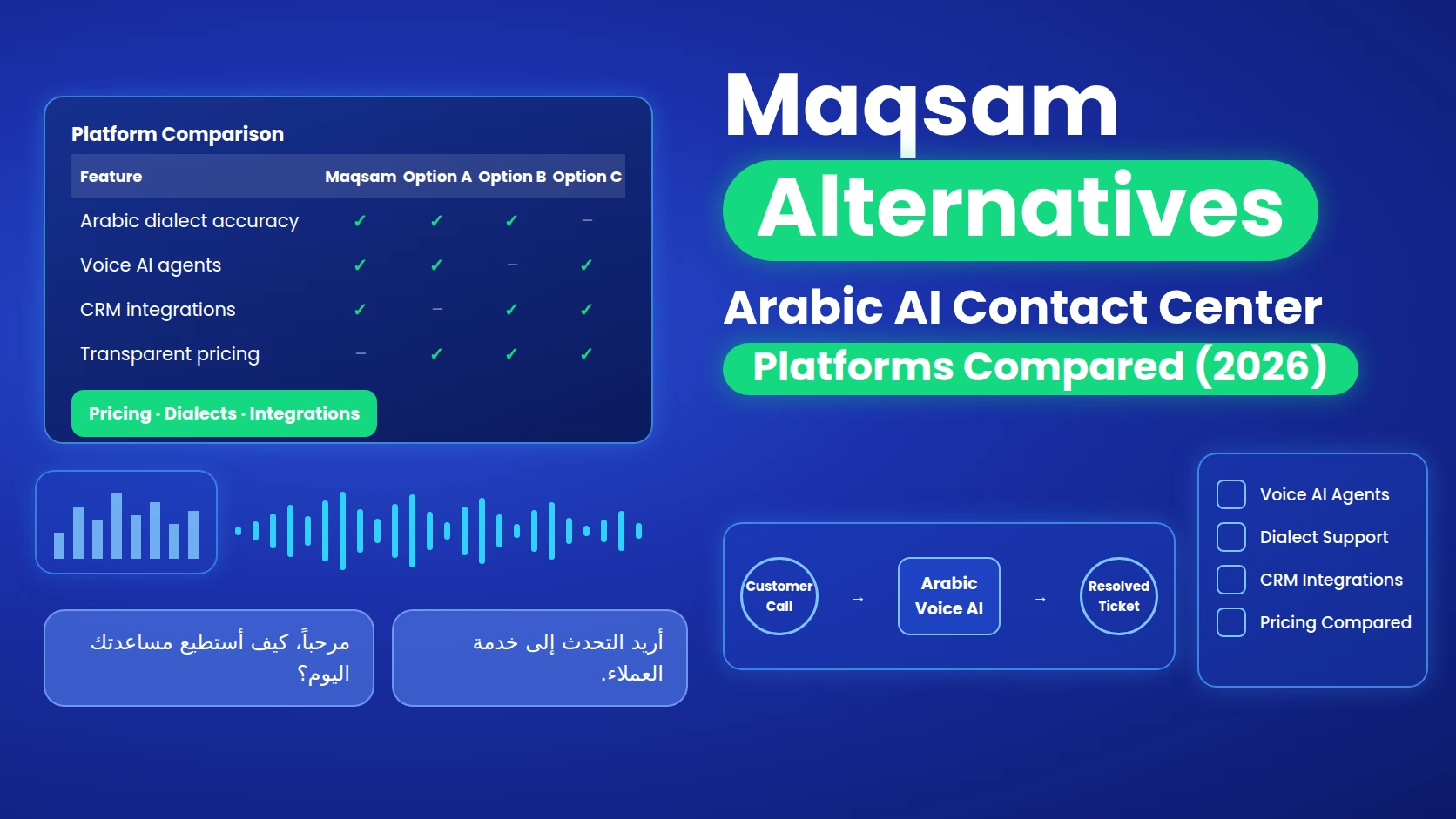
Maqsam Alternatives: Arabic AI Contact Center Platforms Compared (2026)

Arabic Voice AI
Author
Rym Bachouche

Powering the Future with AI

Join our newsletter for insights on cutting-edge technology built in the UAE

Key Takeaways

1

Maqsam, Intella, and Wittify ship complete contact center products (IVR, routing, dashboards, CRM integrations). Munsit provides only the Arabic STT/TTS API and plugins for LiveKit, Pipecat, VAPI, and Ultravox.

2

Both Intella (Ziila) and Maqsam are full Arabic-first AI contact center suites with call analytics and agent automation. Intella adds on-premise deployment for banking, telecom, government, and healthcare.

3

It was rated the single best recording in 53.1% of evaluations, ahead of the human reference (25.7%), Commercial A (17.2%), and Commercial B (4.0%

4

Gulf business calls mix Arabic and English mid-sentence. A robotic or mispronouncing TTS voice erodes caller trust as much as a transcription error.

The post opens by defining Maqsam as an Arabic-first contact center suite and explains why buyers look elsewhere: to cross-check dialect claims, to get more developer control, or to test a specialist speech vendor against bundled Arabic support.

It gives a six-point evaluation framework (dialect coverage, code-switching, TTS quality, data residency, integration depth, pricing). It then profiles four competitors and states plainly that Munsit is an API and framework-plugin layer (LiveKit, Pipecat, VAPI, Ultravox), not an IVR or dashboard product.

‍

Maqsam Alternatives: Arabic AI Contact Center Platforms Compared (2026)

Maqsam is an Arabic-first cloud contact center platform, founded in 2019 by Sinan Taifour and Fouad Jeryes, with a regional presence across Saudi Arabia, the UAE, and Jordan (sources disagree on a single founding city  some report Riyadh, others Amman  so this piece doesn’t assert one). It’s known primarily for its AI Agent and customer service software built specifically for Arabic-speaking markets: call routing, IVR, real-time dashboards, call transcription, summarization, sentiment analysis, and a proprietary Arabic speech recognition engine the company claims performs at 99.1% accuracy against competitors (self-reported, unaudited). Maqsam itself has published its own case for why this is hard to get right  Arabic’s complex morphology, the gap between Modern Standard Arabic and the dialects people actually speak day to day, mid-sentence code-switching between Arabic and English, and accent variation that degrades generic speech-to-text  a fair description of the problem space this whole category is trying to solve, not just a marketing claim specific to Maqsam.

People look for alternatives to Maqsam for the reasons people usually look for alternatives to any vertical SaaS platform: to compare dialect coverage and accuracy claims against a second vendor before a renewal, to find a lighter-weight or more developer-controllable option if the out-of-the-box IVR/dashboard package is more than what’s needed, or to evaluate whether a dedicated speech-AI vendor can outperform a generalist contact-center platform’s bundled Arabic support on accuracy specifically.

‍

This is some text inside of a div block.

Platform What it is Dialect/accuracy claim (self-reported) HQ / founded Best for
Maqsam Full Arabic-first contact-center suite: AI Agent, IVR, call routing, dashboards, CRM integrations 99.1% ASR accuracy vs. competitors Saudi/UAE/Jordan regional presence; founded 2019 (single HQ city disputed) Teams wanting a packaged, ready-to-deploy Arabic contact center
Intella (Ziila) Full Arabic-first contact-center suite + call analytics (intellaCX) + media translation (intellaMX) 25+ dialects, 95.73% STT accuracy, 98% intent recognition Riyadh, Saudi Arabia; founded in Egypt, 2021 Regulated enterprises wanting on-premise deployment alongside packaged agent + analytics tools
Wittify.ai No-code Arabic AI agent platform (voice, text, multimodal) Arabic dialects + English, no independent figure published Riyadh, with Dubai/Cairo operations; $1.5M pre-seed, July 2025 Teams wanting fast, no-code deployment from a newer, smaller vendor
Lucidya MENA CXM platform: social listening, omnichannel service, AI agents (not voice/IVR-first) 92% accuracy, native handling of 17 Arabic dialects MENA-focused; HQ city not disclosed on-site Teams evaluating Arabic AI across social/chat/omnichannel, not just the phone channel
Sprinklr Global enterprise CX platform, not Arabic-specialist No Arabic-specific accuracy figure published Global (US-headquartered); deployed regionally (e.g. Aramex) Organizations already standardized on Sprinklr wanting to consolidate rather than add a specialist vendor
Munsit Arabic STT/TTS API + voice-agent framework plugins (LiveKit, Pipecat, VAPI, Ultravox) — not a packaged contact-center product TTS: 4.27/5 vs. 4.30/5 human reference, 53.1% top-rated share in a 352-rater blind test UAE (CNTXT AI) Teams building a custom Arabic voice agent, or evaluating underlying voice/dialect quality rather than buying a packaged platform
This is some text inside of a div block.

Heading

Lorem ipsum dolor sit amet, consectetur adipiscing elit. Suspendisse varius enim in eros elementum tristique. Duis cursus, mi quis viverra ornare, eros dolor interdum nulla, ut commodo diam libero vitae erat. Aenean faucibus nibh et justo cursus id rutrum lorem imperdiet. Nunc ut sem vitae risus tristique posuere.

Lorem ipsum dolor sit amet, consectetur adipiscing elit. Suspendisse varius enim in eros elementum tristique. Duis cursus, mi quis viverra ornare, eros dolor interdum nulla, ut commodo diam libero vitae erat. Aenean faucibus nibh et justo cursus id rutrum lorem imperdiet. Nunc ut sem vitae risus tristique posuere.

Lorem ipsum dolor sit amet, consectetur adipiscing elit. Suspendisse varius enim in eros elementum tristique. Duis cursus, mi quis viverra ornare, eros dolor interdum nulla, ut commodo diam libero vitae erat. Aenean faucibus nibh et justo cursus id rutrum lorem imperdiet. Nunc ut sem vitae risus tristique posuere.

Lorem ipsum dolor sit amet, consectetur adipiscing elit. Suspendisse varius enim in eros elementum tristique. Duis cursus, mi quis viverra ornare, eros dolor interdum nulla, ut commodo diam libero vitae erat. Aenean faucibus nibh et justo cursus id rutrum lorem imperdiet. Nunc ut sem vitae risus tristique posuere.

What to Evaluate in a Maqsam Alternative

•Named dialect coverage, not just “Arabic.” A vendor that lists specific dialect groups (Gulf, Egyptian, Levantine, Saudi, Emirati) in its own documentation is a different claim than generic “Arabic support,” which often means Modern Standard Arabic only.
‍

•Code-switching handling. Real Gulf business conversation routinely mixes Arabic and English mid-sentence to ask whether this is handled natively or breaks the system’s intent recognition, as Maqsam’s own blog post on the topic describes happening with less dialect-aware systems.
‍

•Voice quality for the AI Agent’s spoken responses, not just transcription accuracy on the inbound side, a contact center AI agent is a two-way voice system, and a robotic-sounding or mispronouncing TTS voice undermines caller trust as much as a transcription error does.
‍

•Deployment and data residency. Call recordings and transcripts are sensitive by default; confirm whether the vendor offers in-region or on-premises deployment versus cloud-only processing outside the jurisdiction.
‍

•Integration depth versus build flexibility. A packaged platform like Maqsam ships CRM integrations, IVR builders, and dashboards out of the box; an API-first speech vendor gives more control over the end-to-end experience but requires more engineering to assemble into a working contact-center product.
‍

•Pricing structure. Per-minute, per-seat, and flat enterprise models all show up in this category, and the right one depends heavily on call volume predictability.

‍

Maqsam Alternatives

Intella (Ziila)


Intella is a Saudi-based AI company (Riyadh-headquartered, originally founded in Egypt in 2021) offering a product suite built around Ziila, described as “the AI agent that speaks your dialect,” alongside intellaCX (call center analytics), intellaMX (media translation/subtitling), and intellaVX (the underlying speech-to-text engine). Intella claims 25+ Arabic dialects, 95.73% speech-to-text accuracy, and 98% intent recognition (all self-reported, not independently audited), and positions itself for high-security, on-premise deployment in regulated sectors  banking, telecom, government, healthcare. This makes it one of the more direct like-for-like alternatives to Maqsam: both are full Arabic-first contact-center AI suites rather than a pure API.
‍

Wittify.ai


Wittify.ai is a Riyadh-based startup (with operations in Dubai and Cairo) that raised a $1.5 million pre-seed round in July 2025 from Saudi angel investors, founded by CEO Nader El-Batrawi and Chief AI Officer Dr. Sarah Alhumoud. It offers a no-code platform for deploying Arabic-speaking AI agents across voice, text, and multimodal channels, built on proprietary Arabic speech recognition and synthesis, and currently serves enterprise and government clients. It’s a newer, smaller company than Maqsam  worth evaluating specifically if a no-code deployment workflow matters more than an established track record.
‍

Lucidya


Lucidya is a MENA-focused AI-native customer experience management (CXM) platform that combines social listening, omnichannel service, customer data, and autonomous AI agents in one product, rather than being a voice-first contact-center platform like Maqsam. It claims 92% accuracy across English and Arabic with native handling of 17 Arabic dialects (self-reported). Lucidya is the right comparison point specifically for teams evaluating Arabic AI beyond the phone channel  social media, chat, and omnichannel service  rather than a pure voice/IVR replacement.
‍

Sprinklr


Sprinklr is a global enterprise customer experience platform, not Arabic-first, but with genuine MENA deployment experience  Aramex selected Sprinklr’s AI chatbots for its customer service across its global operations, including the Middle East. Sprinklr is the generalist option: stronger on broad omnichannel enterprise features and existing global deployments, weaker on the kind of dialect-specific tuning that Arabic-first vendors like Maqsam, Intella, or Munsit build around as their core differentiator. Worth including in an evaluation specifically if the organization already runs other CX workloads on Sprinklr and wants to consolidate rather than add an Arabic-specialist vendor.

See how Munsit performs on real Arabic speech

Evaluate dialect coverage, noise handling, and in-region deployment on data that reflects your customers.
Explore

Where Munsit Fits

Munsit isn’t a packaged contact-center replacement for Maqsam out of the box; it doesn't ship IVR builders, call routing, or CRM dashboards the way Maqsam, Intella, or Wittify do. What it offers instead is the underlying Arabic speech infrastructure  speech-to-text and text-to-speech  as an API, with plugins for the open-source voice-agent frameworks (LiveKit, Pipecat, VAPI, Ultravox) that a team would use to build a custom Arabic voice agent, or to swap into a contact-center stack that’s already assembled around one of those frameworks. The honest comparison: if what’s needed is a plug-and-play Arabic contact center product, Munsit alone isn’t that  Maqsam, Intella, or Wittify are closer fits. If the evaluation is really about the underlying voice quality and dialect accuracy an Arabic AI agent runs on, and there’s engineering capacity to build or already-assembled infrastructure to plug into, Munsit’s API is the more relevant comparison.
‍

On that specific axis  voice quality  there’s independent-style blind-test data worth citing. In CNTXT AI’s 2026 Arabic TTS benchmark, 352 native Arabic speakers rated Munsit’s synthesized speech against two unnamed commercial TTS systems and professional human studio recordings, with all four recordings blind and re-randomized on every item so listeners couldn’t learn to spot Munsit by position. Results:

System Overall Quality (1–5) Top-Rated Share
Munsit 4.27 53.1%
Professional human reference 4.30 25.7%
Commercial system A 4.02 17.2%
Commercial system B 2.92 4.0%

Munsit statistically tied the human reference on overall quality (95% CI on the gap: −0.08 to +0.02) and was rated the single best recording in 53.1% of evaluations more often than the human reference or either commercial competitor. On the dialect-specific breakdown, results were statistically significant for Modern Standard Arabic (251 raters) and Saudi Arabic (76 raters); the Emirati Arabic subsample (25 raters, 32 sessions) was too small to confirm statistically on its own, and CNTXT AI’s own report flags a larger round as underway. This is a vendor-funded benchmark, not independently peer-reviewed, and the competitor systems’ configurations were frozen as of May–June 2026 worth treating as a data point to verify against your own test audio rather than a final word, same as any vendor-run benchmark, including one from Maqsam, Intella, or any other company claiming an accuracy number in this article.

FAQ

Is Munsit a direct replacement for Maqsam?
What’s the most direct like-for-like alternative to Maqsam?
How reliable are the self-reported accuracy numbers vendors publish in this category including Maqsam’s own 99.1% claim?

Powering the Future with AI

Join our newsletter for insights on cutting-edge technology built in the UAE
Thank you! Your submission has been received!
Oops! Something went wrong while submitting the form.
Last update :
October 5, 2026

Maqsam Alternatives: Arabic AI Contact Center Platforms Compared (2026)

How-To
Arabic Voice AI
Author
Sarra Turki
Rym Bachouche
5min read

Bring Arabic Voice AI to production

Native‑level Arabic STT & TTS
Built for GCC gov & enterprises
Sovereign and on‑prem deployment
Contact Sales
Thank you! Your submission has been received!
Oops! Something went wrong while submitting the form.

Key Takeaways

Maqsam, Intella, and Wittify ship complete contact center products (IVR, routing, dashboards, CRM integrations). Munsit provides only the Arabic STT/TTS API and plugins for LiveKit, Pipecat, VAPI, and Ultravox.

Both Intella (Ziila) and Maqsam are full Arabic-first AI contact center suites with call analytics and agent automation. Intella adds on-premise deployment for banking, telecom, government, and healthcare.

It was rated the single best recording in 53.1% of evaluations, ahead of the human reference (25.7%), Commercial A (17.2%), and Commercial B (4.0%

Gulf business calls mix Arabic and English mid-sentence. A robotic or mispronouncing TTS voice erodes caller trust as much as a transcription error.

Call audio often contains financial or health details. Confirm in-region storage and processing before deploying in banking, healthcare, or government.

The UAE AI Charter sets transparency as a principle but no law mandates telling callers they're talking to an AI. Disclose early anyway.

The post opens by defining Maqsam as an Arabic-first contact center suite and explains why buyers look elsewhere: to cross-check dialect claims, to get more developer control, or to test a specialist speech vendor against bundled Arabic support.

It gives a six-point evaluation framework (dialect coverage, code-switching, TTS quality, data residency, integration depth, pricing). It then profiles four competitors and states plainly that Munsit is an API and framework-plugin layer (LiveKit, Pipecat, VAPI, Ultravox), not an IVR or dashboard product.

‍

Maqsam Alternatives: Arabic AI Contact Center Platforms Compared (2026)

Maqsam is an Arabic-first cloud contact center platform, founded in 2019 by Sinan Taifour and Fouad Jeryes, with a regional presence across Saudi Arabia, the UAE, and Jordan (sources disagree on a single founding city  some report Riyadh, others Amman  so this piece doesn’t assert one). It’s known primarily for its AI Agent and customer service software built specifically for Arabic-speaking markets: call routing, IVR, real-time dashboards, call transcription, summarization, sentiment analysis, and a proprietary Arabic speech recognition engine the company claims performs at 99.1% accuracy against competitors (self-reported, unaudited). Maqsam itself has published its own case for why this is hard to get right  Arabic’s complex morphology, the gap between Modern Standard Arabic and the dialects people actually speak day to day, mid-sentence code-switching between Arabic and English, and accent variation that degrades generic speech-to-text  a fair description of the problem space this whole category is trying to solve, not just a marketing claim specific to Maqsam.

People look for alternatives to Maqsam for the reasons people usually look for alternatives to any vertical SaaS platform: to compare dialect coverage and accuracy claims against a second vendor before a renewal, to find a lighter-weight or more developer-controllable option if the out-of-the-box IVR/dashboard package is more than what’s needed, or to evaluate whether a dedicated speech-AI vendor can outperform a generalist contact-center platform’s bundled Arabic support on accuracy specifically.

‍

Lorem ipsum dolor
Lorem ipsum dolor
Lorem ipsum dolor
Lorem ipsum dolor
Lorem ipsum dolor
Lorem ipsum dolor
Lorem ipsum dolor
Lorem ipsum dolor
Lorem ipsum dolor
Lorem ipsum dolor
Lorem ipsum dolor
Lorem ipsum dolor
Lorem ipsum dolor
Lorem ipsum dolor
Lorem ipsum dolor
Lorem ipsum dolor
Lorem ipsum dolor
Lorem ipsum dolor
Lorem ipsum dolor
Lorem ipsum dolor
Lorem ipsum dolor
Lorem ipsum dolor
Lorem ipsum dolor
Lorem ipsum dolor
Lorem ipsum dolor
Lorem ipsum dolor
Lorem ipsum dolor
Lorem ipsum dolor
Lorem ipsum dolor
Lorem ipsum dolor
Lorem ipsum dolor
Lorem ipsum dolor

Understanding the origins of AI hallucinations is the first step toward mitigating them. The phenomenon is not a single problem but rather a complex issue with multiple contributing factors.

1

Training Data Deficiencies

Platform What it is Dialect/accuracy claim (self-reported) HQ / founded Best for
Maqsam Full Arabic-first contact-center suite: AI Agent, IVR, call routing, dashboards, CRM integrations 99.1% ASR accuracy vs. competitors Saudi/UAE/Jordan regional presence; founded 2019 (single HQ city disputed) Teams wanting a packaged, ready-to-deploy Arabic contact center
Intella (Ziila) Full Arabic-first contact-center suite + call analytics (intellaCX) + media translation (intellaMX) 25+ dialects, 95.73% STT accuracy, 98% intent recognition Riyadh, Saudi Arabia; founded in Egypt, 2021 Regulated enterprises wanting on-premise deployment alongside packaged agent + analytics tools
Wittify.ai No-code Arabic AI agent platform (voice, text, multimodal) Arabic dialects + English, no independent figure published Riyadh, with Dubai/Cairo operations; $1.5M pre-seed, July 2025 Teams wanting fast, no-code deployment from a newer, smaller vendor
Lucidya MENA CXM platform: social listening, omnichannel service, AI agents (not voice/IVR-first) 92% accuracy, native handling of 17 Arabic dialects MENA-focused; HQ city not disclosed on-site Teams evaluating Arabic AI across social/chat/omnichannel, not just the phone channel
Sprinklr Global enterprise CX platform, not Arabic-specialist No Arabic-specific accuracy figure published Global (US-headquartered); deployed regionally (e.g. Aramex) Organizations already standardized on Sprinklr wanting to consolidate rather than add a specialist vendor
Munsit Arabic STT/TTS API + voice-agent framework plugins (LiveKit, Pipecat, VAPI, Ultravox) — not a packaged contact-center product TTS: 4.27/5 vs. 4.30/5 human reference, 53.1% top-rated share in a 352-rater blind test UAE (CNTXT AI) Teams building a custom Arabic voice agent, or evaluating underlying voice/dialect quality rather than buying a packaged platform
2

Training Data Deficiencies

The most significant contributor to AI hallucinations is the data on which the models are trained. LLMs learn from vast datasets scraped from the internet, which contain a mixture of factual information, opinions, misinformation, and biases. Several specific data-related issues can lead to hallucinations:

Enterprise Use Cases for Arabic Voice AI in 2025

The move to dialect-aware Arabic ASR is unlocking a new wave of enterprise applications across the GCC and MENA regions. Organizations are moving beyond basic transcription to sophisticated Arabic speech analytics.

Arabic speech technology is rapidly advancing in 2025, driven by massive multilingual models and new Arabic-centric foundation models.

Arabic speech technology is rapidly advancing in 2025, driven by massive multilingual models and new Arabic-centric foundation models.

Arabic speech technology is rapidly advancing in 2025, driven by massive multilingual models and new Arabic-centric foundation models.

Arabic speech technology is rapidly advancing in 2025, driven by massive multilingual models and new Arabic-centric foundation models.

What to Evaluate in a Maqsam Alternative

Understanding the origins of AI hallucinations is the first step toward mitigating them. The phenomenon is not a single problem but rather a complex issue with multiple contributing factors.

1

Training Data Deficiencies

•Named dialect coverage, not just “Arabic.” A vendor that lists specific dialect groups (Gulf, Egyptian, Levantine, Saudi, Emirati) in its own documentation is a different claim than generic “Arabic support,” which often means Modern Standard Arabic only.
‍

•Code-switching handling. Real Gulf business conversation routinely mixes Arabic and English mid-sentence to ask whether this is handled natively or breaks the system’s intent recognition, as Maqsam’s own blog post on the topic describes happening with less dialect-aware systems.
‍

•Voice quality for the AI Agent’s spoken responses, not just transcription accuracy on the inbound side, a contact center AI agent is a two-way voice system, and a robotic-sounding or mispronouncing TTS voice undermines caller trust as much as a transcription error does.
‍

•Deployment and data residency. Call recordings and transcripts are sensitive by default; confirm whether the vendor offers in-region or on-premises deployment versus cloud-only processing outside the jurisdiction.
‍

•Integration depth versus build flexibility. A packaged platform like Maqsam ships CRM integrations, IVR builders, and dashboards out of the box; an API-first speech vendor gives more control over the end-to-end experience but requires more engineering to assemble into a working contact-center product.
‍

•Pricing structure. Per-minute, per-seat, and flat enterprise models all show up in this category, and the right one depends heavily on call volume predictability.

‍

2

Training Data Deficiencies

The most significant contributor to AI hallucinations is the data on which the models are trained. LLMs learn from vast datasets scraped from the internet, which contain a mixture of factual information, opinions, misinformation, and biases. Several specific data-related issues can lead to hallucinations:

Enterprise Use Cases for Arabic Voice AI in 2025

The move to dialect-aware Arabic ASR is unlocking a new wave of enterprise applications across the GCC and MENA regions. Organizations are moving beyond basic transcription to sophisticated Arabic speech analytics.

Arabic speech technology is rapidly advancing in 2025, driven by massive multilingual models and new Arabic-centric foundation models.

Arabic speech technology is rapidly advancing in 2025, driven by massive multilingual models and new Arabic-centric foundation models.

Arabic speech technology is rapidly advancing in 2025, driven by massive multilingual models and new Arabic-centric foundation models.

Arabic speech technology is rapidly advancing in 2025, driven by massive multilingual models and new Arabic-centric foundation models.

Building better AI systems takes the right approach

We help with custom solutions, data pipelines, and Arabic intelligence.

Maqsam Alternatives

Understanding the origins of AI hallucinations is the first step toward mitigating them. The phenomenon is not a single problem but rather a complex issue with multiple contributing factors.

1

Training Data Deficiencies

Intella (Ziila)


Intella is a Saudi-based AI company (Riyadh-headquartered, originally founded in Egypt in 2021) offering a product suite built around Ziila, described as “the AI agent that speaks your dialect,” alongside intellaCX (call center analytics), intellaMX (media translation/subtitling), and intellaVX (the underlying speech-to-text engine). Intella claims 25+ Arabic dialects, 95.73% speech-to-text accuracy, and 98% intent recognition (all self-reported, not independently audited), and positions itself for high-security, on-premise deployment in regulated sectors  banking, telecom, government, healthcare. This makes it one of the more direct like-for-like alternatives to Maqsam: both are full Arabic-first contact-center AI suites rather than a pure API.
‍

Wittify.ai


Wittify.ai is a Riyadh-based startup (with operations in Dubai and Cairo) that raised a $1.5 million pre-seed round in July 2025 from Saudi angel investors, founded by CEO Nader El-Batrawi and Chief AI Officer Dr. Sarah Alhumoud. It offers a no-code platform for deploying Arabic-speaking AI agents across voice, text, and multimodal channels, built on proprietary Arabic speech recognition and synthesis, and currently serves enterprise and government clients. It’s a newer, smaller company than Maqsam  worth evaluating specifically if a no-code deployment workflow matters more than an established track record.
‍

Lucidya


Lucidya is a MENA-focused AI-native customer experience management (CXM) platform that combines social listening, omnichannel service, customer data, and autonomous AI agents in one product, rather than being a voice-first contact-center platform like Maqsam. It claims 92% accuracy across English and Arabic with native handling of 17 Arabic dialects (self-reported). Lucidya is the right comparison point specifically for teams evaluating Arabic AI beyond the phone channel  social media, chat, and omnichannel service  rather than a pure voice/IVR replacement.
‍

Sprinklr


Sprinklr is a global enterprise customer experience platform, not Arabic-first, but with genuine MENA deployment experience  Aramex selected Sprinklr’s AI chatbots for its customer service across its global operations, including the Middle East. Sprinklr is the generalist option: stronger on broad omnichannel enterprise features and existing global deployments, weaker on the kind of dialect-specific tuning that Arabic-first vendors like Maqsam, Intella, or Munsit build around as their core differentiator. Worth including in an evaluation specifically if the organization already runs other CX workloads on Sprinklr and wants to consolidate rather than add an Arabic-specialist vendor.

2

Training Data Deficiencies

The most significant contributor to AI hallucinations is the data on which the models are trained. LLMs learn from vast datasets scraped from the internet, which contain a mixture of factual information, opinions, misinformation, and biases. Several specific data-related issues can lead to hallucinations:

Enterprise Use Cases for Arabic Voice AI in 2025

The move to dialect-aware Arabic ASR is unlocking a new wave of enterprise applications across the GCC and MENA regions. Organizations are moving beyond basic transcription to sophisticated Arabic speech analytics.

Arabic speech technology is rapidly advancing in 2025, driven by massive multilingual models and new Arabic-centric foundation models.

Arabic speech technology is rapidly advancing in 2025, driven by massive multilingual models and new Arabic-centric foundation models.

Arabic speech technology is rapidly advancing in 2025, driven by massive multilingual models and new Arabic-centric foundation models.

Arabic speech technology is rapidly advancing in 2025, driven by massive multilingual models and new Arabic-centric foundation models.

Where Munsit Fits

Understanding the origins of AI hallucinations is the first step toward mitigating them. The phenomenon is not a single problem but rather a complex issue with multiple contributing factors.

1

Training Data Deficiencies

Munsit isn’t a packaged contact-center replacement for Maqsam out of the box; it doesn't ship IVR builders, call routing, or CRM dashboards the way Maqsam, Intella, or Wittify do. What it offers instead is the underlying Arabic speech infrastructure  speech-to-text and text-to-speech  as an API, with plugins for the open-source voice-agent frameworks (LiveKit, Pipecat, VAPI, Ultravox) that a team would use to build a custom Arabic voice agent, or to swap into a contact-center stack that’s already assembled around one of those frameworks. The honest comparison: if what’s needed is a plug-and-play Arabic contact center product, Munsit alone isn’t that  Maqsam, Intella, or Wittify are closer fits. If the evaluation is really about the underlying voice quality and dialect accuracy an Arabic AI agent runs on, and there’s engineering capacity to build or already-assembled infrastructure to plug into, Munsit’s API is the more relevant comparison.
‍

On that specific axis  voice quality  there’s independent-style blind-test data worth citing. In CNTXT AI’s 2026 Arabic TTS benchmark, 352 native Arabic speakers rated Munsit’s synthesized speech against two unnamed commercial TTS systems and professional human studio recordings, with all four recordings blind and re-randomized on every item so listeners couldn’t learn to spot Munsit by position. Results:

System Overall Quality (1–5) Top-Rated Share
Munsit 4.27 53.1%
Professional human reference 4.30 25.7%
Commercial system A 4.02 17.2%
Commercial system B 2.92 4.0%

Munsit statistically tied the human reference on overall quality (95% CI on the gap: −0.08 to +0.02) and was rated the single best recording in 53.1% of evaluations more often than the human reference or either commercial competitor. On the dialect-specific breakdown, results were statistically significant for Modern Standard Arabic (251 raters) and Saudi Arabic (76 raters); the Emirati Arabic subsample (25 raters, 32 sessions) was too small to confirm statistically on its own, and CNTXT AI’s own report flags a larger round as underway. This is a vendor-funded benchmark, not independently peer-reviewed, and the competitor systems’ configurations were frozen as of May–June 2026 worth treating as a data point to verify against your own test audio rather than a final word, same as any vendor-run benchmark, including one from Maqsam, Intella, or any other company claiming an accuracy number in this article.

2

Training Data Deficiencies

The most significant contributor to AI hallucinations is the data on which the models are trained. LLMs learn from vast datasets scraped from the internet, which contain a mixture of factual information, opinions, misinformation, and biases. Several specific data-related issues can lead to hallucinations:

Enterprise Use Cases for Arabic Voice AI in 2025

The move to dialect-aware Arabic ASR is unlocking a new wave of enterprise applications across the GCC and MENA regions. Organizations are moving beyond basic transcription to sophisticated Arabic speech analytics.

Arabic speech technology is rapidly advancing in 2025, driven by massive multilingual models and new Arabic-centric foundation models.

Arabic speech technology is rapidly advancing in 2025, driven by massive multilingual models and new Arabic-centric foundation models.

Arabic speech technology is rapidly advancing in 2025, driven by massive multilingual models and new Arabic-centric foundation models.

Arabic speech technology is rapidly advancing in 2025, driven by massive multilingual models and new Arabic-centric foundation models.

UAE and Saudi Compliance Considerations for Contact Center AI

Understanding the origins of AI hallucinations is the first step toward mitigating them. The phenomenon is not a single problem but rather a complex issue with multiple contributing factors.

1

Training Data Deficiencies

A contact-center platform  whichever vendor it runs on  processes live customer voice and call recordings, which carries specific regulatory weight in the UAE and Saudi Arabia:

‍

Call recordings and derived transcripts are personal data. Under the UAE’s Federal Decree-Law No. 45/2021 (PDPL) and Saudi Arabia’s PDPL (enforced since September 2024), recorded calls, transcripts, and any sentiment or intent data derived from them are personal data requiring a documented legal basis for processing  typically consent (often satisfied by a standard “this call may be recorded” notice) or legitimate business interest with proper disclosure.

‍

AI agent disclosure is good practice, not yet a specific statutory mandate. As with other Arabic voice AI deployments, the UAE Charter for the Development and Use of Artificial Intelligence sets transparency as a national AI principle without a specific statute mandating disclosure to callers that they’re speaking with an AI agent  disclosing this early in the call is a reasonable practice consistent with that principle regardless.
‍

Data residency matters more for contact centers than most voice AI use cases, since call recordings often include financial, health, or other sensitive details disclosed over the phone. Confirm whether a vendor processes and stores audio within the UAE/Saudi region or routes it through infrastructure outside the jurisdiction, particularly for banking, healthcare, or government deployments.
‍

This section provides general information, not legal advice. Consult qualified legal counsel for compliance decisions specific to your deployment and jurisdiction.

‍

2

Training Data Deficiencies

The most significant contributor to AI hallucinations is the data on which the models are trained. LLMs learn from vast datasets scraped from the internet, which contain a mixture of factual information, opinions, misinformation, and biases. Several specific data-related issues can lead to hallucinations:

Enterprise Use Cases for Arabic Voice AI in 2025

The move to dialect-aware Arabic ASR is unlocking a new wave of enterprise applications across the GCC and MENA regions. Organizations are moving beyond basic transcription to sophisticated Arabic speech analytics.

Arabic speech technology is rapidly advancing in 2025, driven by massive multilingual models and new Arabic-centric foundation models.

Arabic speech technology is rapidly advancing in 2025, driven by massive multilingual models and new Arabic-centric foundation models.

Arabic speech technology is rapidly advancing in 2025, driven by massive multilingual models and new Arabic-centric foundation models.

Arabic speech technology is rapidly advancing in 2025, driven by massive multilingual models and new Arabic-centric foundation models.

Understanding the origins of AI hallucinations is the first step toward mitigating them. The phenomenon is not a single problem but rather a complex issue with multiple contributing factors.

1

Training Data Deficiencies

2

Training Data Deficiencies

The most significant contributor to AI hallucinations is the data on which the models are trained. LLMs learn from vast datasets scraped from the internet, which contain a mixture of factual information, opinions, misinformation, and biases. Several specific data-related issues can lead to hallucinations:

Enterprise Use Cases for Arabic Voice AI in 2025

The move to dialect-aware Arabic ASR is unlocking a new wave of enterprise applications across the GCC and MENA regions. Organizations are moving beyond basic transcription to sophisticated Arabic speech analytics.

Arabic speech technology is rapidly advancing in 2025, driven by massive multilingual models and new Arabic-centric foundation models.

Arabic speech technology is rapidly advancing in 2025, driven by massive multilingual models and new Arabic-centric foundation models.

Arabic speech technology is rapidly advancing in 2025, driven by massive multilingual models and new Arabic-centric foundation models.

Arabic speech technology is rapidly advancing in 2025, driven by massive multilingual models and new Arabic-centric foundation models.

Understanding the origins of AI hallucinations is the first step toward mitigating them. The phenomenon is not a single problem but rather a complex issue with multiple contributing factors.

1

Training Data Deficiencies

2

Training Data Deficiencies

The most significant contributor to AI hallucinations is the data on which the models are trained. LLMs learn from vast datasets scraped from the internet, which contain a mixture of factual information, opinions, misinformation, and biases. Several specific data-related issues can lead to hallucinations:

Enterprise Use Cases for Arabic Voice AI in 2025

The move to dialect-aware Arabic ASR is unlocking a new wave of enterprise applications across the GCC and MENA regions. Organizations are moving beyond basic transcription to sophisticated Arabic speech analytics.

Arabic speech technology is rapidly advancing in 2025, driven by massive multilingual models and new Arabic-centric foundation models.

Arabic speech technology is rapidly advancing in 2025, driven by massive multilingual models and new Arabic-centric foundation models.

Arabic speech technology is rapidly advancing in 2025, driven by massive multilingual models and new Arabic-centric foundation models.

Arabic speech technology is rapidly advancing in 2025, driven by massive multilingual models and new Arabic-centric foundation models.

Understanding the origins of AI hallucinations is the first step toward mitigating them. The phenomenon is not a single problem but rather a complex issue with multiple contributing factors.

1

Training Data Deficiencies

2

Training Data Deficiencies

The most significant contributor to AI hallucinations is the data on which the models are trained. LLMs learn from vast datasets scraped from the internet, which contain a mixture of factual information, opinions, misinformation, and biases. Several specific data-related issues can lead to hallucinations:

Enterprise Use Cases for Arabic Voice AI in 2025

The move to dialect-aware Arabic ASR is unlocking a new wave of enterprise applications across the GCC and MENA regions. Organizations are moving beyond basic transcription to sophisticated Arabic speech analytics.

Arabic speech technology is rapidly advancing in 2025, driven by massive multilingual models and new Arabic-centric foundation models.

Arabic speech technology is rapidly advancing in 2025, driven by massive multilingual models and new Arabic-centric foundation models.

Arabic speech technology is rapidly advancing in 2025, driven by massive multilingual models and new Arabic-centric foundation models.

Arabic speech technology is rapidly advancing in 2025, driven by massive multilingual models and new Arabic-centric foundation models.

Understanding the origins of AI hallucinations is the first step toward mitigating them. The phenomenon is not a single problem but rather a complex issue with multiple contributing factors.

1

Training Data Deficiencies

2

Training Data Deficiencies

The most significant contributor to AI hallucinations is the data on which the models are trained. LLMs learn from vast datasets scraped from the internet, which contain a mixture of factual information, opinions, misinformation, and biases. Several specific data-related issues can lead to hallucinations:

Enterprise Use Cases for Arabic Voice AI in 2025

The move to dialect-aware Arabic ASR is unlocking a new wave of enterprise applications across the GCC and MENA regions. Organizations are moving beyond basic transcription to sophisticated Arabic speech analytics.

Arabic speech technology is rapidly advancing in 2025, driven by massive multilingual models and new Arabic-centric foundation models.

Arabic speech technology is rapidly advancing in 2025, driven by massive multilingual models and new Arabic-centric foundation models.

Arabic speech technology is rapidly advancing in 2025, driven by massive multilingual models and new Arabic-centric foundation models.

Arabic speech technology is rapidly advancing in 2025, driven by massive multilingual models and new Arabic-centric foundation models.

FAQ
Is Munsit a direct replacement for Maqsam?
What’s the most direct like-for-like alternative to Maqsam?
How reliable are the self-reported accuracy numbers vendors publish in this category including Maqsam’s own 99.1% claim?
Does dialect coverage matter more than overall “Arabic support”?

Bring Arabic Voice AI to production

Native‑level Arabic STT & TTS
Built for GCC gov & enterprises
Sovereign and on‑prem deployment
Contact Sales
Thank you! Your submission has been received!
Oops! Something went wrong while submitting the form.

Start free.  
Pay when you are ready.

10,000 credits. Test Munsit with your own audio, in your own dialect, and see the accuracy for yourself.