أدلة إرشادية
لتر 5 دقيقة

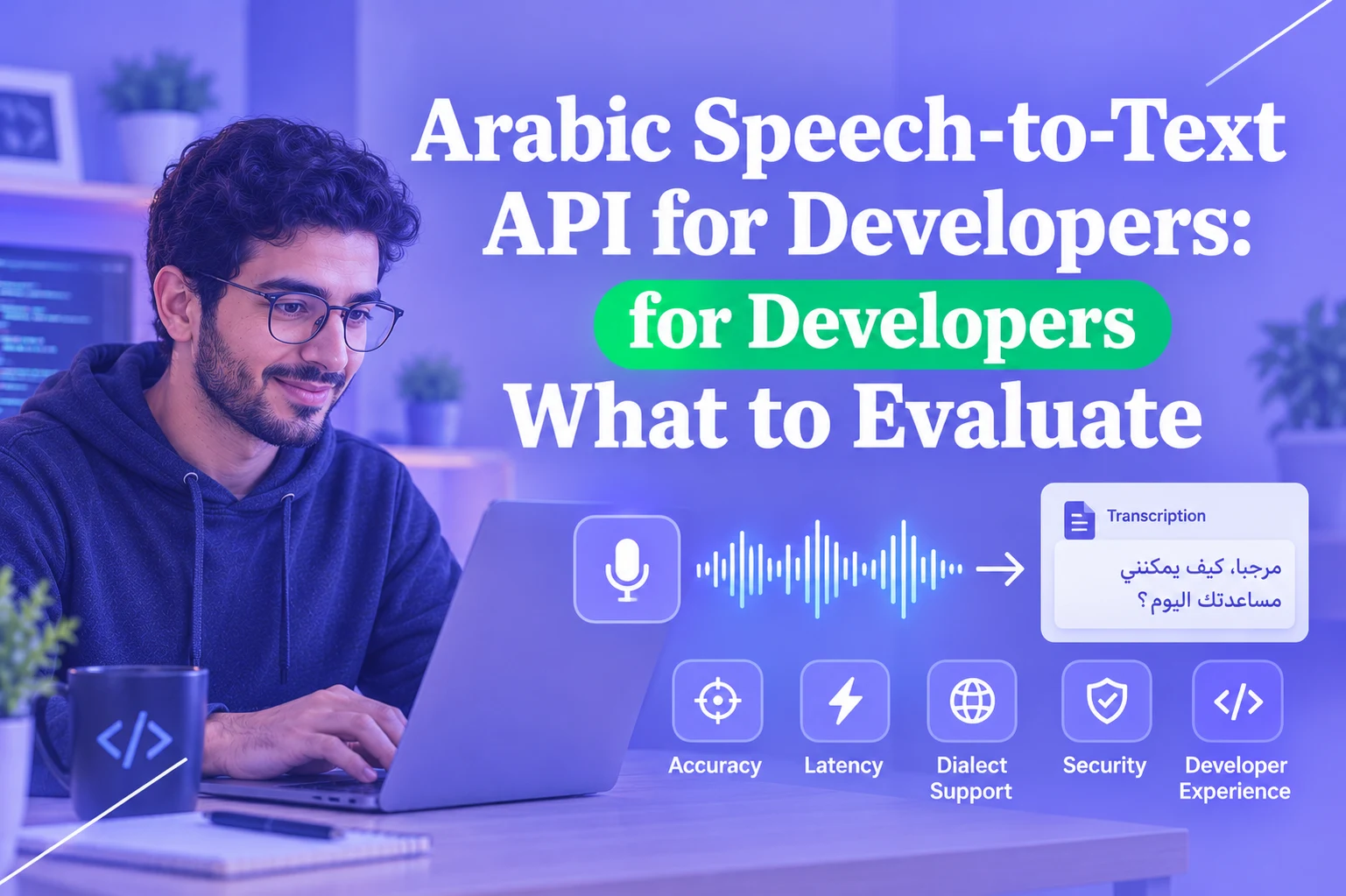
Arabic Speech-to-Text API for Developers: What to Evaluate

التقنيات الصوتية بالذكاء الاصطناعي
المؤلف
ريم باشوش

تعزيز المستقبل باستخدام الذكاء الاصطناعي

انضم إلى النشرة الإخبارية للحصول على رؤى حول أحدث التقنيات المبنية في الإمارات العربية المتحدة

الوجبات السريعة الرئيسية

1

Look beyond the feature checklist: Arabic STT accuracy depends heavily on dialect, vocabulary, pronunciation, code-switching, and real-world audio conditions.

2

Test real-time performance: Developers should evaluate both streaming and batch processing based on their specific use case, especially for voice agents and live applications.

3

Dialect handling matters: Automatic dialect detection is valuable for mixed-dialect conversations, particularly in GCC contact centers where speakers may switch between Arabic varieties and English.

4

Don't compare WER blindly: Arabic WER results can vary because of differences in text normalization, so vendors should be tested using the same datasets and evaluation rules.

Choosing an Arabic speech-to-text API requires more than checking language support. This guide explains how to evaluate dialect handling, Arabic-English code-switching, streaming, WER, audio quality, deployment, and downstream capabilities, while showing how to run a reliable real-world pilot before choosing a provider

Arabic Speech-to-Text API for Developers

Evaluating an Arabic speech-to-text API by feature checklist alone misses most of what actually breaks in production. Two providers can both list “Arabic” as a supported language and produce very different results on the same call recording, because Arabic isn’t one language to a model  it’s Modern Standard Arabic (MSA) plus 25+ spoken dialects with real differences in vocabulary, pronunciation, and grammar, not just accent. A model that scores well on formal, MSA-register benchmark audio can still fail badly on a Dubai contact-center call where the customer is speaking Emirati Arabic and switching into English mid-sentence.
‍

This article walks through what actually matters when evaluating an Arabic STT API as a developer, then covers how Munsit’s API addresses each of those points  including an independent benchmark of its accuracy against a widely used open baseline.

‍

This is some text inside of a div block.

What Developers Actually Need to Evaluate

Real-time streaming vs. batch processing. Live call monitoring, voice agents, and real-time dashboards need partial transcripts delivered as the speaker talks, typically over WebSocket. Recorded-file processing  meetings, broadcasts, medical dictation  can tolerate higher latency in exchange for maximum accuracy. Not every provider optimizes for both, and some (OpenAI Whisper, for instance) are batch-only with no real-time streaming path at all.
‍

Whether dialect handling is automatic or requires a locale parameter. This is one of the more overlooked evaluation criteria because it doesn’t show up in a feature list; it shows up the first time a single call contains more than one dialect. Locale-code systems require the caller to declare the expected variety per request (ar-AE, ar-EG, and so on), which breaks down when a Gulf contact-center call mixes Emirati, Egyptian, and English in the same conversation. Dialect-aware single models work from one language setting and handle the variation internally, which is the safer default for genuinely mixed-dialect environments.
‍

Code-switching support. In GCC business environments, speakers frequently alternate between Arabic and English within the same sentence  “I need to check the report قبل ما نبدأ the meeting” is a normal construction, not an edge case. Generic multilingual models often treat this as two separate recognition tasks and switch models mid-sentence, producing seams and errors at the language boundary. Whether a provider trains on real bilingual data versus stitching separate monolingual models together is worth confirming directly, not assuming from a features page.
‍

Why WER numbers aren’t directly comparable between vendors. Word error rate in Arabic is inflated by orthographic variation that has nothing to do with recognition quality  the same spoken word can be legitimately written multiple ways, English loanwords can be rendered in Arabic or Latin script, and diacritics may or may not be counted. Two vendors can transcribe identical audio equally well and report WER figures several points apart purely because their text normalizers differ. The practical consequence: never compare Vendor A’s self-reported WER directly against Vendor B’s self-reported WER. Compare both on the same test set with the same normalization  which is exactly what independent, third-party benchmarks exist to do  or run your own pilot.
‍

The understanding layer beyond raw transcription. A transcript alone is rarely the end deliverable. Diarization (who said what), sentiment analysis per speaker, keyword extraction, translation, and structured meeting minutes are common downstream requirements. Whether a provider bundles these behind the same API key or leaves them to a separate NLP pipeline changes both engineering effort and the number of vendors in a stack.
‍

Audio quality and pre-processing. Contact-center and field audio is rarely clean; background noise, crosstalk, variable microphone quality, telephony bandwidth (8 kHz) are the norm, not the exception. Whether a provider trained on real contact-center audio, and whether it offers a denoising or voice-isolation step ahead of transcription, affects real-world accuracy more than headline WER figures from clean test sets.
‍

Authentication, SDKs, and spec publication. A single API key vs. more complex auth flows, official SDKs vs. community wrappers, and  for teams generating their own clients  whether the vendor publishes an OpenAPI or AsyncAPI spec for codegen rather than hand-rolled docs to translate into types.
‍

Rate limits and concurrency. Documented limits (requests per minute, concurrent streams) to plan capacity around, rather than limits discovered in production.
‍

Deployment model. Cloud APIs are fastest to integrate but send all audio to the provider’s infrastructure. Government, banking, healthcare, and other regulated GCC sectors frequently require sovereign cloud (VPC), on-premises deployment for air-gapped environments, or on-device processing for offline use cases  worth confirming before an architecture decision locks a product into cloud-only.

‍

This is some text inside of a div block.

Heading

Lorem ipsum dolor sit amet, consectetur adipiscing elit. Suspendisse varius enim in eros elementum tristique. Duis cursus, mi quis viverra ornare, eros dolor interdum nulla, ut commodo diam libero vitae erat. Aenean faucibus nibh et justo cursus id rutrum lorem imperdiet. Nunc ut sem vitae risus tristique posuere.

Lorem ipsum dolor sit amet, consectetur adipiscing elit. Suspendisse varius enim in eros elementum tristique. Duis cursus, mi quis viverra ornare, eros dolor interdum nulla, ut commodo diam libero vitae erat. Aenean faucibus nibh et justo cursus id rutrum lorem imperdiet. Nunc ut sem vitae risus tristique posuere.

Lorem ipsum dolor sit amet, consectetur adipiscing elit. Suspendisse varius enim in eros elementum tristique. Duis cursus, mi quis viverra ornare, eros dolor interdum nulla, ut commodo diam libero vitae erat. Aenean faucibus nibh et justo cursus id rutrum lorem imperdiet. Nunc ut sem vitae risus tristique posuere.

Lorem ipsum dolor sit amet, consectetur adipiscing elit. Suspendisse varius enim in eros elementum tristique. Duis cursus, mi quis viverra ornare, eros dolor interdum nulla, ut commodo diam libero vitae erat. Aenean faucibus nibh et justo cursus id rutrum lorem imperdiet. Nunc ut sem vitae risus tristique posuere.

How to Run a Pilot That Produces Trustworthy Numbers

Given the WER-comparability problem above, the most reliable way to evaluate any shortlist is a short, structured pilot rather than trusting vendor-published figures against each other:
‍

1.  Build a test set from real audio  60 to 120 minutes sampled to match the actual dialect distribution, not clean studio recordings

2. Include the hard cases deliberately  code-switched clips, overlapping speakers, the noisiest channel in the pipeline (telephony audio, field recordings)

3. Have a native speaker produce reference transcripts once, then score every vendor against the same references with the same normalization rules

4. Test streaming latency on real infrastructure, measured end-to-end and in-region, not from a vendor’s demo page

5. Score the downstream output, not just the transcript  if the product needs meeting minutes or sentiment, evaluate that final output, because a slightly better raw transcript feeding a worse downstream pipeline can still lose overall

‍

How Munsit’s API Addresses This

Munsit is an Arabic Voice AI platform built in the UAE, offering Arabic speech-to-text via REST and WebSocket streaming behind a single API key, documented with a published OpenAPI specification and a WebSocket protocol specification.
‍

API surface:
‍

•Transcribe: POST /audio/transcribe  send a file, receive a transcript

•Stream in real time: WebSocket at /websocket/speech-to-text  transcripts arrive as the speaker talks

•Speaker diarization: POST /audio/diarization/transcribe

•Diarization + sentiment: per-speaker sentiment analysis layered on a diarized transcript

•Minutes of meetings: POST /minutes-of-meeting/transcribe  send a recording, receive structured minutes directly

•Keyword extraction and translation on transcripts and meeting outputs

•Voice isolation: POST /denoise  clean noisy contact-center or field audio before transcription, in the speech to text API
‍

Dialect handling is automatic, with no locale parameter to configure. The model covers 25+ dialects  Gulf varieties (Emirati, Khaleeji, Najdi, Hijazi), Levantine, Egyptian, Sudanese, Iraqi, North African dialects, and MSA  and identifies the spoken variety on its own, including handling code-switching between Arabic and English within the same conversation. This matters specifically for the locale-parameter problem described above: a single call that shifts between dialects and English doesn’t require the caller to guess or declare a variety in advance.
‍

The understanding layer sits behind the same key. Diarization, per-speaker sentiment, meeting minutes, keyword extraction, translation, and voice isolation are all reachable with the same API key used for transcription  for teams building call analytics or compliance review, this collapses what is normally a three-vendor pipeline (ASR, NLP, audio cleanup) into one.
‍

Real-time streaming is available over a dedicated WebSocket (/websocket/speech-to-text), producing partial transcripts as the speaker talks, suitable for live call monitoring, voice agents, and real-time dashboards. Batch file processing runs through the REST endpoint for recorded audio.
‍

Voice agent framework integrations: drop-in plugins for LiveKit, Pipecat, VAPI, and Ultravox, so teams building Arabic voice agents on standard frameworks integrate without writing custom WebSocket handling.
‍

Deployment options: cloud API, sovereign cloud (VPC), on-premises for air-gapped government and banking environments, and on-device processing.
‍

Authentication: a single API key (x-api-key header) covers transcription, the understanding layer, and Munsit’s text-to-speech product.
‍

Pricing: free credits on signup, no card required. Paid plans from $8/month (billed annually) with 200,000 credits/month; enterprise pricing for sovereign deployment and high volume. (Verify current rates and the credits-to-audio-duration conversion directly at munsit.com/pricing, since usage-based pricing details change.)

‍

شاهد أداء Munsit في الكلام العربي الحقيقي

قم بتقييم تغطية اللهجة ومعالجة الضوضاء والنشر داخل المنطقة على البيانات التي تعكس عملائك.
اكتشف

Independent Benchmark: Where Munsit Lands on Accuracy

On the test sets used by the independent Open Universal Arabic ASR Leaderboard, hosted on Hugging Face  which benchmarks speech recognition across Modern Standard Arabic, Egyptian, Gulf, Levantine, and Maghrebi test sets  the Munsit-1 model records an average word error rate of 26.68%, against 36.86% for OpenAI Whisper on the same evaluation. This is the specific comparability problem described above solved the right way: both figures come from the same third-party test sets with the same normalization, rather than being lifted from separate vendor marketing pages.
‍

Two things worth noting about this figure. First, multi-dialect average  general-purpose models trail dialect-focused ones by roughly 10 WER points on these test sets specifically because dialectal Arabic, not formal MSA, is where most models lose accuracy. Second, leaderboard rankings shift as new models launch  including a wave of open-weight Arabic ASR models in 2026 pushing accuracy into similar ranges  so it’s worth re-checking the live leaderboard at evaluation time rather than treating any single snapshot as permanent.
‍

Note: This figure is cited because it comes from an independent, third-party benchmark rather than vendor-reported testing. Real-world accuracy still depends on dialect distribution, audio quality, and domain vocabulary in a specific product’s actual data  request sample transcripts from real audio before committing to any platform.

‍

التعليمات

Do I need to specify a dialect parameter when transcribing Arabic?
Can an Arabic STT API generate meeting minutes automatically, not just a transcript?
Why do different vendors report such different WER numbers for Arabic?

Powering the Future with AI

Join our newsletter for insights on cutting-edge technology built in the UAE
Thank you! Your submission has been received!
Oops! Something went wrong while submitting the form.
آخر تحديث:
September 24, 2026

Arabic Speech-to-Text API for Developers: What to Evaluate

أدلة إرشادية
التقنيات الصوتية بالذكاء الاصطناعي
المؤلف
سارة تركي
ريم باشوش
زمن القراءة: 5 دقائق

اطرح أنظمة الذكاء الاصطناعي الصوتي العربي في بيئة الإنتاج الفعلي  للشركات (Production)

حلول تحويل الكلام إلى نص والنص إلى كلام باللغة العربية بمستويات  جودة ودقة أصلية كلياً تفوق النماذج العامة
بنية تحتية برمجية صُممت خصيصاً لتلبية أدق متطلبات حكومات ومؤسسات  كبرى دول مجلس التعاون الخليجي
خيارات استضافة مرنة تدعم خيار الاستضافة المحلية بالكامل والسحب  السيادية والوطنية المستقلة
احجز موعداً لعرض توضيحي واستشارة الخبراء لمؤسستك
شكرًا لك! لقد تم استلام طلبك!
عذرًا! حدث خطأ ما أثناء إرسال النموذج.

أبرز النقاط

Look beyond the feature checklist: Arabic STT accuracy depends heavily on dialect, vocabulary, pronunciation, code-switching, and real-world audio conditions.

Test real-time performance: Developers should evaluate both streaming and batch processing based on their specific use case, especially for voice agents and live applications.

Dialect handling matters: Automatic dialect detection is valuable for mixed-dialect conversations, particularly in GCC contact centers where speakers may switch between Arabic varieties and English.

Don't compare WER blindly: Arabic WER results can vary because of differences in text normalization, so vendors should be tested using the same datasets and evaluation rules.

Run a real-world pilot: Use 60–120 minutes of representative audio, including code-switching, overlapping speakers, and noisy recordings, to get meaningful results.

Deployment and downstream features matter: APIs should be evaluated for deployment options, authentication, concurrency, diarization, sentiment, meeting minutes, translation, and audio preprocessing, not just transcription accuracy.

Choosing an Arabic speech-to-text API requires more than checking language support. This guide explains how to evaluate dialect handling, Arabic-English code-switching, streaming, WER, audio quality, deployment, and downstream capabilities, while showing how to run a reliable real-world pilot before choosing a provider

Arabic Speech-to-Text API for Developers

Evaluating an Arabic speech-to-text API by feature checklist alone misses most of what actually breaks in production. Two providers can both list “Arabic” as a supported language and produce very different results on the same call recording, because Arabic isn’t one language to a model  it’s Modern Standard Arabic (MSA) plus 25+ spoken dialects with real differences in vocabulary, pronunciation, and grammar, not just accent. A model that scores well on formal, MSA-register benchmark audio can still fail badly on a Dubai contact-center call where the customer is speaking Emirati Arabic and switching into English mid-sentence.
‍

This article walks through what actually matters when evaluating an Arabic STT API as a developer, then covers how Munsit’s API addresses each of those points  including an independent benchmark of its accuracy against a widely used open baseline.

‍

Lorem ipsum dolor
لوريم إيبسوم ألم
لوريم إيبسوم ألم
لوريم إيبسوم ألم
لوريم إيبسوم ألم
لوريم إيبسوم ألم
لوريم إيبسوم ألم
لوريم إيبسوم ألم
لوريم إيبسوم ألم
لوريم إيبسوم ألم
لوريم إيبسوم ألم
لوريم إيبسوم ألم
لوريم إيبسوم ألم
لوريم إيبسوم ألم
لوريم إيبسوم ألم
لوريم إيبسوم ألم
لوريم إيبسوم ألم
لوريم إيبسوم ألم
لوريم إيبسوم ألم
لوريم إيبسوم ألم
لوريم إيبسوم ألم
Lorem ipsum dolor
Lorem ipsum dolor
Lorem ipsum dolor
Lorem ipsum dolor
Lorem ipsum dolor
Lorem ipsum dolor
Lorem ipsum dolor
Lorem ipsum dolor
Lorem ipsum dolor
Lorem ipsum dolor
Lorem ipsum dolor

What Developers Actually Need to Evaluate

فهم أصول هلوسات الذكاء الاصطناعي هو الخطوة الأولى نحو التخفيف منها. هذه الظاهرة ليست مشكلة واحدة، بل هي قضية معقدة ذات عوامل متعددة تساهم فيها.

1

أوجه القصور في بيانات التدريب

Real-time streaming vs. batch processing. Live call monitoring, voice agents, and real-time dashboards need partial transcripts delivered as the speaker talks, typically over WebSocket. Recorded-file processing  meetings, broadcasts, medical dictation  can tolerate higher latency in exchange for maximum accuracy. Not every provider optimizes for both, and some (OpenAI Whisper, for instance) are batch-only with no real-time streaming path at all.
‍

Whether dialect handling is automatic or requires a locale parameter. This is one of the more overlooked evaluation criteria because it doesn’t show up in a feature list; it shows up the first time a single call contains more than one dialect. Locale-code systems require the caller to declare the expected variety per request (ar-AE, ar-EG, and so on), which breaks down when a Gulf contact-center call mixes Emirati, Egyptian, and English in the same conversation. Dialect-aware single models work from one language setting and handle the variation internally, which is the safer default for genuinely mixed-dialect environments.
‍

Code-switching support. In GCC business environments, speakers frequently alternate between Arabic and English within the same sentence  “I need to check the report قبل ما نبدأ the meeting” is a normal construction, not an edge case. Generic multilingual models often treat this as two separate recognition tasks and switch models mid-sentence, producing seams and errors at the language boundary. Whether a provider trains on real bilingual data versus stitching separate monolingual models together is worth confirming directly, not assuming from a features page.
‍

Why WER numbers aren’t directly comparable between vendors. Word error rate in Arabic is inflated by orthographic variation that has nothing to do with recognition quality  the same spoken word can be legitimately written multiple ways, English loanwords can be rendered in Arabic or Latin script, and diacritics may or may not be counted. Two vendors can transcribe identical audio equally well and report WER figures several points apart purely because their text normalizers differ. The practical consequence: never compare Vendor A’s self-reported WER directly against Vendor B’s self-reported WER. Compare both on the same test set with the same normalization  which is exactly what independent, third-party benchmarks exist to do  or run your own pilot.
‍

The understanding layer beyond raw transcription. A transcript alone is rarely the end deliverable. Diarization (who said what), sentiment analysis per speaker, keyword extraction, translation, and structured meeting minutes are common downstream requirements. Whether a provider bundles these behind the same API key or leaves them to a separate NLP pipeline changes both engineering effort and the number of vendors in a stack.
‍

Audio quality and pre-processing. Contact-center and field audio is rarely clean; background noise, crosstalk, variable microphone quality, telephony bandwidth (8 kHz) are the norm, not the exception. Whether a provider trained on real contact-center audio, and whether it offers a denoising or voice-isolation step ahead of transcription, affects real-world accuracy more than headline WER figures from clean test sets.
‍

Authentication, SDKs, and spec publication. A single API key vs. more complex auth flows, official SDKs vs. community wrappers, and  for teams generating their own clients  whether the vendor publishes an OpenAPI or AsyncAPI spec for codegen rather than hand-rolled docs to translate into types.
‍

Rate limits and concurrency. Documented limits (requests per minute, concurrent streams) to plan capacity around, rather than limits discovered in production.
‍

Deployment model. Cloud APIs are fastest to integrate but send all audio to the provider’s infrastructure. Government, banking, healthcare, and other regulated GCC sectors frequently require sovereign cloud (VPC), on-premises deployment for air-gapped environments, or on-device processing for offline use cases  worth confirming before an architecture decision locks a product into cloud-only.

‍

2

أوجه القصور في بيانات التدريب

العامل الأكثر أهمية في هلوسات الذكاء الاصطناعي هو البيانات التي تُدرّب عليها النماذج. تتعلم النماذج اللغوية الكبيرة (LLMs) من مجموعات بيانات ضخمة مجمعة من الإنترنت، والتي تحتوي على مزيج من المعلومات الواقعية والآراء والمعلومات المضللة والتحيزات. يمكن أن تؤدي العديد من المشكلات المحددة المتعلقة بالبيانات إلى الهلوسات:

حالات استخدام الذكاء الاصطناعي الصوتي العربي في الشركات لعام 2025

يفتح التحول نحو أنظمة التعرف التلقائي على الكلام (ASR) العربية التي تراعي اللهجات، آفاقاً جديدة لتطبيقات الشركات في جميع أنحاء منطقة الخليج والشرق الأوسط وشمال إفريقيا. تتجاوز المؤسسات الآن النسخ الأساسي لتصل إلى تحليلات كلام عربية متطورة.

تشهد تقنية الكلام العربية تطوراً سريعاً في عام 2025، مدفوعة بالنماذج اللغوية الضخمة متعددة اللغات والنماذج الأساسية الجديدة التي تركز على اللغة العربية.

تتقدم تقنية الكلام العربية بسرعة في عام 2025، مدفوعة بالنماذج اللغوية الضخمة متعددة اللغات ونماذج الأساس الجديدة المرتكزة على اللغة العربية.

تتقدم تقنية الكلام العربية بسرعة في عام 2025، مدفوعة بالنماذج اللغوية الضخمة متعددة اللغات ونماذج الأساس الجديدة المرتكزة على اللغة العربية.

تتقدم تقنية الكلام العربية بسرعة في عام 2025، مدفوعة بالنماذج اللغوية الضخمة متعددة اللغات ونماذج الأساس الجديدة المرتكزة على اللغة العربية.

How to Run a Pilot That Produces Trustworthy Numbers

فهم أصول هلوسات الذكاء الاصطناعي هو الخطوة الأولى نحو التخفيف منها. هذه الظاهرة ليست مشكلة واحدة بل هي قضية معقدة ذات عوامل متعددة تساهم فيها.

1

أوجه القصور في بيانات التدريب

Given the WER-comparability problem above, the most reliable way to evaluate any shortlist is a short, structured pilot rather than trusting vendor-published figures against each other:
‍

1.  Build a test set from real audio  60 to 120 minutes sampled to match the actual dialect distribution, not clean studio recordings

2. Include the hard cases deliberately  code-switched clips, overlapping speakers, the noisiest channel in the pipeline (telephony audio, field recordings)

3. Have a native speaker produce reference transcripts once, then score every vendor against the same references with the same normalization rules

4. Test streaming latency on real infrastructure, measured end-to-end and in-region, not from a vendor’s demo page

5. Score the downstream output, not just the transcript  if the product needs meeting minutes or sentiment, evaluate that final output, because a slightly better raw transcript feeding a worse downstream pipeline can still lose overall

‍

2

أوجه القصور في بيانات التدريب

أكبر عامل مساهم في هلوسات الذكاء الاصطناعي هو البيانات التي تُدرب عليها النماذج. تتعلم نماذج اللغة الكبيرة (LLMs) من مجموعات بيانات ضخمة مجمعة من الإنترنت، والتي تحتوي على مزيج من المعلومات الواقعية والآراء والمعلومات المضللة والتحيزات. يمكن أن تؤدي العديد من المشكلات المحددة المتعلقة بالبيانات إلى الهلوسات:

حالات استخدام المؤسسات للذكاء الاصطناعي الصوتي العربي في عام 2025

يفتح الانتقال إلى أنظمة التعرف التلقائي على الكلام (ASR) العربية المدركة للهجات موجة جديدة من تطبيقات المؤسسات عبر مناطق مجلس التعاون الخليجي والشرق الأوسط وشمال إفريقيا. تتجاوز المؤسسات الآن النسخ الأساسي لتصل إلى تحليلات الكلام العربية المتطورة.

تتقدم تقنية الكلام العربية بسرعة في عام 2025، مدفوعة بالنماذج اللغوية الضخمة متعددة اللغات ونماذج الأساس الجديدة المرتكزة على اللغة العربية.

تتقدم تقنية الكلام العربية بسرعة في عام 2025، مدفوعة بالنماذج اللغوية الضخمة متعددة اللغات ونماذج الأساس الجديدة المرتكزة على اللغة العربية.

تتقدم تقنية الكلام العربية بسرعة في عام 2025، مدفوعة بالنماذج اللغوية الضخمة متعددة اللغات ونماذج الأساس الجديدة المرتكزة على اللغة العربية.

تتقدم تقنية الكلام العربية بسرعة في عام 2025، مدفوعة بالنماذج اللغوية الضخمة متعددة اللغات ونماذج الأساس الجديدة المرتكزة على اللغة العربية.

بناء وهندسة أنظمة ذكاء اصطناعي صوتي فائقة الكفاءة يتطلب حتماً  اعتماد المنهجية العلمية الصحيحة

نحن في شركة CNTXT AI نساعدك باحترافية في تصميم وهندسة حلول صوتية  مخصصة ومطابقة لأعمالك، وبناء وإدارة مسارات تدفق البيانات (Data Pipelines)  المتقدمة، وتأمين وصول منتجاتك لقمة تطبيقات الذكاء الاصطناعي العربي المتطور  والآمن كلياً.

How Munsit’s API Addresses This

فهم أصول هلوسات الذكاء الاصطناعي هو الخطوة الأولى نحو التخفيف منها. هذه الظاهرة ليست مشكلة واحدة بل هي قضية معقدة ذات عوامل متعددة تساهم فيها.

1

أوجه القصور في بيانات التدريب

Munsit is an Arabic Voice AI platform built in the UAE, offering Arabic speech-to-text via REST and WebSocket streaming behind a single API key, documented with a published OpenAPI specification and a WebSocket protocol specification.
‍

API surface:
‍

•Transcribe: POST /audio/transcribe  send a file, receive a transcript

•Stream in real time: WebSocket at /websocket/speech-to-text  transcripts arrive as the speaker talks

•Speaker diarization: POST /audio/diarization/transcribe

•Diarization + sentiment: per-speaker sentiment analysis layered on a diarized transcript

•Minutes of meetings: POST /minutes-of-meeting/transcribe  send a recording, receive structured minutes directly

•Keyword extraction and translation on transcripts and meeting outputs

•Voice isolation: POST /denoise  clean noisy contact-center or field audio before transcription, in the speech to text API
‍

Dialect handling is automatic, with no locale parameter to configure. The model covers 25+ dialects  Gulf varieties (Emirati, Khaleeji, Najdi, Hijazi), Levantine, Egyptian, Sudanese, Iraqi, North African dialects, and MSA  and identifies the spoken variety on its own, including handling code-switching between Arabic and English within the same conversation. This matters specifically for the locale-parameter problem described above: a single call that shifts between dialects and English doesn’t require the caller to guess or declare a variety in advance.
‍

The understanding layer sits behind the same key. Diarization, per-speaker sentiment, meeting minutes, keyword extraction, translation, and voice isolation are all reachable with the same API key used for transcription  for teams building call analytics or compliance review, this collapses what is normally a three-vendor pipeline (ASR, NLP, audio cleanup) into one.
‍

Real-time streaming is available over a dedicated WebSocket (/websocket/speech-to-text), producing partial transcripts as the speaker talks, suitable for live call monitoring, voice agents, and real-time dashboards. Batch file processing runs through the REST endpoint for recorded audio.
‍

Voice agent framework integrations: drop-in plugins for LiveKit, Pipecat, VAPI, and Ultravox, so teams building Arabic voice agents on standard frameworks integrate without writing custom WebSocket handling.
‍

Deployment options: cloud API, sovereign cloud (VPC), on-premises for air-gapped government and banking environments, and on-device processing.
‍

Authentication: a single API key (x-api-key header) covers transcription, the understanding layer, and Munsit’s text-to-speech product.
‍

Pricing: free credits on signup, no card required. Paid plans from $8/month (billed annually) with 200,000 credits/month; enterprise pricing for sovereign deployment and high volume. (Verify current rates and the credits-to-audio-duration conversion directly at munsit.com/pricing, since usage-based pricing details change.)

‍

2

أوجه القصور في بيانات التدريب

المساهم الأكبر في هلوسات الذكاء الاصطناعي هو البيانات التي تُدرّب عليها النماذج. تتعلم النماذج اللغوية الكبيرة (LLMs) من مجموعات بيانات ضخمة مجمعة من الإنترنت، والتي تحتوي على مزيج من المعلومات الواقعية والآراء والمعلومات المضللة والتحيزات. يمكن أن تؤدي عدة مشكلات محددة متعلقة بالبيانات إلى الهلوسات:

حالات الاستخدام المؤسسية للذكاء الاصطناعي الصوتي العربي في عام 2025

يفتح الانتقال إلى تقنية التعرف التلقائي على الكلام (ASR) للغة العربية المدركة للهجات آفاقًا جديدة لتطبيقات الشركات في جميع أنحاء منطقة الخليج والشرق الأوسط وشمال إفريقيا. تتجاوز المؤسسات النسخ الأساسي لتصل إلى تحليلات الكلام العربية المتطورة.

تتطور تقنية الكلام العربية بسرعة في عام 2025، مدفوعة بالنماذج اللغوية الضخمة متعددة اللغات والنماذج التأسيسية الجديدة المرتكزة على اللغة العربية.

تتطور تقنية الكلام العربية بسرعة في عام 2025، مدفوعة بالنماذج اللغوية الضخمة متعددة اللغات والنماذج التأسيسية الجديدة المرتكزة على اللغة العربية.

تتطور تقنية الكلام العربية بسرعة في عام 2025، مدفوعة بالنماذج اللغوية الضخمة متعددة اللغات والنماذج التأسيسية الجديدة المرتكزة على اللغة العربية.

تتطور تقنية الكلام العربية بسرعة في عام 2025، مدفوعة بالنماذج اللغوية الضخمة متعددة اللغات والنماذج التأسيسية الجديدة المرتكزة على اللغة العربية.

Independent Benchmark: Where Munsit Lands on Accuracy

يُعد فهم أصول هلوسات الذكاء الاصطناعي الخطوة الأولى نحو التخفيف منها. هذه الظاهرة ليست مشكلة واحدة بل قضية معقدة ذات عوامل متعددة تساهم فيها.

1

أوجه القصور في بيانات التدريب

On the test sets used by the independent Open Universal Arabic ASR Leaderboard, hosted on Hugging Face  which benchmarks speech recognition across Modern Standard Arabic, Egyptian, Gulf, Levantine, and Maghrebi test sets  the Munsit-1 model records an average word error rate of 26.68%, against 36.86% for OpenAI Whisper on the same evaluation. This is the specific comparability problem described above solved the right way: both figures come from the same third-party test sets with the same normalization, rather than being lifted from separate vendor marketing pages.
‍

Two things worth noting about this figure. First, multi-dialect average  general-purpose models trail dialect-focused ones by roughly 10 WER points on these test sets specifically because dialectal Arabic, not formal MSA, is where most models lose accuracy. Second, leaderboard rankings shift as new models launch  including a wave of open-weight Arabic ASR models in 2026 pushing accuracy into similar ranges  so it’s worth re-checking the live leaderboard at evaluation time rather than treating any single snapshot as permanent.
‍

Note: This figure is cited because it comes from an independent, third-party benchmark rather than vendor-reported testing. Real-world accuracy still depends on dialect distribution, audio quality, and domain vocabulary in a specific product’s actual data  request sample transcripts from real audio before committing to any platform.

‍

2

أوجه القصور في بيانات التدريب

المساهم الأكبر في هلوسات الذكاء الاصطناعي هو البيانات التي تُدرّب عليها النماذج. تتعلم النماذج اللغوية الكبيرة (LLMs) من مجموعات بيانات ضخمة مجمعة من الإنترنت، والتي تحتوي على مزيج من المعلومات الواقعية والآراء والمعلومات المضللة والتحيزات. يمكن أن تؤدي عدة مشكلات محددة متعلقة بالبيانات إلى الهلوسات:

حالات الاستخدام المؤسسية للذكاء الاصطناعي الصوتي العربي في عام 2025

يفتح الانتقال إلى تقنية التعرف التلقائي على الكلام (ASR) للغة العربية المدركة للهجات آفاقًا جديدة لتطبيقات الشركات في جميع أنحاء منطقة الخليج والشرق الأوسط وشمال إفريقيا. تتجاوز المؤسسات النسخ الأساسي لتصل إلى تحليلات الكلام العربية المتطورة.

تتطور تقنية الكلام العربية بسرعة في عام 2025، مدفوعة بالنماذج اللغوية الضخمة متعددة اللغات والنماذج التأسيسية الجديدة المرتكزة على اللغة العربية.

تتطور تقنية الكلام العربية بسرعة في عام 2025، مدفوعة بالنماذج اللغوية الضخمة متعددة اللغات والنماذج التأسيسية الجديدة المرتكزة على اللغة العربية.

تتقدم تقنية الكلام العربية بسرعة في عام 2025، مدفوعة بالنماذج اللغوية المتعددة الضخمة والنماذج التأسيسية الجديدة المرتكزة على اللغة العربية.

تتقدم تقنية الكلام العربية بسرعة في عام 2025، مدفوعة بالنماذج اللغوية المتعددة الضخمة والنماذج التأسيسية الجديدة المرتكزة على اللغة العربية.

UAE and Saudi Compliance Considerations for Arabic STT

Understanding the origins of AI hallucinations is the first step toward mitigating them. The phenomenon is not a single problem but rather a complex issue with multiple contributing factors.

1

Training Data Deficiencies

Speech-to-text integrations that process customer calls, meeting recordings, or other personal data carry specific compliance obligations in the UAE and Saudi Arabia:
‍

Data protection. The UAE’s Federal Decree-Law No. 45/2021 (PDPL) and Saudi Arabia’s PDPL (enforced since September 2024) govern processing of personal data, which extends to voice recordings and their transcripts. If a provider processes audio outside the UAE or Saudi Arabia, confirm the legal basis for that transfer and whether the vendor offers in-region or sovereign deployment as an alternative.
‍

Call recording consent. Transcribing customer or employee calls should be built on the applicable consent or notice requirements for recording in the relevant jurisdiction, captured and documented before audio is submitted to any transcription endpoint.
‍

Sovereign deployment for regulated sectors. Government, banking, and healthcare integrations frequently require audio processing to stay within a defined jurisdiction or air-gapped environment  worth checking whether a shortlisted vendor supports VPC, on-premises, or on-device deployment before an architecture assumes cloud-only.
‍

This section provides general information, not legal advice. Consult qualified legal counsel for compliance decisions specific to your product and jurisdiction.

‍

2

Training Data Deficiencies

The most significant contributor to AI hallucinations is the data on which the models are trained. LLMs learn from vast datasets scraped from the internet, which contain a mixture of factual information, opinions, misinformation, and biases. Several specific data-related issues can lead to hallucinations:

Enterprise Use Cases for Arabic Voice AI in 2025

The move to dialect-aware Arabic ASR is unlocking a new wave of enterprise applications across the GCC and MENA regions. Organizations are moving beyond basic transcription to sophisticated Arabic speech analytics.

Arabic speech technology is rapidly advancing in 2025, driven by massive multilingual models and new Arabic-centric foundation models.

Arabic speech technology is rapidly advancing in 2025, driven by massive multilingual models and new Arabic-centric foundation models.

Arabic speech technology is rapidly advancing in 2025, driven by massive multilingual models and new Arabic-centric foundation models.

Arabic speech technology is rapidly advancing in 2025, driven by massive multilingual models and new Arabic-centric foundation models.

Understanding the origins of AI hallucinations is the first step toward mitigating them. The phenomenon is not a single problem but rather a complex issue with multiple contributing factors.

1

Training Data Deficiencies

2

Training Data Deficiencies

The most significant contributor to AI hallucinations is the data on which the models are trained. LLMs learn from vast datasets scraped from the internet, which contain a mixture of factual information, opinions, misinformation, and biases. Several specific data-related issues can lead to hallucinations:

Enterprise Use Cases for Arabic Voice AI in 2025

The move to dialect-aware Arabic ASR is unlocking a new wave of enterprise applications across the GCC and MENA regions. Organizations are moving beyond basic transcription to sophisticated Arabic speech analytics.

Arabic speech technology is rapidly advancing in 2025, driven by massive multilingual models and new Arabic-centric foundation models.

Arabic speech technology is rapidly advancing in 2025, driven by massive multilingual models and new Arabic-centric foundation models.

Arabic speech technology is rapidly advancing in 2025, driven by massive multilingual models and new Arabic-centric foundation models.

Arabic speech technology is rapidly advancing in 2025, driven by massive multilingual models and new Arabic-centric foundation models.

Understanding the origins of AI hallucinations is the first step toward mitigating them. The phenomenon is not a single problem but rather a complex issue with multiple contributing factors.

1

Training Data Deficiencies

2

Training Data Deficiencies

The most significant contributor to AI hallucinations is the data on which the models are trained. LLMs learn from vast datasets scraped from the internet, which contain a mixture of factual information, opinions, misinformation, and biases. Several specific data-related issues can lead to hallucinations:

Enterprise Use Cases for Arabic Voice AI in 2025

The move to dialect-aware Arabic ASR is unlocking a new wave of enterprise applications across the GCC and MENA regions. Organizations are moving beyond basic transcription to sophisticated Arabic speech analytics.

Arabic speech technology is rapidly advancing in 2025, driven by massive multilingual models and new Arabic-centric foundation models.

Arabic speech technology is rapidly advancing in 2025, driven by massive multilingual models and new Arabic-centric foundation models.

Arabic speech technology is rapidly advancing in 2025, driven by massive multilingual models and new Arabic-centric foundation models.

Arabic speech technology is rapidly advancing in 2025, driven by massive multilingual models and new Arabic-centric foundation models.

Understanding the origins of AI hallucinations is the first step toward mitigating them. The phenomenon is not a single problem but rather a complex issue with multiple contributing factors.

1

Training Data Deficiencies

2

Training Data Deficiencies

The most significant contributor to AI hallucinations is the data on which the models are trained. LLMs learn from vast datasets scraped from the internet, which contain a mixture of factual information, opinions, misinformation, and biases. Several specific data-related issues can lead to hallucinations:

Enterprise Use Cases for Arabic Voice AI in 2025

The move to dialect-aware Arabic ASR is unlocking a new wave of enterprise applications across the GCC and MENA regions. Organizations are moving beyond basic transcription to sophisticated Arabic speech analytics.

Arabic speech technology is rapidly advancing in 2025, driven by massive multilingual models and new Arabic-centric foundation models.

Arabic speech technology is rapidly advancing in 2025, driven by massive multilingual models and new Arabic-centric foundation models.

Arabic speech technology is rapidly advancing in 2025, driven by massive multilingual models and new Arabic-centric foundation models.

Arabic speech technology is rapidly advancing in 2025, driven by massive multilingual models and new Arabic-centric foundation models.

Understanding the origins of AI hallucinations is the first step toward mitigating them. The phenomenon is not a single problem but rather a complex issue with multiple contributing factors.

1

Training Data Deficiencies

2

Training Data Deficiencies

The most significant contributor to AI hallucinations is the data on which the models are trained. LLMs learn from vast datasets scraped from the internet, which contain a mixture of factual information, opinions, misinformation, and biases. Several specific data-related issues can lead to hallucinations:

Enterprise Use Cases for Arabic Voice AI in 2025

The move to dialect-aware Arabic ASR is unlocking a new wave of enterprise applications across the GCC and MENA regions. Organizations are moving beyond basic transcription to sophisticated Arabic speech analytics.

Arabic speech technology is rapidly advancing in 2025, driven by massive multilingual models and new Arabic-centric foundation models.

Arabic speech technology is rapidly advancing in 2025, driven by massive multilingual models and new Arabic-centric foundation models.

Arabic speech technology is rapidly advancing in 2025, driven by massive multilingual models and new Arabic-centric foundation models.

Arabic speech technology is rapidly advancing in 2025, driven by massive multilingual models and new Arabic-centric foundation models.

الأسئلة الشائعة وإرشادات التشغيل للمؤسسات الإعلامية
Do I need to specify a dialect parameter when transcribing Arabic?
Can an Arabic STT API generate meeting minutes automatically, not just a transcript?
Why do different vendors report such different WER numbers for Arabic?
Does Munsit’s API support real-time streaming?
Can Arabic speech-to-text handle code-switching between Arabic and English?
What audio quality do Arabic STT APIs require?

اجعل الذكاء الاصطناعي الصوتي العربي جاهزًا للإنتاج

تقنية تحويل الكلام إلى نص (STT) والنص إلى كلام (TTS) باللغة العربية بمستوى أصلي
مصمم لحكومات وشركات دول مجلس التعاون الخليجي
نشر سيادي ومحلي
احجز عرضًا توضيحيًا
شكرًا لك! تم استلام طلبك بنجاح!
عذرًا! حدث خطأ ما أثناء إرسال النموذج.

ابدأ مجاناً الآن كلياً... وادفع بمرونة عندما تكون مستعداً  للانطلاق الحقيقي.

10,000 رصيد مجاني فوري بانتظارك. اختبر كفاءة وقدرات Munsit  الفائقة بصوتك ولهجتك الخاصة، واشهد فارق الدقة والموثوقية بنفسك.